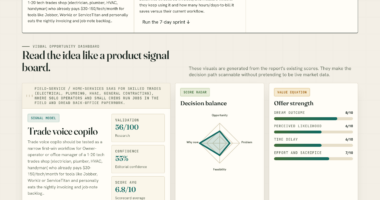

📊 Full opportunity report: Readiness: Before You Fund the Answer on ThorstenMeyerAI.com — validation score, market gap, and execution plan.
TL;DR
A new diagnostic tool emphasizes the need for organizations to evaluate their AI readiness in just 20 minutes before funding. It aims to prevent costly failures by identifying specific risks tied to business type and deployment stage.
A new diagnostic tool now offers organizations a twenty-minute assessment to determine their AI readiness before funding AI projects. This approach aims to prevent organizations from deploying AI systems that are unlikely to succeed, saving time and money. The tool provides a clear verdict, specific insights into potential failure modes, and actionable steps, making it a critical step in responsible AI adoption.
The diagnostic evaluates whether a company’s AI implementation is ready for deployment by analyzing its business type and specific risks. It distinguishes three common failure modes: data-rich organizations that overlook unmeasured factors, regulated businesses that cannot adapt quickly enough, and document-driven firms that mistake confident answers for informed decisions. The process delivers six key outputs, including a readiness verdict, a risk profile, percentile comparison, calibration to sector specifics, company quotes, and a concrete plan for immediate action.
Importantly, the assessment is designed to be simple and non-intrusive — requiring only a corporate email and twenty minutes. It does not collect passwords or social logins, emphasizing trust and minimal friction. The results are tailored to the organization’s actual operational context, including regulatory constraints and data realities, making the diagnosis both relevant and actionable.
Before You Fund the Answer
Most world-model AI implementations look clean for a year, then decision quality erodes where no dashboard can see it. Twenty minutes and a corporate email tell you — before you sign — whether the money will compound or quietly evaporate.
A clear tier framed in language a CFO will accept — plus your percentile against peers in your sector and size band, so a score becomes a position you can take to the board.
+ twenty minutes
- No follow-up machine — no vendor in your inbox next week.
- No “book a call.” The output is an action you can take without it.
- No vendor scorecard. It doesn’t sell the implementation it assesses.
- No thumb on the scale toward “you’re ready, let’s talk.”
- Subtraction, pointed at a decision. Strip the vendor theater and dashboard-green comfort until the few things that decide success are visible.
- Independence is the product. A diagnostic that deletes your email has nothing to gain from any verdict but the true one — including “not ready.”
- The shift it’s built for. AI is moving from describing to predicting and acting; readiness is a question you answer before deployment, not during it.
- Find out before you fund the answer. The only thing more expensive than this assessment is learning the answer the slow way.
Independent commentary, produced with AI assistance under human editorial oversight. The views are the author’s own and may change. Readiness is a diagnostic tool, not business, financial, legal, or technical advice; its verdict is one input, not a substitute for due diligence. Regulatory references are named as examples, not legal guidance. Product, model, and company names are trademarks of their respective owners; mention does not imply endorsement.
Why Pre-Deployment Readiness Matters for AI Success
Deploying AI without assessing organizational readiness can lead to costly failures that only become apparent after months or even quarters. Many organizations discover too late that their AI systems are eroding critical unmeasured factors, locking in outdated structures, or producing overconfident but inaccurate outputs. The diagnostic offers a cost-effective, early warning that can prevent these issues, saving resources and reputation. As AI systems increasingly influence decision-making, ensuring readiness is essential to avoid embedding errors into core business processes.

ANCEL AD310 Classic Enhanced Universal OBD II Scanner Car Engine Fault Code Reader CAN Diagnostic Scan Tool, Read and Clear Error Codes for 1996 or Newer OBD2 Protocol Vehicle (Black)
- Popular OBD II Scanner: Recommended by Scotty Kilmer
- Sturdy and Compact Design: Lightweight, durable, easy to transport
- Quick and Accurate Diagnostics: Reads and clears codes in seconds
As an affiliate, we earn on qualifying purchases.
As an affiliate, we earn on qualifying purchases.
The Growing Need for Organizational AI Readiness Checks
Most AI failures in enterprises are hidden for a year or more, as dashboard metrics remain stable while decision quality erodes. Traditional evaluation occurs too late, often after significant investment and operational disruption. The emergence of world-model AI systems, which build internal representations of business processes, elevates the importance of readiness assessments. These systems are more confident and embedded, making failures less obvious but potentially more damaging. Existing approaches lack a quick, reliable way to evaluate whether an organization is prepared for this shift, creating a gap that the new diagnostic aims to fill.
“Most failed AI implementations don’t look like failures for about a year. The dashboards stay green. The demos land. The board is pleased. The real issues are invisible by design, emerging only after months.”
— Thorsten Meyer
![Express Schedule Free Employee Scheduling Software [PC/Mac Download]](https://m.media-amazon.com/images/I/41yvuCFIVfS._SL500_.jpg)
Express Schedule Free Employee Scheduling Software [PC/Mac Download]
- User-friendly drag & drop interface: Simple shift planning
- Manage time-off and holidays: Add sick leave, breaks, holidays
- Email schedules to staff: Send schedules directly via email
As an affiliate, we earn on qualifying purchases.
As an affiliate, we earn on qualifying purchases.
Unclear Aspects of AI Readiness Assessment Effectiveness
It is not yet clear how widely organizations will adopt this twenty-minute diagnostic or how accurately it predicts long-term AI success across diverse sectors. The effectiveness of the tool in different regulatory environments or highly complex business models remains to be validated through broader deployment and longitudinal studies.

Practice Standard for Project Risk Management
- Condition: Used Book in Good Condition
As an affiliate, we earn on qualifying purchases.
As an affiliate, we earn on qualifying purchases.
Next Steps for Adoption and Validation of the Diagnostic Tool
Organizations interested in AI deployment are encouraged to pilot the diagnostic to assess their readiness. Further validation studies are expected to refine the tool’s accuracy and expand its applicability. Industry groups and regulators may also incorporate similar assessments into best practices for responsible AI adoption, emphasizing early evaluation before significant investment.

in-job for AI Implementation (Non-Engineers): Using AI Tools to Improve Workflows Without Breaking the Business (in-job Series)
As an affiliate, we earn on qualifying purchases.
As an affiliate, we earn on qualifying purchases.
Key Questions
What is the main purpose of the AI readiness diagnostic?
The diagnostic aims to quickly assess whether an organization is prepared to deploy AI systems successfully, identifying potential failure modes and providing actionable insights in just twenty minutes.
How does the diagnostic determine if a company is ready?
It evaluates the company’s business type, data practices, regulatory environment, and decision-making processes, producing a verdict, risk profile, percentile comparison, and specific action plan tailored to the organization.
Is this diagnostic suitable for all types of businesses?
The tool is designed to identify common failure modes in data-rich, regulated, and document-driven organizations. Its effectiveness may vary depending on specific sector complexities, and further validation is ongoing.
What happens after the twenty-minute assessment?
Organizations receive a report with a readiness verdict and recommended actions, which can guide immediate steps to improve AI implementation success and avoid costly failures.
Can this diagnostic replace comprehensive AI readiness evaluations?
No, it is intended as a quick screening tool. More detailed, sector-specific assessments may still be necessary for complex or high-stakes deployments.
Source: ThorstenMeyerAI.com