
The industry is transforming with Block’s debut of modular Bitcoin mining hardware and free management software. You can now upgrade or replace individual parts like hashboards easily, saving costs and reducing waste. Advanced cooling options like immersion and hydro cooling boost efficiency and lower noise. The free software platforms enable you to monitor and optimize performance remotely. This innovative approach helps you build scalable, sustainable operations that adapt to future market shifts—stay tuned to learn more.

Get hardware and tech essentials delivered free — and shop member deals
- Fast, free delivery on millions of items
- Access to Prime Big Deal Days deals on October 6–7
- Prime Video, Amazon Music and more included
Key Takeaways
- Block Inc. introduces Proto Rig, a durable, modular Bitcoin mining hardware designed for a decade-long lifespan.
- Modular design enables easy hashboard replacements, reducing upgrade costs and increasing flexibility.
- Block’s free software platform, Proto Fleet, allows remote management, performance monitoring, and predictive maintenance.
- The hardware supports advanced cooling options—air, immersion, hydro—for improved thermal efficiency and quieter operation.
- These innovations promote scalable, eco-friendly mining setups with lower electricity costs and extended hardware longevity.

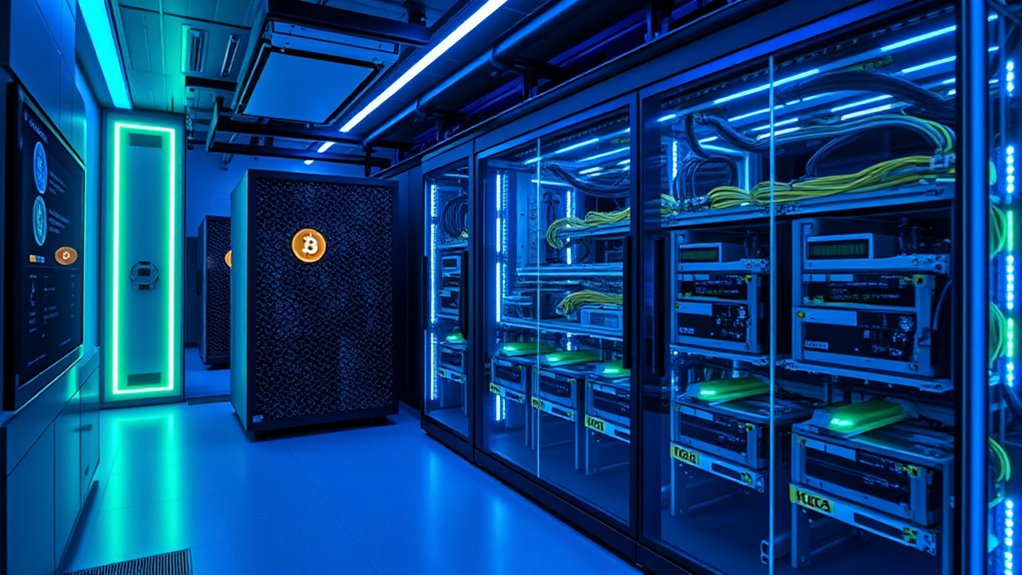
Mining hardware and software are evolving rapidly to meet the demands of efficiency, scalability, and sustainability. As a miner, you’re likely noticing that innovation is now focused on modular designs, which transform how you build and upgrade your mining operations. Block Inc. has introduced Proto Rig, a modular Bitcoin mining hardware built to last over a decade. Its design allows you to replace individual hashboards instead of the entire rig, which can cut upgrade costs by around 20% each time you refresh your setup. This modular approach means you can adapt your hardware to changing mining conditions more flexibly, without the need for total replacements. Auradine, on the other hand, offers fully modular container solutions that house 100–200 miners each, enabling scalable deployments that suit both small farms and large facilities. These containers come in various cooling options—air-cooled, immersion-cooled, and hydro-cooled—adding operational flexibility and allowing you to choose the best cooling method for your environment, whether it’s high-density or noise-sensitive. Auradine’s modular container solutions are designed to be easily scalable and customizable to meet diverse deployment needs. Furthermore, it is crucial to establish consistent routines to help ensure that your mining operations remain stable and efficient. When it comes to hardware specifications, you have a range of options that balance performance and efficiency. The Bitmain Antminer S21e XP Hyd 3U is among the top-tier miners, boasting a hash rate of 860 TH/s but with a power draw of over 11,000W. Meanwhile, Auradine’s Teraflux AH3880 offers a solid 600 TH/s at 8,700W, providing a middle ground for those seeking competitive performance without excessive energy costs. MicroBT’s WhatsMiner M66S++ achieves 356 TH/s with considerably lower power consumption of 5,518W. Hydro-cooled models like Bitmain’s Antminer XP 500Th improve thermal management and reduce noise levels to around 50dB, making them suitable for quieter, high-density setups. Choosing the right hardware means balancing upfront costs with ongoing electricity expenses and desired hash power. Cooling technologies are also advancing, with modern ASIC miners integrating air, immersion, and hydro cooling systems. Hydro-cooled machines are especially valuable for reducing noise and increasing thermal efficiency, which is essential for dense deployments. Immersion cooling takes this further by submerging chips in dielectric fluids, boosting energy efficiency and extending hardware lifespan. These innovations help you lower your carbon footprint and electricity bills while maintaining top performance. Top manufacturers like Auradine and Bitmain are pushing these technologies forward, giving you more options to optimize energy use. Software platforms are equally indispensable, with open-source solutions like Block’s Proto Fleet empowering large-scale miners to monitor, manage, and optimize their rigs remotely. These platforms facilitate performance tracking, energy management, and predictive maintenance, often incorporating AI-driven analytics to maximize uptime and profitability. The ability to scale your operations with modular rigs and sophisticated management tools allows you to adapt quickly to market shifts or technological advancements. Long-term strategies focus on extending hardware lifespan over 10 years, with swappable components and backward compatibility, reducing electronic waste and ensuring your investment remains relevant amid fluctuating mining difficulty and bitcoin prices. This new era in mining ensures you can build resilient, efficient, and sustainable operations for the future.
As an affiliate, we earn on qualifying purchases.
Frequently Asked Questions
How Does Modular Hardware Improve Mining Efficiency?
Modular hardware boosts your mining efficiency by allowing quick scaling and customization to match your needs. You can add or upgrade modules without disrupting operations, optimizing resource use. Advanced cooling keeps equipment running at peak performance, while energy-efficient systems lower costs. Smart network management and remote control let you monitor and adjust settings in real-time, ensuring maximum uptime and hash rates. Overall, modular setups make your mining more flexible, cost-effective, and resilient.
What Are the Compatibility Requirements for the New Hardware?
You need to guarantee your existing infrastructure can support the modular hardware’s compatibility requirements. This means your power supply units, cooling solutions, and servers should be compatible with the hardware’s modular components. Check if your environment can accommodate the rack-sized units and support the 5kW power draw per miner. Also, verify your cooling systems can handle air-cooled or immersion options, and guarantee your management software can integrate with the hardware’s APIs for ideal operation.
How Does Free Software Support Scalability in Mining Operations?
You find that free software supports scalability by lowering entry barriers and reducing costs, allowing you to expand operations easily. With cloud-based dashboards, you can monitor and manage multiple rigs remotely, making adjustments in real-time. Customizable features and automation tools optimize performance and energy use, while transparent reporting and AI algorithms guarantee consistent growth. All these elements work together to help you grow your mining farm efficiently without heavy upfront investments.
Are There Any Security Concerns With Open-Source Mining Software?
Yes, there are security concerns with open-source mining software. You might face vulnerabilities like malicious code embedded in dependencies or updates, which can be exploited by attackers. These risks include cryptojacking, data theft, and supply chain attacks through compromised packages or container images. To stay protected, you need to monitor software closely, vet dependencies carefully, and stay updated on security patches to prevent malicious exploits.
What Is the Expected Lifespan of the New Modular Mining Hardware?
You see your mining rig standing tall, built to last a decade. The Proto Rig’s modular design lets you swap out parts like fresh leaves on a tree, extending its life far beyond traditional rigs. With advanced chips and cooling, it endures the harshest conditions. This means fewer replacements, less e-waste, and more savings. Your investment stays productive longer, making your mining operation more sustainable and cost-efficient over the years.
As an affiliate, we earn on qualifying purchases.
Conclusion
As you embrace this new era, think of yourself as an explorer charting uncharted waters with a sturdy, modular vessel—ready to adapt and grow. With Block’s innovative hardware and free software, you’re not just mining; you’re building a future where technology and opportunity intertwine like constellations guiding you forward. This journey isn’t just about coins; it’s about opening a universe of possibilities, illuminating your path to success amid the stars of innovation.
remote management mining software
As an affiliate, we earn on qualifying purchases.
As an affiliate, we earn on qualifying purchases.
scalable mining container solutions
As an affiliate, we earn on qualifying purchases.
As an affiliate, we earn on qualifying purchases.
Fall Picks
fall essentials
As an affiliate, we earn on qualifying purchases.