
If you’re choosing between building real-world asset tokens on Ethereum or APTos, consider your project’s scale and compliance needs. Ethereum offers a proven, secure environment with established standards, perfect for compliant, widely-accepted tokens. APTos provides high scalability and low costs, ideal if rapid, large-scale issuance and flexible compliance are priorities. Both platforms are evolving to support asset-backed tokens, and exploring their unique advantages can help you make the right choice for your goals.
Key Takeaways
- Ethereum offers mature security, established standards, and comprehensive smart contract capabilities for legal compliance and asset tokenization.
- APTos provides high scalability, low transaction costs, and rapid issuance suitable for large-scale RWAT projects.
- Ethereum supports embedded compliance through smart contracts, while APTos enables real-time, adaptable regulatory checks.
- Choosing Ethereum emphasizes proven stability and broad market adoption; APTos favors flexibility and efficiency for innovative tokenization.
- Both platforms are advancing RWAT development, with the best choice aligning to project-specific regulatory, scalability, and operational needs.
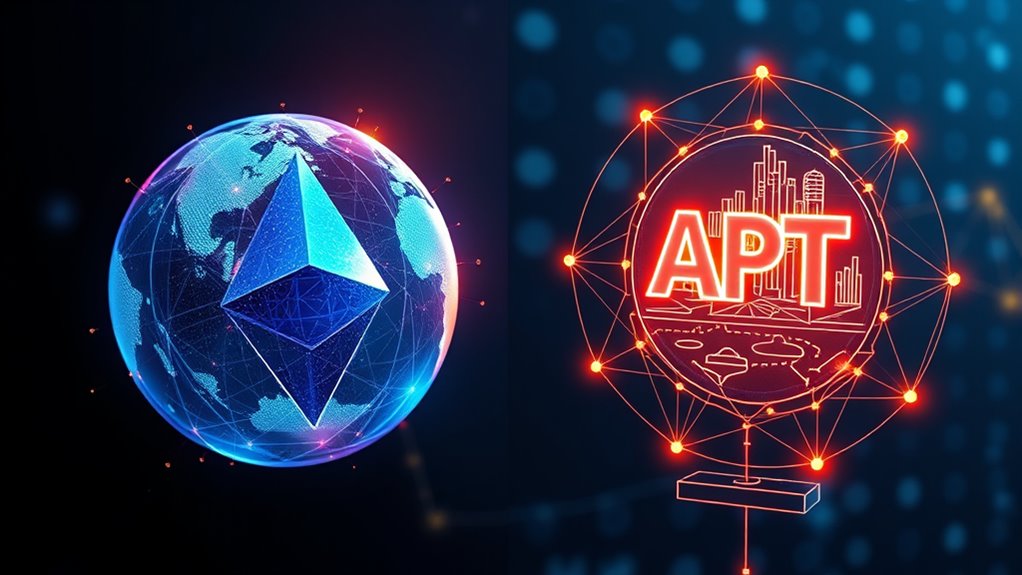
Real‑World Asset Tokens (RWATs) are transforming how we invest by digitizing tangible assets like real estate, commodities, and infrastructure. These tokens enable you to access investment opportunities previously limited by traditional barriers, offering liquidity and fractional ownership. When it comes to building RWATs, two leading platforms emerge: BUIDL on Ethereum and APT on APTos. Both aim to streamline asset-backed financing, but they approach it differently, especially regarding regulatory compliance.
On Ethereum, BUIDL leverages the network’s mature ecosystem, emphasizing security and broad adoption. Its infrastructure supports complex smart contracts that automate processes like asset origination, token issuance, and compliance checks. If you’re considering asset-backed financing through Ethereum, you’ll find that BUIDL’s ecosystem is well-suited for integrating regulatory compliance measures. It allows issuers to embed KYC/AML procedures directly into the token issuance process, ensuring adherence to legal standards. This focus on compliance is vital if you want your RWATs to be legally sound and easily tradable across regulated markets.
Ethereum’s mature ecosystem supports complex smart contracts for secure, compliant asset-backed token issuance.
In contrast, APT on APTos offers a newer but rapidly evolving environment. Its architecture emphasizes high throughput and low transaction costs, which can be advantageous for large-scale issuance of RWATs. APTos’s design makes it easier to implement real-time compliance checks and dynamic asset management, helping you stay in line with evolving regulations. Since regulatory frameworks around real-world assets are complex and vary by jurisdiction, APTos’s flexibility allows issuers to adapt their processes accordingly. This is particularly important for ensuring that asset-backed financing remains compliant, avoiding legal pitfalls that could jeopardize the token’s legitimacy.
Both platforms aim to facilitate seamless integration of regulatory compliance into the token lifecycle. On Ethereum, the emphasis on established standards and tools makes it a safer choice if you prioritize proven security and broad market acceptance. Meanwhile, APTos’s focus on scalability and efficiency makes it attractive for innovative, fast-moving projects that need to stay agile with compliance. Whichever platform you choose, ensuring that your RWATs are compliant from the outset is essential; it secures investor confidence and helps navigate the legal landscape of asset-backed financing. Ultimately, both Ethereum and APTos are pushing the boundaries of how tangible assets can be tokenized and financed, but your success depends on understanding their strengths and aligning them with your regulatory needs.
A new sentence with blockchain technology and the rest of the sentence.
Ethereum smart contract development kit
As an affiliate, we earn on qualifying purchases.
As an affiliate, we earn on qualifying purchases.
Frequently Asked Questions
How Do Real-World Asset Tokens Ensure Legal Compliance?
You guarantee legal compliance of real-world asset tokens by adhering to relevant legal frameworks and addressing regulatory challenges. You work with legal experts to design tokens that meet jurisdiction-specific rules, incorporate Know Your Customer (KYC) and Anti-Money Laundering (AML) measures, and ensure transparent documentation. Regularly updating your practices helps you stay compliant as regulations evolve, reducing legal risks and building trust among investors and regulators alike.
What Are the Main Security Risks of Tokenizing Assets?
Did you know that over 60% of asset tokenization projects face security risks? You should be aware that custodial risks and valuation challenges are key concerns. Custodial risks involve potential loss or theft of assets due to centralized control, while valuation challenges can lead to inaccurate asset pricing. These vulnerabilities can compromise your investment’s safety, so understanding and mitigating these risks is vital for secure tokenization.
How Does Cross-Chain Interoperability Affect Asset Tokenization?
Cross-chain interoperability enhances asset tokenization by allowing you to transfer tokens seamlessly across different blockchains, increasing liquidity and flexibility. By adhering to interoperability standards, you can access broader markets and improve cross-chain liquidity, making your assets more versatile. However, it also introduces risks like potential security vulnerabilities during token swaps or bridge attacks. Ensuring robust standards and security measures helps you harness interoperability’s benefits while protecting your assets.
What Are the Costs Involved in Minting and Trading These Tokens?
Think of minting and trading these tokens as planting seeds in a garden—you’ll face costs that vary like weather. The cost analysis reveals fees for minting, often including gas or transaction fees, and trading, which may involve platform or network fees. The fee structure depends on the blockchain, like Ethereum’s higher gas fees compared to APTos. You must weigh these costs to grow your assets efficiently across different platforms.
How Do Real-World Asset Tokens Impact Traditional Asset Markets?
Real-world asset tokens can transform traditional markets by increasing transparency and liquidity. As you use these tokens, your digital identity remains protected through privacy preservation, ensuring sensitive information stays secure. These tokens enable smoother transactions, reduce intermediaries, and foster trust. By integrating real-world assets into blockchain, you can diversify your portfolio, access new markets, and benefit from enhanced security while maintaining control over your personal data.
asset-backed token compliance tools
As an affiliate, we earn on qualifying purchases.
As an affiliate, we earn on qualifying purchases.
Conclusion
In the battle between Ethereum and Aptos for real-world asset tokenization, your choice hinges on what matters most—stability or speed. Ethereum’s established ecosystem offers unmatched security, while Aptos promises lightning-fast transactions and innovative features. Whichever you pick, remember this isn’t just a trend; it’s a revolution that could reshape finance as you know it. Get ready—you’re on the front lines of a technological renaissance that’s redefining what’s possible in blockchain!
Aptos blockchain development platform
As an affiliate, we earn on qualifying purchases.
As an affiliate, we earn on qualifying purchases.

RWA – Real World Asset: Guide to Tokenize an ASSET (Blockchain & Real Estate; Learn and make it happen)
As an affiliate, we earn on qualifying purchases.
As an affiliate, we earn on qualifying purchases.