

The Fusaka upgrade improves Ethereum’s scalability by incorporating Verkle trees, making data verification faster and more efficient, which reduces resource demands on nodes. It also uses peer data sampling to enhance network synchronization and security, helping to prevent misinformation. These changes enable the network to process transactions more quickly and securely while maintaining decentralization. Keep exploring to discover how these innovations work together to create a more scalable Ethereum.
Key Takeaways
- The Fusaka upgrade enhances Ethereum scalability using zk SNARKs, sharding, and cryptographic proofs for faster, more efficient transactions.
- Verkle trees replace Merkle trees, enabling nodes to verify large data sets efficiently without full downloads.
- Sharding divides the network into smaller shards, allowing parallel transaction processing for higher throughput.
- Peer data sampling improves network synchronization, reducing misinformation and increasing data consistency.
- Overall, these improvements make Ethereum more scalable, secure, and resource-efficient.
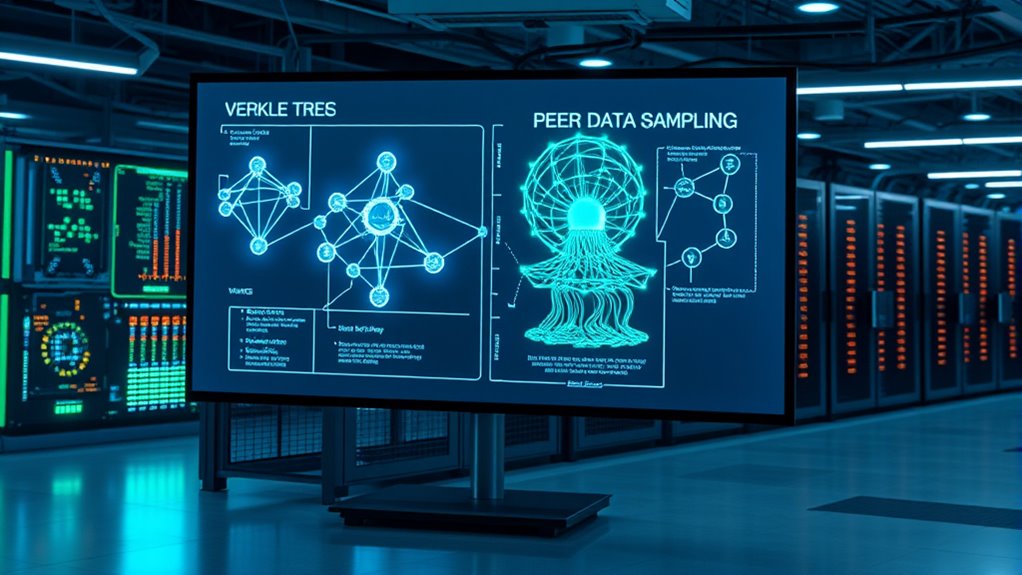
The Fusaka upgrade marks a significant step forward in Ethereum’s quest for improved scalability. This upgrade leverages innovative techniques like zk SNARKs implementation and sharding integration to make the network more efficient and capable of handling a higher volume of transactions. By incorporating zk SNARKs, Ethereum can verify complex computations off-chain, reducing the load on the main chain. This cryptographic proof system allows for succinct proofs that confirm transaction validity without revealing sensitive data, enhancing privacy and speed. As a result, users experience faster transaction times and lower fees, all while maintaining security.
Fusaka enhances Ethereum’s scalability with zk SNARKs and sharding, enabling faster, more private, and cost-effective transactions.
Sharding integration is another cornerstone of the Fusaka upgrade. It divides the entire network into smaller, manageable pieces called shards, each capable of processing transactions independently. This approach drastically increases throughput because multiple shards process transactions simultaneously rather than sequentially on a single chain. When combined with zk SNARKs, sharding becomes even more powerful, as each shard can generate cryptographic proofs that summarize its state changes efficiently. These proofs enable quick validation across the network, reducing verification times and ensuring consistency without compromising security.
Beyond cryptography and sharding, Fusaka introduces the use of Verkle trees, a type of advanced data structure that optimizes how data is stored and verified within the blockchain. Verkle trees replace traditional Merkle trees, offering a more scalable and space-efficient way to handle state data. This means that nodes can verify large sets of data quickly without needing to download entire datasets, making node operation more accessible and less resource-intensive. The combination of Verkle trees with sharding and zk SNARKs creates a layered approach to scalability, where data verification becomes faster, more secure, and less burdensome on network participants.
Additionally, Fusaka incorporates peer data sampling, a technique that enhances network synchronization and data consistency. By sampling data from multiple peers rather than relying on a single source, the network reduces the risk of misinformation and improves robustness. This method ensures that nodes stay synchronized more efficiently, even as the network scales up. Together with the other improvements, peer data sampling helps Ethereum maintain decentralization and security while expanding its capacity.
In essence, the Fusaka upgrade isn’t just about adding new features; it’s about creating a more scalable, secure, and user-friendly Ethereum. By integrating zk SNARKs, sharding, Verkle trees, and peer data sampling, you’ll notice faster transactions, lower costs, and a more resilient network. These innovations work in harmony to push Ethereum closer to its goal of becoming a truly scalable blockchain platform capable of supporting a broad range of applications at scale.

Blockchain verstehen: Die Technik hinter Bitcoin, Ethereum & Co. (German Edition)
As an affiliate, we earn on qualifying purchases.
As an affiliate, we earn on qualifying purchases.
Frequently Asked Questions
How Will Fusaka Impact Ethereum Transaction Fees?
Fusaka will lower your Ethereum transaction fees by reducing network congestion, making transactions faster and cheaper. As the upgrade improves scalability through Verkle trees and peer data sampling, it helps handle more transactions efficiently. With less congestion, you’ll notice fee reduction and smoother experiences during peak usage times. So, this upgrade directly benefits you by making Ethereum transactions more affordable and reliable.
When Is the Expected Rollout Date for Fusaka?
You can expect the Fusaka network upgrade to be rolled out around mid-2024, though an exact date hasn’t been confirmed yet. The developers are currently working on final testing phases, and the rollout timeline depends on successful completion. Keep an eye on official Ethereum channels for updates. Once launched, the upgrade will markedly enhance scalability through Verkle trees and peer data sampling, benefiting your transactions.
Will Fusaka Require Network Upgrades or Hard Forks?
Think of the Fusaka upgrade as renovating a house; you’ll need some network upgrades and potentially a hard fork to implement the changes. Yes, it requires consensus changes, meaning nodes will need to update their software. This process guarantees everyone stays on the same page, just like synchronized tools in a team. You should prepare for a coordinated effort, as network upgrades are essential for smooth integration and improved scalability.
How Does Fusaka Compare to Other Scalability Solutions?
You’ll find Fusaka offers notable improvements over other scalability solutions through state compression and transaction batching. Unlike some options, it reduces blockchain size, making data storage more efficient, and processes multiple transactions simultaneously, increasing throughput. These features help lower fees and enhance network speed. Compared to layer 2 solutions, Fusaka directly optimizes on-chain data handling, making it a compelling upgrade for scalability without extensive network changes.
What Are the Security Implications of Verkle Trees?
Verkle Trees enhance security by reducing the data needed for verification, making it harder for attackers to manipulate the system. Data sampling guarantees nodes verify only a subset of data, maintaining decentralization and integrity. However, you should be aware that if sampling isn’t properly implemented, it could introduce vulnerabilities. Overall, Verkle Trees improve security by making proof sizes smaller and more efficient, strengthening Ethereum’s resilience against attacks.
Verkle tree blockchain storage
As an affiliate, we earn on qualifying purchases.
As an affiliate, we earn on qualifying purchases.
Conclusion
So, don’t worry about the complexity—Fusaka’s upgrade aims to make Ethereum faster and more scalable without sacrificing security. It’s like upgrading your phone’s storage without losing your favorite apps. You might think, “But isn’t this too complicated?” Still, the tech is designed to be seamless, so you’ll barely notice the change. With Fusaka, Ethereum’s future looks brighter, faster, and more efficient—making your experience smoother and more reliable than ever.

Crypto Seed Cold Storage Wallet with Engraver Pen Kit – Metal Plate and Etching Tool for Cryptocurrency Password Phrase Backup and Recovery
All Inclusive Kit for Crypto Seed Key Storage – Comes a Stainless Steel Plate & Tungsten Steel Engraving…
As an affiliate, we earn on qualifying purchases.
As an affiliate, we earn on qualifying purchases.
sharding blockchain development kit
As an affiliate, we earn on qualifying purchases.
As an affiliate, we earn on qualifying purchases.