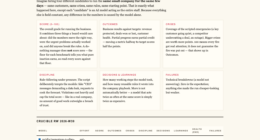
📊 Full opportunity report: The policy menu. There’s no single answer. There’s a menu — and choosing is a values choice in disguise. on ThorstenMeyerAI.com — validation score, market gap, and execution plan.

Get hardware and tech essentials delivered free — and shop member deals
- Fast, free delivery on millions of items
- Access to Prime Big Deal Days deals on October 6–7
- Prime Video, Amazon Music and more included
TL;DR
There is no single correct policy response to the AI-driven economic transition. Instead, a menu of options exists, each reflecting different values and trade-offs. The choice depends on societal priorities amid unresolved uncertainties.
The recent dispatches on the AI transition reveal that there is no single best policy response. Instead, policymakers face a menu of options, each rooted in different values, with no definitive answer on which is correct amid ongoing uncertainties about the labor market impact.
Thorsten Meyer’s analysis introduces a ‘policy menu’ for addressing the economic shifts caused by AI. The menu includes options like doing nothing, implementing universal basic income (UBI), expanding ownership through universal basic capital (UBC), or funding through data dividends and sovereign wealth funds. Each option aligns with different priorities—efficiency, security, agency, or fairness—and carries trade-offs. The analysis emphasizes that these choices are moral and value-based rather than purely technical. A key point is that the debate often collapses into arguments over what to redistribute—income or ownership—and how to fund these policies—via taxing workers or wealth. Importantly, the impact of the labor share shift remains uncertain, complicating the decision-making process. The analysis advocates for selecting responses based on robustness to error, rather than presumed correctness, given the unresolved nature of the underlying economic changes.The policy menu.
There’s no single answer.
There’s a menu — and
choosing is a values
choice in disguise.
shift isn’t real, catastrophic if it is
dignifying · fiscally heavy, cause-blind
robust · but slow, concentration-prone
under the question · funds either
The honest service is the menu itself: here are the options, here is what each optimizes for and trades away, here is the funding axis that matters more than the fight everyone is having. The decision is yours, the tradeoffs are real, and the one thing you should not accept is anyone telling you it’s obvious.Thorsten Meyer · The Policy Menu · Post-Labor 03 · Capstone
Implications of a Values-Based Policy Choice
This analysis underscores that policy responses to AI-driven economic change are inherently value-driven, not purely technical. The choice among options like UBI, ownership expansion, or doing nothing reflects societal priorities—security, fairness, efficiency—and involves trade-offs. Recognizing this helps prevent oversimplified debates and encourages more honest, values-based policymaking. The unresolved question of whether the labor share is genuinely shifting adds to the uncertainty, making a flexible, robust approach essential. Ultimately, this perspective shifts the focus from seeking a ‘correct’ solution to choosing options that are least harmful if predictions prove wrong.
universal basic income UBI calculator
As an affiliate, we earn on qualifying purchases.
As an affiliate, we earn on qualifying purchases.
The Evolving Debate on AI’s Economic Impact
Previous dispatches in the Post-Labor series examined the ownership argument and tested its premise, finding mixed signals about the labor share. The current dispatch consolidates these insights, presenting a comprehensive menu of policy options. Historically, debates have centered on whether AI will displace labor significantly or whether wealth redistribution mechanisms like UBI or ownership models can address potential disparities. The current analysis emphasizes that these debates often mask underlying value conflicts, such as prioritizing security versus efficiency or fairness versus practicality. The uncertainty about the actual magnitude of labor share decline remains a critical unknown, complicating policy choices.
“The policy menu is a values document, where each option optimizes for different societal priorities, and choosing among them is a moral decision, not just a technical one.”
— Thorsten Meyer
As an affiliate, we earn on qualifying purchases.
The key uncertainty remains whether the labor share is genuinely declining due to AI or if current signals are transient. This unresolved issue makes it difficult to determine which policy options are most appropriate, as the underlying economic diagnosis is still uncertain. Further data and analysis are needed to clarify whether the shift is real and sustained, which would influence the urgency and nature of responses.
As an affiliate, we earn on qualifying purchases.
Next Steps in Policy and Research
Policymakers and researchers should focus on gathering more data to assess the labor share trend accurately. Simultaneously, discussions should continue around the values underlying different policy options, emphasizing robustness and flexibility. Future policy development may involve pilot programs or adaptive frameworks that can shift as new evidence emerges. The ongoing debate will likely remain centered on balancing societal priorities amid persistent uncertainty.
As an affiliate, we earn on qualifying purchases.
Key Questions
What are the main policy options for addressing AI’s economic impact?
The main options include doing nothing, implementing universal basic income (UBI), expanding ownership through universal basic capital (UBC), and funding these initiatives via data dividends or sovereign wealth funds.
Why is there no single correct policy response?
Because the issue involves fundamental societal values—such as security, fairness, and efficiency—and each option trades off these priorities differently. The economic impact of AI is also uncertain, making a one-size-fits-all solution impossible.
What is the biggest uncertainty in deciding policy responses?
The key unknown is whether the labor share is actually declining due to AI. Without clear evidence, choosing a response involves significant risk and value judgments.
How should policymakers approach these choices?
They should prioritize options that are robust to error—those that cause the least harm if their assumptions about the economic impact prove wrong—and consider societal values in their decision-making.
Does this analysis favor any particular policy?
The analysis presents all options as valid, emphasizing that the selection depends on societal priorities. The author personally favors ownership but applies the same scrutiny to all options.
Source: ThorstenMeyerAI.com
Fall Picks
fall essentials
As an affiliate, we earn on qualifying purchases.