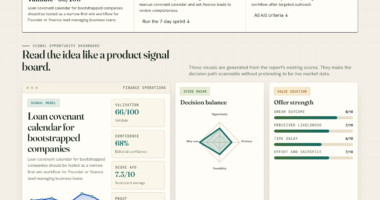

📊 Full opportunity report: Capital: The Lever Beneath the Levers on ThorstenMeyerAI.com — validation score, market gap, and execution plan.

Get hardware and tech essentials delivered free — and shop member deals
- Fast, free delivery on millions of items
- Access to Prime Big Deal Days deals on October 6–7
- Prime Video, Amazon Music and more included
TL;DR
In 2026, major AI companies like SpaceX, Anthropic, and OpenAI have gone public with valuations totaling around $4 trillion, highlighting how capital funding drives AI infrastructure. The circular flow of money creates risks of demand collapse and mispricing, making the capital chokepoint critical and fragile.
In June 2026, SpaceX, Anthropic, and OpenAI listed on public markets with combined valuations near $4 trillion, marking a historic shift in AI funding and signaling the central role of capital in industry growth. This development underscores how the flow of capital determines who controls AI infrastructure and research, making it a critical chokepoint with significant economic implications.
On June 12, SpaceX, now including xAI, listed on the Nasdaq with a valuation close to $1.77 trillion, briefly surpassing $2 trillion in early trading. The offering was heavily oversubscribed, with about 30% of shares reserved for retail investors, far above typical allocations. Simultaneously, Anthropic confidentially filed for a roughly $965 billion valuation, after closing a $65 billion funding round. OpenAI is reportedly preparing for a fall IPO valued between $730 billion and $850 billion. These three companies together represent approximately $4 trillion in private value heading to public markets within 18 months.
Bank of America describes this as a large-scale transfer of risk from early investors to the public, with more than $6.6 billion worth of OpenAI stock sold on secondary markets before the IPOs. This indicates that early stakeholders are cashing out just as the broader market is invited to invest, highlighting the flow of risk and capital in the industry.
Capital: The Lever Beneath the Levers
Every chokepoint costs money — so whoever can fund the buildout decides who builds at all. In 2026 the bill came due in public: a trillion-dollar IPO wave, financed by a circle of firms paying each other, now sold to everyone else.
The meta-chokepoint: it gates the other five, because you can’t build any of them without clearing the capital bar. A synchronized machine has no natural brake — no one can slow first — and the IPO wave moves the risk to the public as insiders take gains. The hedge is solvency that doesn’t depend on the music playing: sane burn, own what’s cheap, self-host where you can.
Why Capital Flow Shapes AI Industry Risks
The concentration of valuations and the circular flow of capital create systemic risks, including demand fragility and mispriced capacity. The heavy debt financing and internal demand loops make the industry vulnerable to sudden downturns, which could impact the broader economy. The recent IPOs move risk from private insiders to the public, raising questions about valuation sustainability and economic stability.
AI infrastructure investment books
As an affiliate, we earn on qualifying purchases.
As an affiliate, we earn on qualifying purchases.
The Financial Ecosystem Driving AI Expansion
Major tech giants like Microsoft, Amazon, and Google are funneling money into Nvidia, which supplies AI chips. Nvidia, in turn, invests heavily in AI research and infrastructure, which is funded partly through internal spending and credits like Azure and AWS. Musk’s SpaceX acquired xAI from himself, illustrating the interconnected ownership and funding structures. This circular funding pattern resembles a snake eating its tail, where each node’s demand sustains the others, creating a fragile yet dominant financial loop.
As of 2026, estimates suggest over $3 trillion will be spent on AI infrastructure globally between 2025 and 2028, with private credit financing about half of that. Yet, only around 3% of consumers pay for AI services, indicating a thin revenue base supporting enormous capital expenditure. Economists warn this structure increases economic fragility, especially as AI companies now comprise a significant share of stock markets worldwide.
“There is more greed than fear right now, and plenty of liquidity — so long as optimism persists.”
— Goldman Sachs CEO
As an affiliate, we earn on qualifying purchases.
Unclear Risks of the Capital-Driven Model
It remains uncertain how sustainable these high valuations are given the thin revenue base and reliance on debt. The potential for demand shocks or a sudden market correction could expose systemic vulnerabilities, but the timing and scale of such risks are still developing and debated among economists and industry analysts.
As an affiliate, we earn on qualifying purchases.
Upcoming Market Movements and Regulatory Scrutiny
Expect continued public listings of major AI firms and further scrutiny of valuation practices. Monitoring how the industry manages its circular funding and debt levels will be crucial. Regulatory agencies may also increase oversight as systemic risks become more apparent, potentially impacting the flow of capital and industry growth.
As an affiliate, we earn on qualifying purchases.
Key Questions
Why are these AI companies listing now?
They are listing to capitalize on high valuations and raise funds for further growth, while early investors seek liquidity amid a market environment that favors large-scale public offerings.
What does the circular funding pattern mean for industry stability?
The circular flow of capital creates a fragile ecosystem where demand and capacity can become misaligned, increasing systemic risk if demand falters or investments slow.
How does this affect the broader economy?
The large-scale capital commitments and debt financing in AI infrastructure could amplify economic shocks if demand collapses or valuations correct sharply, impacting markets beyond tech.
Are regulators likely to intervene?
Regulators may increase oversight as systemic risks become more evident, especially concerning valuation practices and debt levels in AI infrastructure investments.
Source: ThorstenMeyerAI.com
Halloween Picks
halloween
As an affiliate, we earn on qualifying purchases.