
TL;DR
Anthropic’s $65 billion raise at a $965 billion valuation signals more than just a valuation milestone. It’s a clear bet on the hardware, chips, and infrastructure needed to train and run massive AI models, transforming AI from software into an infrastructure game.
When you see a company valued at nearly a trillion dollars, your mind might jump to its market dominance or innovative products. But behind Anthropic’s latest $65 billion raise lies a different story — one about hardware, chips, and the infrastructure that makes today’s AI giants possible.
This isn’t your typical funding round. It’s a capacity play — a strategic bet that the real bottleneck to AI progress is compute power, not just clever algorithms. Understanding this shift can change how you see the future of AI and its biggest players, especially as hardware and infrastructure investments become central.
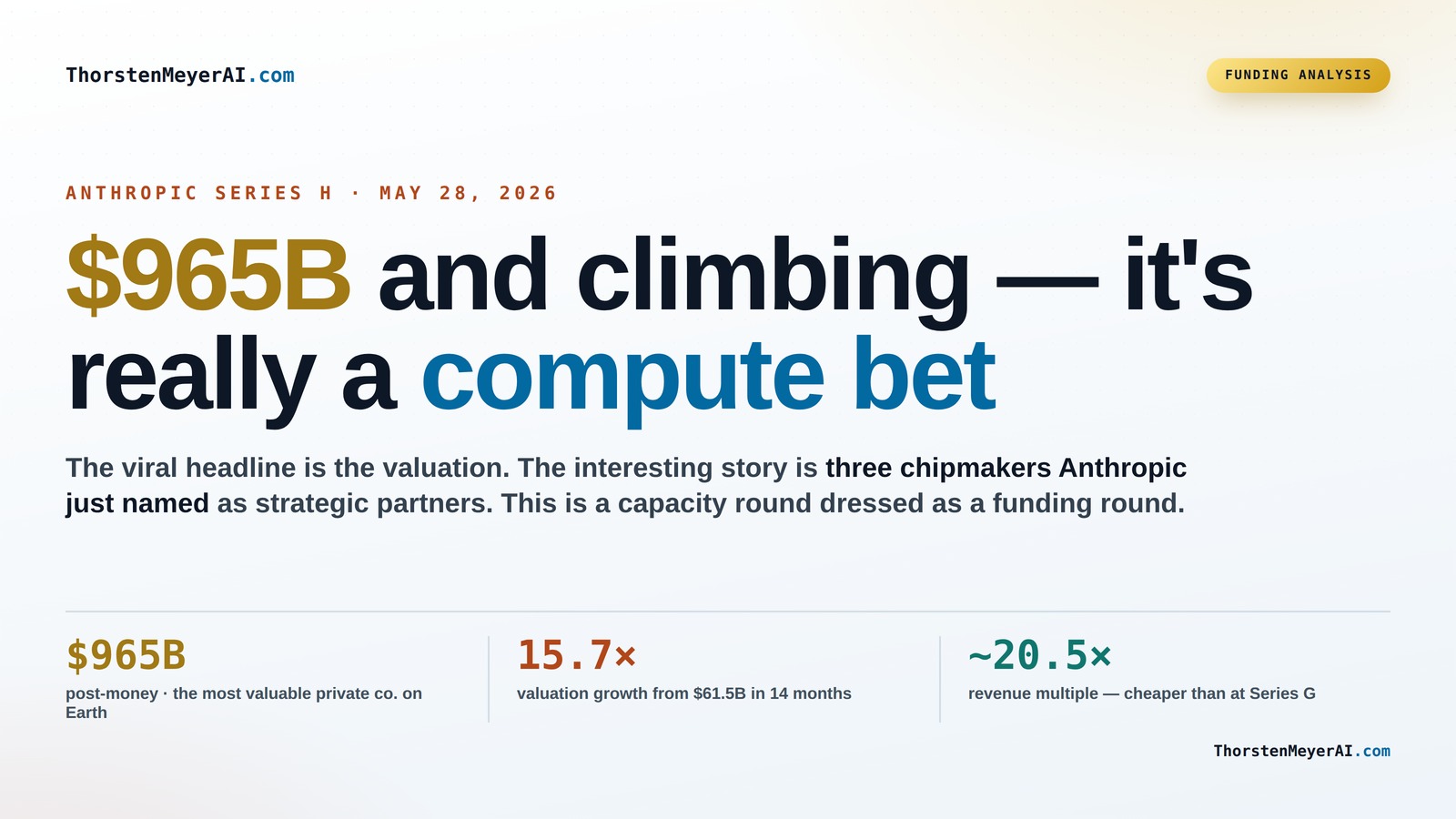
$965B and climbing — it’s really a compute bet
The viral headline is the valuation. The interesting story is in the press release’s middle paragraphs — and in three chipmakers Anthropic just named as strategic partners. This is a capacity round dressed as a funding round.
The numbers nobody can quite parse in sequence
Read together they describe a trajectory with no precedent in enterprise software. Read individually, each looks like a typo.
From $61.5B to $965B in fourteen months
Salesforce took roughly two decades to reach revenue numbers Anthropic just blew past. The sequence below is the part most coverage skips — it’s not the size, it’s the shape.
Anthropic’s valuation ladder · Mar 2025 → May 2026
Five rounds, fourteen months. Bar height is the valuation; the climb itself is the story. Tap any milestone for context.
The multiple actually got cheaper
Bubbles look like multiples expanding while revenue lags. Anthropic’s pattern is the inverse — the valuation tripled, but revenue grew faster, and the multiple compressed.
Revenue-to-valuation multiple · Series G → Series H
Same company, three months apart. The denominator (revenue) is outrunning the numerator (valuation) — exactly the opposite of what a bubble narrative predicts.
10+ gigawatts and three chipmakers
When you name Micron, Samsung & SK hynix alongside your equity backers, you’re saying the binding constraint isn’t demand or model quality — it’s the physical supply of memory chips. The Series H is a capacity round.
Compute commitments backing Anthropic’s capacity bet
$200B+ in announced compute spend across multi-year contracts. The $65B Series H raise has to be read against that bill, not against operating losses.
A genuinely durable bet — or a structural exposure?
Both readings can be true at once. The answer arrives over the next 18–24 months as the gigawatts come online and either fill with paying demand or don’t.
Revenue growth has no precedent in B2B software ($1B → $47B in 17 months). The multiple is compressing, not expanding. Claude is the only frontier model on all 3 major clouds. Enterprise AI spend share went from ~10% to >65% in a year. Compute commitments are tied to specific contracts with capacity dates.
20× revenue is not cheap by any historical software-investing standard. Revenue is reported gross of cloud-reseller pass-throughs, which inflates the top line. Profitability is 2 years out. Amodei’s own warning: a 12-month delay in AI progress “would make him bankrupt” — the compute commitments are a structural exposure to demand persistence.
The valuation race — and the IPO context
Anthropic shipped Opus 4.8 the same morning as Series H — not a coincidence. One week after OpenAI filed confidentially for IPO. The late-2026 frame is set: two frontier AI companies racing to public markets, each pitching durability.
Key Takeaways
- Anthropic’s $65 billion Series H is less about valuation and more about securing massive compute capacity for AI training and inference.
- The valuation increase is driven by revenue growth and infrastructure investments, not a bubble of multiples expanding without fundamentals.
- Major chipmakers and hyperscalers are deeply embedded in funding, making the hardware supply chain a strategic battleground.
- Compared to OpenAI, Anthropic now leads in valuation and scale, with a focus shifting from models to infrastructure.
- The future of AI depends heavily on access to hardware – this capacity race will shape AI’s capabilities and costs for years to come.
As an affiliate, we earn on qualifying purchases.
The real numbers behind Anthropic’s record-breaking raise
Anthropic’s valuation skyrocketed from $61.5 billion in March 2025 to an eye-popping $965 billion in May 2026. Meanwhile, its revenue exploded, jumping from around $1 billion to over $47 billion in just a year, highlighting the importance of hardware scaling in AI growth.
This rapid growth isn’t just a coincidence. It signals a fundamental shift: AI companies are now valued based on their ability to scale compute, not just their current products. The multiple of revenue to valuation actually decreased — from 27× at Series G to around 20.5× today — showing that revenue growth is outpacing valuation increases.
In practical terms, Anthropic’s revenue growth of 5.4× in just 14 weeks is staggering, with estimates of over $10 billion in Q2 alone. This rapid expansion is fueling a new kind of race — one driven by hardware and infrastructure needs.

As an affiliate, we earn on qualifying purchases.
Why this is really a compute deal in disguise
Anthropic’s $65 billion raise isn’t just about funding more AI models. It’s a massive investment in hardware, chips, memory, and cloud capacity. The middle paragraphs of the press release reveal a focus on securing chips from Micron, Samsung, SK hynix, and over 10 gigawatts of compute commitments.
Imagine it like buying a fleet of supercomputers, not just funding a startup. This is a capacity race. The goal? To have enough compute power to train larger models faster, cheaper, and more reliably. Think of it as building the highway infrastructure for AI’s future traffic.
And with $15 billion already committed from hyperscalers including Amazon, the message is clear: this is about controlling the hardware supply chain, not just raising money for R&D.

high performance AI compute servers
As an affiliate, we earn on qualifying purchases.
As an affiliate, we earn on qualifying purchases.
The surprising decline in valuation multiples amid explosive revenue
It might seem odd — a valuation tripling but the revenue multiple shrinking. At Series G, Anthropic traded at around 27× revenue, but today, at nearly a trillion-dollar valuation, it’s just about 20.5×. That’s because revenue grew faster than valuation, emphasizing the shift towards hardware-driven valuation.
This pattern flips the bubble narrative. Instead of multiples expanding as revenue lags, Anthropic’s revenue growth is pulling valuation multiples down, even as the company becomes more valuable overall.
Think of it like buying a house that appreciates quickly but at a rate that makes its price-to-income ratio look more reasonable. The company is growing fast, but the market is valuing it more on future potential and infrastructure needs than just current earnings.

As an affiliate, we earn on qualifying purchases.
How Anthropic compares to OpenAI — and what it means
Anthropic’s valuation at roughly $965 billion now surpasses OpenAI’s $852 billion. The key difference? Anthropic’s multiple is lower — about 20.5× run-rate revenue vs. OpenAI’s estimated 65× on trailing revenue, reflecting a focus on infrastructure and capacity.
While OpenAI is still seen as the leader in innovation, Anthropic’s larger valuation and faster revenue growth suggest it’s gaining ground, especially as the focus shifts to infrastructure and scale.
It’s like two runners: one with a head start, but the other closing in fast, fueled by a massive capacity push. The race isn’t just about the model anymore; it’s about the hardware, chips, and infrastructure that power these models.

Who’s really funding the AI boom? The big players at the table
Behind the scenes, hyperscalers like Amazon, Microsoft, and Nvidia are deeply involved. The $15 billion in committed hyperscaler money and strategic partnerships with chipmakers like Micron and Samsung point to a new kind of funding — one rooted in hardware and infrastructure investments.
Think of it as a hardware arms race. These giants aren’t just backing AI companies; they’re building the hardware ecosystems needed to run the largest models. It’s a supply chain, a capex cycle, and a strategic game all rolled into one.
In practical terms, this means controlling the chips and memory used in AI training — a move that could determine who leads in AI in the coming years.

What does this mean for AI’s future? Bigger models, faster training, lower costs?
With billions poured into infrastructure, the goal is clear: train bigger models faster and cheaper. The hardware race is as vital as the model architecture itself. If Anthropic and others succeed, we’ll see models that are not only more powerful but also more accessible.
Imagine a future where AI can process complex tasks in real time, thanks to the massive compute capacity being built now. It’s like upgrading from a bicycle to a rocket — the speed and scale of AI’s evolution are about to skyrocket.
But it also raises questions: How sustainable is this arms race? Will the costs come down, or are we heading toward a new era of hardware-driven AI dominance?
Frequently Asked Questions
What does a $965 billion valuation really mean for Anthropic?
It indicates the market’s confidence that Anthropic will dominate AI infrastructure and capacity. The valuation reflects not just current revenue, but huge bets on future hardware, chips, and scaling capabilities.Why is this called a compute deal rather than a normal funding round?
Because most of the money is earmarked for hardware, chips, memory, and cloud capacity. It’s a strategic capacity investment, not just funding for product development.How much of the $65 billion is new cash versus strategic commitments?
Approximately $15 billion is from previously committed hyperscaler investments, with the rest dedicated to infrastructure and chip procurement, including $5 billion from Amazon.What will Anthropic spend the money on?
Primarily on chips, memory, cloud infrastructure, and capacity expansion to train larger models faster and more efficiently.Does this mean Anthropic is more valuable than OpenAI?
In terms of valuation, yes. But the real story is the shift in focus toward infrastructure and capacity, which could redefine leadership in AI.Conclusion
This isn’t just a big number — it’s a signal. The AI industry has shifted from a model-centric race to a hardware and capacity war. If you want to understand where AI is headed, follow the chips, the memory, and the infrastructure investments.
In a world where billions are invested in hardware, the real power lies in who controls the capacity. The AI revolution is becoming a game of infrastructure — and the winners will be those who build it first.