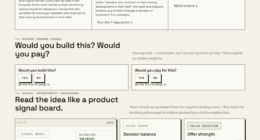

📊 Full opportunity report: IdeaClyst: The Validation Council on ThorstenMeyerAI.com — validation score, market gap, and execution plan.

Get hardware and tech essentials delivered free — and shop member deals
- Fast, free delivery on millions of items
- Access to Prime Big Deal Days deals on October 6–7
- Prime Video, Amazon Music and more included
TL;DR
IdeaClyst has launched a new validation process called The Validation Council, using opposing AI models to rigorously stress-test ideas before they are added to roadmaps. This approach aims to improve decision accuracy and reduce costly errors.
IdeaClyst has unveiled its Validation Council, a new process that employs two different AI models—Claude and Codex—to rigorously evaluate ideas before they are considered for development. This development aims to improve decision quality by ensuring ideas are thoroughly stress-tested through structured disagreement, reducing the risk of costly failures.
The Validation Council is a core component of IdeaClyst’s broader platform, designed to act as an internal gatekeeper for idea validation. It operates by first conducting a comprehensive research pre-step, gathering relevant context and evidence, before engaging two models to argue for and against the idea in five deliberate steps: framing, steelmanning, red-teaming, evidence-checking, and synthesizing a verdict.
Unlike single-model assessments, this process fosters structured disagreement, with the opposing models tasked with challenging each other’s assumptions and evidence. The output is an auditable recommendation that details the reasoning behind acceptance or rejection, emphasizing transparency and rigorous analysis. The system is open source under the MIT license and runs locally, making it accessible and cost-effective for operators.
While acknowledging that AI models can share blind spots and produce confident but incorrect conclusions, IdeaClyst emphasizes that the council’s primary value lies in identifying weak ideas early, preventing them from occupying valuable development resources. The process aims to make decision-making more reliable and repeatable, especially in high-leverage scenarios where the cost of bad ideas is significant.
IdeaClyst — the validation council
Most ideas don’t die from being bad — they die from being plausible and untested. A research pre-step, then two models cross-examining the idea before it earns a roadmap slot.
Independent commentary, produced with AI assistance under human editorial oversight. The views are the author’s own and may change. IdeaClyst is open source under MIT, provided “as is” without warranty; see the repository LICENSE. The council’s research, deliberation and verdicts are produced by automated models and may contain errors or shared blind spots — a verdict is auditable reasoning, not validated demand; verify independently before committing. Product and company names are trademarks of their respective owners; mention does not imply endorsement.
Why Structured AI Disagreement Enhances Decision-Making
The Validation Council represents a shift toward more rigorous internal vetting of ideas, leveraging AI to surface objections and weaknesses that might be overlooked in traditional review. By requiring models to argue from opposing perspectives, the process reduces the risk of groupthink and confirmation bias, leading to more robust decision-making. This approach is particularly relevant for organizations seeking to minimize costly project failures and improve strategic planning through structured, transparent evaluation.
As an affiliate, we earn on qualifying purchases.
Background of IdeaClyst and Its Validation Approach
IdeaClyst originated from the need to improve how organizations vet ideas internally before committing resources. Its predecessor, IdeaNavigator, provided a public, evidence-mined idea stream, but the company identified a gap in private, rigorous validation. The platform’s architecture is provider-agnostic, requiring multiple models and local compute, which aligns with its mission to democratize and decentralize idea validation. The launch of the Validation Council builds on these principles, introducing a formalized, multi-model debate process designed to catch weak ideas early and improve decision quality.
“The core of the Validation Council is to make the stress-testing of ideas a repeatable, transparent process that surfaces weaknesses before they become costly mistakes.”
— Thorsten Meyer, founder of IdeaClyst
As an affiliate, we earn on qualifying purchases.
Limitations and Risks of AI-Based Idea Validation
While the Validation Council aims to improve idea vetting, it is acknowledged that AI models can share blind spots and confidently produce incorrect conclusions. The process cannot guarantee ground truth or market validation, and the structured disagreement might give a false sense of certainty if not carefully interpreted. For more on AI validation, see A War Room for Your Next Idea.
As an affiliate, we earn on qualifying purchases.
Next Steps for IdeaClyst and Its Validation Ecosystem
IdeaClyst plans to expand the use of the Validation Council within its platform, integrating feedback from early adopters to refine the process. Further development may include more models, enhanced transparency features, and case studies demonstrating its effectiveness. The company also intends to promote open-source collaboration to improve and adapt the framework across different industries and use cases.
As an affiliate, we earn on qualifying purchases.
Key Questions
How does the Validation Council differ from traditional idea review?
The Validation Council employs opposing AI models to argue for and against an idea in a structured, transparent process, unlike traditional reviews that rely on subjective judgment or single-model assessments.
Can the AI models produce false positives or negatives?
Yes, models can share blind spots and confidently produce incorrect conclusions. The process aims to reduce these risks through structured disagreement but cannot eliminate them entirely.
Is the Validation Council open source?
Yes, the full framework is open source under the MIT license and runs locally on owned compute, making it accessible for organizations to implement and adapt.
What are the main benefits of using the Validation Council?
It helps identify weak ideas early, reduces costly failures, improves decision transparency, and makes internal vetting more rigorous and repeatable.
Will this process replace human judgment?
No, it is designed to augment human decision-making by surfacing objections and weaknesses that humans might overlook, not to replace judgment entirely.
Source: ThorstenMeyerAI.com
Fall Picks
fall essentials
As an affiliate, we earn on qualifying purchases.