
📊 Full opportunity report: Inside 'SINGULARITY': The AI Technique Of Particle Geometry Mapping Explained on ThorstenMeyerAI.com — validation score, market gap, and execution plan.

Get hardware and tech essentials delivered free — and shop member deals
- Fast, free delivery on millions of items
- Access to Prime Big Deal Days deals on October 6–7
- Prime Video, Amazon Music and more included
TL;DR
‘SINGULARITY’ is a cutting-edge AI design project that employs Particle Geometry Mapping to craft immersive, data-driven environments. This article explains the technique and its significance.
‘SINGULARITY’ is an innovative AI-driven environment that visually represents complex data through a technique called Particle Geometry Mapping. This project, recently showcased live, demonstrates how advanced algorithms can generate immersive spaces that challenge traditional notions of form and function, marking a significant step in AI-assisted design and spatial visualization.
The ‘SINGULARITY’ project was developed as a design case study to explore how Particle Geometry Mapping can translate abstract data into tangible visual forms. The space, originally a stark black room, was transformed into a visual symphony of data and geometry, achieved through precise algorithmic control. According to Thorsten Meyer, the project integrates complex technical processes with seamless aesthetic execution, illustrating the potential of AI to shape future environments.
Key to this process is the use of Particle Geometry Mapping, an innovative technique that assigns data points to geometric particles, enabling the creation of dynamic, data-driven structures. This method allows for real-time manipulation of form based on input data, resulting in spaces that are both visually striking and deeply connected to underlying information. The project aims to push boundaries in AI-generated environments, blending artistic expression with technical rigor.
While the project has been demonstrated live, detailed technical descriptions remain limited. Experts suggest that the process involves complex algorithms that interpret data into geometric instructions, which are then rendered into immersive visual forms. The project’s success hints at broader applications in architecture, art, and interactive environments, though practical deployment is still in development stages.
Inside “SINGULARITY”
How Particle Geometry Mapping translates abstract information into responsive particles, geometric structures, and immersive data-driven environments.
Recently demonstrated in a live showcase
Inputs become particle-level instructions
Geometry can respond as information changes
Technical frameworks remain in development
From abstract signal to spatial experience
Particle Geometry Mapping assigns data values to controllable geometric particles. Algorithms interpret those values as position, scale, density, movement, connection, or surface behavior.
Input data
Numbers, signals, relationships, or changing information enter the system.
Algorithmic reading
Rules identify patterns, ranges, weights, and meaningful connections.
Particle assignment
Values are mapped to individual particles and geometric attributes.
Geometry synthesis
Particles aggregate into fields, structures, surfaces, and motion.
Immersive output
The resulting environment makes hidden information spatially tangible.
Geometry becomes a living data interface
Instead of treating a space as a fixed container, “SINGULARITY” treats form as a continuously generated response to information.
Every particle can carry meaning
A particle may encode a value through position, size, velocity, color assignment, proximity, or connection strength.
Form can change with the source
As input data shifts, the generated structure can reorganize without requiring a manually rebuilt scene.
Information becomes inhabitable
Complex relationships are encountered as scale, rhythm, density, depth, and movement rather than as a flat chart.
Where the technique is strongest—and least certain
The current project demonstrates compelling artistic and conceptual performance. Industrial scalability, repeatability, and implementation details remain less established.
Development spectrum
Position is an editorial assessment based on the successful showcase and the limited availability of public technical details.
How it differs from familiar visual systems
Particle Geometry Mapping combines traits of visualization, generative art, spatial design, and responsive simulation—but its defining move is turning data into environmental geometry.
| Capability | Static visualization | Generative art | Particle Geometry Mapping |
|---|---|---|---|
| Directly tied to source data | ✓ Usually | ~ Sometimes | ✓ Core principle |
| Forms an immersive environment | ✗ Rarely | ~ Possible | ✓ Designed for it |
| Responds to changing inputs | ~ Dashboard-led | ~ Rule-dependent | ✓ Real-time potential |
| Geometry carries information | ~ Symbolically | ~ Aesthetically | ✓ Structurally |
| Broad commercial maturity | ✓ Established | ~ Selective | ✗ Still evolving |
One continuous chain of meaning
The method is most valuable when viewers can trace an expressive spatial result back to the information and mapping rules that produced it.
“SINGULARITY” points toward environments that are not only visually compelling, but also responsive, personalized, and functionally connected to live information—an intersection with potential relevance to architecture, virtual reality, installations, and smart spaces.
What we know—and what comes next
The concept is clear; the path to broad implementation depends on technical documentation, scalable tooling, testing, and proof beyond experimental settings.
What is Particle Geometry Mapping?
An AI-assisted technique that assigns data to geometric particles so information can generate dynamic visual and spatial structures.
How does “SINGULARITY” use it?
Algorithms control particles to transform complex data into an immersive environment where form and information remain connected.
Where could it be applied?
Potential domains include architecture, virtual reality, interactive installations, data visualization, and responsive smart environments.
What are the main barriers?
Technical complexity, scalability, reproducibility, and the conversion of experimental results into dependable real-world systems.
Revolutionizing Design with Data-Driven Environments
The ‘SINGULARITY’ project exemplifies how Particle Geometry Mapping could revolutionize the future of design and spatial visualization. By translating complex data into immersive environments, this technique opens new possibilities for architects, artists, and AI developers. It demonstrates a tangible intersection of art, technology, and data science, paving the way for environments that can adapt and respond to real-time information.
This innovation matters because it signals a shift towards more interactive, personalized, and intelligent spaces. As AI tools become more sophisticated, projects like ‘SINGULARITY’ reveal how they can be harnessed to create environments that are not only aesthetically compelling but also functionally responsive to data inputs. Such developments could influence future applications in virtual reality, smart architecture, and data visualization, making environments more dynamic and meaningful.
As an affiliate, we earn on qualifying purchases.
Advances in AI-Generated Spatial Design
The concept of using AI to generate environments is not new, but ‘SINGULARITY’ pushes the boundary by integrating Particle Geometry Mapping as a core technique. Previous projects have explored data-driven art and virtual spaces; however, this project is notable for its real-time, immersive execution and its focus on translating complex data into physical-like spatial forms.
Thorsten Meyer and other innovators have been experimenting with algorithmic design, but the recent live showcase of ‘SINGULARITY’ marks a significant milestone. The project builds upon earlier work in generative art and AI-driven architecture, emphasizing a seamless blend of technical precision with artistic intent. While detailed technical frameworks remain proprietary or under development, the core concept of data-to-geometry translation is gaining traction in the design community.
“Particle Geometry Mapping enables the transformation of abstract data into tangible, immersive environments, opening new horizons for AI-assisted design.”
— an anonymous researcher
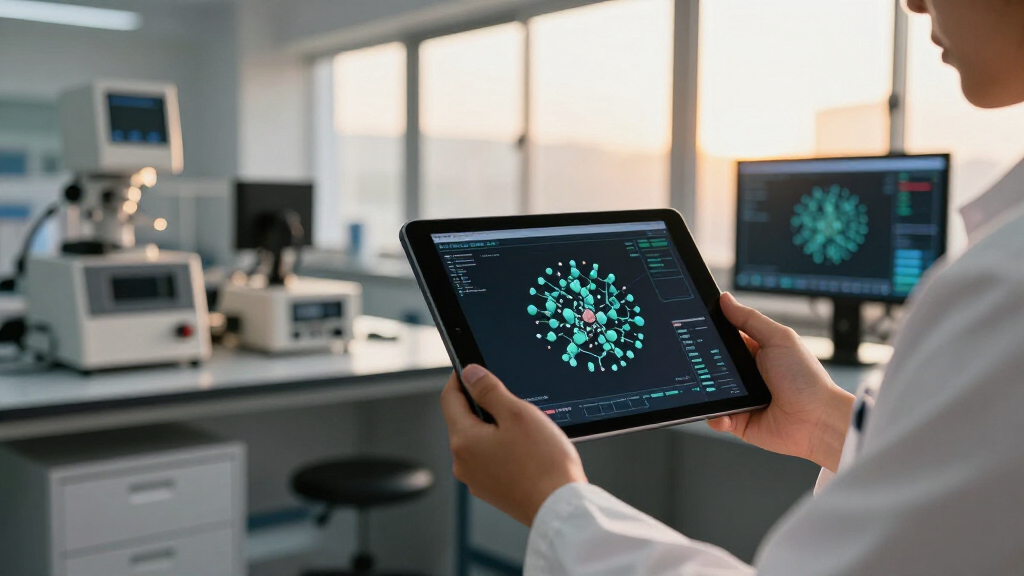
interactive data environment display
As an affiliate, we earn on qualifying purchases.
As an affiliate, we earn on qualifying purchases.
Technical Details and Practical Applications Still Evolving
While the concept and live demonstration have been successful, specific technical details about the algorithms and data processing methods used in ‘SINGULARITY’ remain limited. It is not yet clear how scalable or adaptable the Particle Geometry Mapping technique is for broader industrial or commercial use. Additionally, practical applications beyond artistic and experimental contexts are still under development, and the full potential of this approach has yet to be realized in real-world environments.
As an affiliate, we earn on qualifying purchases.
Future Developments and Broader Implementation Plans
Researchers and developers involved with ‘SINGULARITY’ plan to refine the Particle Geometry Mapping technique and explore its applications in architecture, virtual reality, and interactive environments. Expect further demonstrations and technical publications that detail algorithmic processes. Additionally, efforts to commercialize or adapt this approach for practical use are likely to emerge over the coming months, with potential collaborations in design, art installations, and smart environments.
As an affiliate, we earn on qualifying purchases.
Key Questions
What is Particle Geometry Mapping?
Particle Geometry Mapping is an AI technique that assigns data points to geometric particles, enabling the creation of dynamic, data-driven visual environments.
How does ‘SINGULARITY’ demonstrate this technique?
The project transforms complex data into immersive visual spaces by controlling particles through advanced algorithms, resulting in a seamless integration of data and form.
Can this technique be used outside artistic projects?
Potentially, yes. Developers see applications in architecture, virtual reality, and interactive environments, but practical deployment is still in early stages.
What are the main challenges facing this technology?
Technical complexity, scalability, and translating experimental results into practical, real-world applications remain key challenges.
When will broader applications be available?
It is not yet clear; further research, development, and testing are needed before widespread adoption can occur.
Source: ThorstenMeyerAI.com
Fall Picks
fall essentials
As an affiliate, we earn on qualifying purchases.