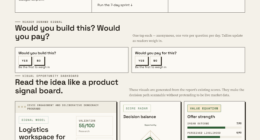

📊 Full opportunity report: SpaceX Owns Every Layer of AI Now. The Model Is Still the Weak Link. on ThorstenMeyerAI.com — validation score, market gap, and execution plan.
TL;DR
SpaceX has acquired Cursor for $60 billion, giving it control over all AI layers—from hardware to applications. Despite this, the AI model itself remains a weak link, highlighting ongoing challenges in AI development.
SpaceX has completed its $60 billion acquisition of Cursor, an AI coding company, making it the owner of every layer of AI infrastructure—from hardware and data centers to AI applications. This move consolidates SpaceX’s position as the most vertically integrated AI entity in the industry, but the performance of the AI models themselves remains a weak point, raising questions about the true strength of its AI dominance.
On June 16, SpaceX announced it exercised its option to acquire Cursor, a profitable AI coding firm founded in 2022, for $60 billion in all-stock. The deal, expected to close in Q3 2026, transforms Cursor into a wholly owned subsidiary of SpaceX. Prior to the acquisition, Cursor had achieved approximately $4 billion in annual revenue, primarily from its AI coding applications, and had rejected offers from OpenAI and Microsoft to maintain independence.
With this acquisition, SpaceX now controls all critical AI layers: the hardware (via supercomputers like Colossus), power infrastructure, research labs (xAI), and application deployment (Cursor and Grok models). The company’s compute capacity includes around 555,000 Nvidia GPUs at its Memphis facility, with plans to deploy orbital data centers powered by solar satellites. SpaceX’s vertical integration extends to leasing compute to rivals like Anthropic and Google, which lease significant GPU capacity from its supercomputers.
Despite owning the hardware and infrastructure, the AI models’ performance is still a concern. Reports indicate that the current models operate at low utilization rates, with internal memos revealing only about 11% FLOPs utilization—far below the 35–45% needed for production-grade AI. SpaceX’s CEO Elon Musk has acknowledged this, noting that the models are still in development and that the infrastructure is being repurposed for more efficient training.
SpaceX owns every layer
of AI now
The $60B Cursor buy completes the stack: power, compute, research, model, app, distribution. But owning every layer isn’t winning every layer — and the model is the weak one.
(Anysphere)
You can buy a coding app and a model team. You can’t buy the research lead that makes your foundation model the one everyone else builds on — which is why Anthropic pays Musk $1.25B/month, not the other way around. Owning every layer bought SpaceX the right to attempt the hard thing. It hasn’t done it yet.
Implications of Full AI Stack Ownership for Industry Power
This acquisition positions SpaceX as the most comprehensive AI conglomerate in the West, controlling hardware, data, research, and applications. However, the weak performance of its AI models underscores that owning infrastructure alone does not guarantee AI excellence. The move signals a strategic shift toward vertical integration, but also highlights ongoing challenges in developing high-performance AI models at scale. For industry competitors and policymakers, this concentration of AI resources raises questions about market dominance, innovation, and the potential for AI arms races.

HPE NVIDIA Tesla V100 32GB HBM2 PCIe 3.0 x16 Passive GPU Computational Accelerator for AI Machine Learning HPC Deep Learning 699-2G500-0216-400 (Renewed)
- Architecture: NVIDIA Volta GV100 architecture with CUDA cores
- CUDA Cores: 5120 CUDA cores for high-performance computing
- Tensor Cores: 640 Tensor Cores for AI and deep learning
As an affiliate, we earn on qualifying purchases.
As an affiliate, we earn on qualifying purchases.
Background of SpaceX’s AI Infrastructure Expansion
Over the past few years, SpaceX has rapidly expanded its AI capabilities, building the Colossus supercomputers in Memphis, which now host approximately 555,000 GPUs. The company has also integrated AI research through xAI, founded by Elon Musk, and developed models like Grok. Prior to the Cursor acquisition, SpaceX had already leased significant GPU capacity to rivals such as Anthropic and Google, generating billions in revenue from these arrangements. The move to acquire Cursor marks a shift from leasing infrastructure to owning a key application developer and model team, completing its control over the entire AI stack.
While other tech giants like Google and OpenAI own silicon and compute, they do not control the full pipeline from hardware to application. SpaceX’s integrated approach is unprecedented in the West, although China’s tech firms have similar vertical integration strategies. The recent deal underscores SpaceX’s ambition to become a dominant force in AI, leveraging its space and computing assets.
“Owning every layer of AI infrastructure gives us unmatched control, but the real challenge is building models that can perform at scale.”
— Elon Musk

NVIDIA DGX Spark™ – Personal AI Desktop Supercomputer – Desktop GB10 Grace Blackwell Chip
- Compact Supercomputer Design: Energy-efficient desktop AI powerhouse
- High AI Performance: Up to 1 petaFLOP with Grace Blackwell
- Full NVIDIA AI Software Stack: Seamless AI development and deployment
As an affiliate, we earn on qualifying purchases.
As an affiliate, we earn on qualifying purchases.
Uncertainties About AI Model Performance and Future Development
While SpaceX controls all hardware and application layers, the performance of its AI models remains suboptimal, with low utilization rates and ongoing development challenges. It is unclear how quickly the models will improve or whether the current weaknesses will limit the company’s competitive position in AI innovation. Additionally, the long-term impact of owning such a concentrated AI infrastructure, especially amid regulatory scrutiny, remains uncertain.

AI Systems Performance Engineering: Optimizing Model Training and Inference Workloads with GPUs, CUDA, and PyTorch
As an affiliate, we earn on qualifying purchases.
As an affiliate, we earn on qualifying purchases.
Next Steps for SpaceX’s AI Strategy and Model Improvement
SpaceX is expected to focus on enhancing the performance of its AI models, potentially through further training, model refinement, and infrastructure optimization. The company’s acquisition of Cursor sets the stage for integrating advanced AI capabilities into its space and other ventures, possibly influencing broader industry standards. Regulatory reviews of the deal are anticipated, and the company may also expand its leasing and application deployment to strengthen its market position.

The NVIDIA Rubin CPX GPU Architecture: Transforming AI Inference Infrastructure for High-Performance Computing and Generative Applications
As an affiliate, we earn on qualifying purchases.
As an affiliate, we earn on qualifying purchases.
Key Questions
Why did SpaceX buy Cursor for $60 billion?
SpaceX acquired Cursor to gain control over all layers of AI infrastructure, including hardware, software, and applications, aiming to build a vertically integrated AI ecosystem.
What are the main challenges facing SpaceX’s AI models?
The models currently operate at low utilization rates, indicating inefficiencies and ongoing development needs to achieve production-level performance.
How does this acquisition affect the AI industry?
It consolidates significant AI resources within a single company, potentially shifting industry power and raising questions about market dominance and innovation pace.
Will owning all AI layers guarantee better models?
Not necessarily; while vertical integration provides control, the quality and performance of AI models depend on ongoing research, training, and development efforts.
What are the regulatory implications of this deal?
Regulators may scrutinize the acquisition for potential anti-competitive effects, given SpaceX’s control over extensive AI infrastructure and applications.
Source: ThorstenMeyerAI.com