
TL;DR
Mistral is betting on control, open weights, and infrastructure sovereignty to carve out a niche in AI. While its strategy aligns with Europe’s push for independence, doubts remain about its technical pace and real independence from US and Chinese tech.
Europe faces a stark choice in AI: follow the US and China, or build its own independent stack. Mistral’s recent summit revealed a company that’s betting on sovereignty as its secret weapon—claiming control over data, infrastructure, and models. But is this a genuine strategic insight or just a clever way to make do with limited resources?
In this article, we’ll break down what Mistral actually says about sovereignty, what critics argue, and whether Europe can really build an AI future free from US tech giants. Expect a deep dive into the strategic, technical, and geopolitical layers of Mistral’s gamble.
Different game, or already lost?
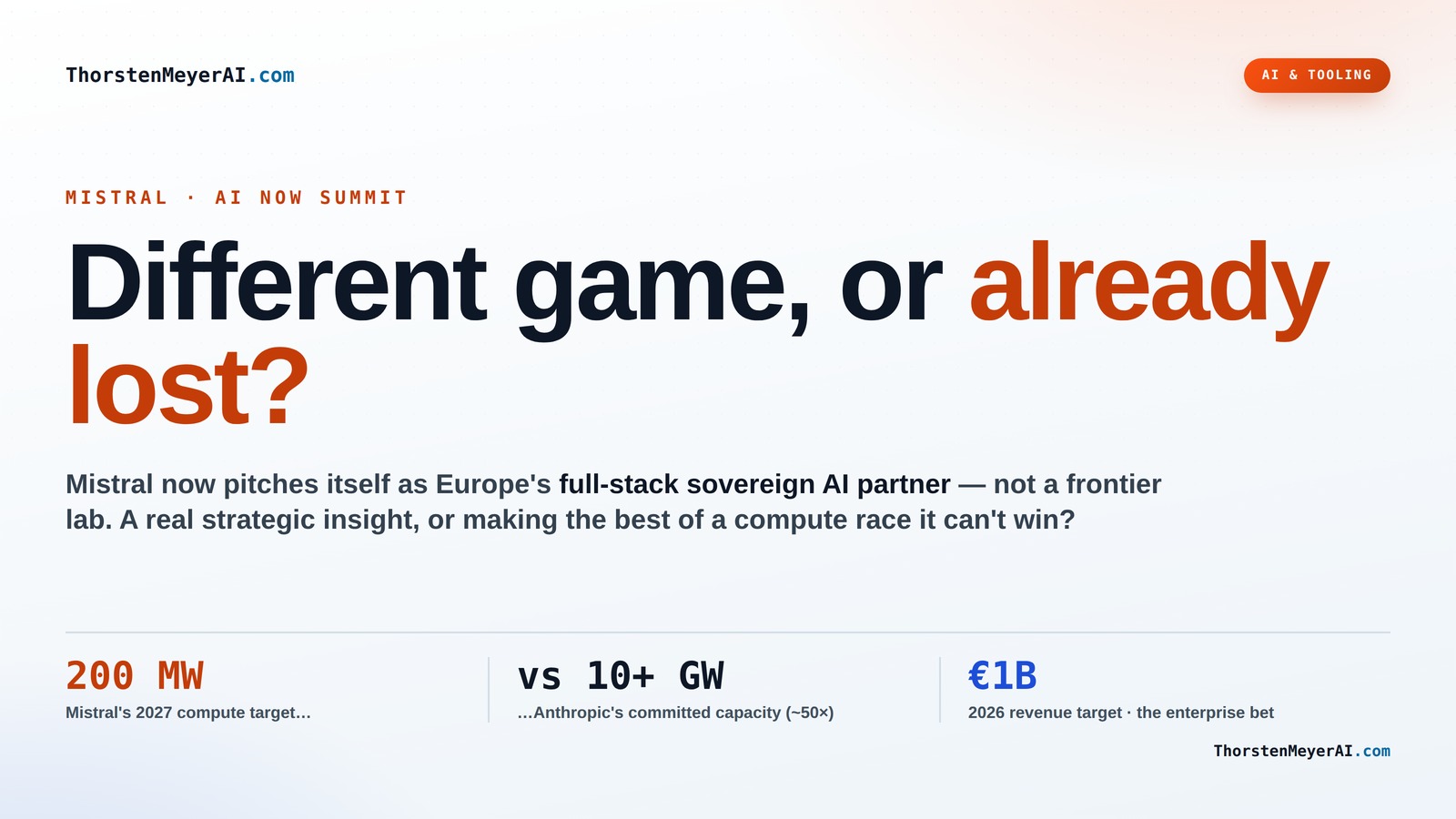
Mistral now pitches itself as Europe’s full-stack AI provider — compute, models, platform, consultancy — not a frontier-model lab. Is that a real strategic insight, or making the best of a race it can’t win? Both readings fit the same facts.
From model lab to full-stack provider
The clearest signal from the summit wasn’t a model — it was a posture. Heavy on enterprise logos and partnerships (ASML, BNP Paribas, Alexa+), light on new-model announcements. That absence is exactly what skeptics seized on.
Compute
40MW Paris DC + Sweden build · 200MW target by 2027
Models
Open & custom · efficient · you own and run them
Platform
Forge for custom models · Vibe for Work agent
Consultancy
Sales teams, integrators, EU provenance & support
Small & focused, or large & general?
Mistral bets on specialized small models. The claim isn’t that they win a reasoning leaderboard — they don’t. It’s that on the metrics that matter in production agent systems, a purpose-built small model wins. Flip the metric to see the case reverse.
Small specialized vs large general — by what you measure
In token-heavy agentic apps making hundreds of calls, speed/energy/cost compound. Toggle the metric.
Narrow models doing real work
Each is one model doing one thing efficiently — the tangible version of the strategy. Strong on their own terms; the open question is whether the bundle beats a free Chinese open-weight download.
On-prem KYC compliance
Mistral models run inside the bank’s walls for know-your-customer checks. Sensitive financial data never leaves. (BNP was Mistral’s first customer, 2023.)
Voxtral multilingual voice
A focused voice model powering Alexa+ across Europe — speed and efficiency over raw size.
Robostral industrial robotics
Plus a “physics AI” push (via the Emmi acquisition) into aerospace, automotive & semiconductor design and simulation.
Document AI / OCR at scale
Large-scale text extraction — the unglamorous, high-volume enterprise work small models excel at.
The strategy is downstream of the compute gap
Once you see the raw numbers, “why is Mistral behind?” answers itself — and the specialized-small-model strategy starts looking partly like a smart adaptation to a binding constraint, not a pure philosophical choice.
Compute & capital · Mistral vs a frontier leader, this same week
Not a knock — it’s the constraint that forces the efficiency-first, sovereignty-wedge strategy. Adapting intelligently to your position is what good strategy is.
“I want them to win, but I’m worried”
That ambivalence is the most accurate read of where Mistral sits. The enterprise pivot gets read two opposite ways — and both deserve airing.
On-prem, real sales teams, the Koyeb deployment acquisition, EU provenance — exactly what regulated enterprises want, and stickier than consumer mindshare. Targeting €1B revenue in 2026 with 1,000 staff, up from 15 people and one customer in 2023. US closed-API labs structurally can’t match the sovereignty axis.
“Software consultancy with a data center,” not a foundation-model moat. Enterprise B2B is where European startups go when they can’t win consumer or world-scale SaaS. Why pay Mistral on-prem when you could run Qwen free? One paying Le Chat Pro user said the quality gap with frontier labs is now hard to ignore.
Key Takeaways
- Mistral’s sovereignty strategy is about control over infrastructure, data, and models—not just performance.
- Open-weight models give European firms the ability to deploy AI locally, reducing dependence on US cloud giants.
- Small, specialized models can outperform large ones in enterprise settings due to speed and cost advantages.
- Europe’s AI future depends on massive investments in hardware, talent, and regulation—Mistral’s approach is a step, but not the whole answer.
- Strategic control and sovereignty may matter more to European clients than chasing benchmark dominance.
enterprise AI infrastructure hardware
As an affiliate, we earn on qualifying purchases.
As an affiliate, we earn on qualifying purchases.
How Mistral Positions Itself as the Sovereign Choice for Europe
At the core, Mistral claims it’s building more than models — it’s creating a full-stack AI ecosystem. From owning a 40MW data center near Paris to planning a €1.2 billion infrastructure in Sweden, Mistral emphasizes control. CEO Arthur Mensch says the goal is to turn electrons into tokens and intelligence, giving clients the ability to deploy AI on their own terms.
This isn’t just about flashy tech; it’s about control. European banks, regulators, and public agencies want AI they can own, govern, and trust. Mistral’s pitch is that open-weight models, operated on private infrastructure, meet this need better than closed APIs from US companies.
They’ve launched products like Vibe for Work, positioning against companies like Claude, and formed partnerships with giants like BNP Paribas and Amazon Alexa+. The message is clear: sovereignty isn’t just where your data lives; it’s about owning the entire stack—hardware, models, and software.
By emphasizing control over every layer of the AI stack, Mistral aims to mitigate risks associated with dependence on foreign cloud providers and software vendors. This approach could provide European institutions with greater legal and operational sovereignty, but it also raises questions about scalability, cost, and the speed of innovation—tradeoffs that might slow down their competitive edge against US and Chinese giants. Learn more about the strategic implications.

custom AI model development platform
As an affiliate, we earn on qualifying purchases.
As an affiliate, we earn on qualifying purchases.
The Real Power Play: Open Weights and Local Deployment
Mistral’s strategy hinges on open weights—models that customers can download, fine-tune, and run locally. This approach addresses a core tension in AI deployment: balancing control with performance. By enabling local deployment, Mistral allows enterprises to keep sensitive data within their own infrastructure, thus reducing exposure to potential data breaches or regulatory scrutiny associated with cloud reliance.
This method also shifts power dynamics. Instead of US cloud giants controlling the data and the model infrastructure, European firms can operate independently, customizing models to their specific needs. For instance, BNP Paribas running Mistral models on-premises not only ensures compliance but also enhances data sovereignty, giving them control over their AI assets in a way that cloud-based models cannot match.
However, the tradeoff is complexity and cost. Maintaining local infrastructure and managing open weights require technical expertise and resources that may be beyond smaller firms. Critics question whether the perceived security and control justify the higher operational costs, especially when free open-source alternatives like Qwen exist. The real implication is a strategic choice: invest in sovereignty or accept the efficiencies of cloud-based, closed models—an ongoing debate with no easy answers.

AI data sovereignty storage solutions
As an affiliate, we earn on qualifying purchases.
As an affiliate, we earn on qualifying purchases.
Is Smaller, Specialized Models the Smartest Strategy?
Mistral champions small, purpose-built models over massive giants like GPT-4. These tiny models—used for OCR, multilingual voice, or industrial robotics—excel in speed, energy efficiency, and cost per token. In enterprise environments where rapid response times and low latency are critical, smaller models can outperform their larger counterparts by providing faster inference and lower operational costs.
They cite success stories like the European Patent Office’s document AI and Amazon’s Alexa+ in Europe, all powered by lean models. The argument is that in real-world applications, especially at the edge or in resource-constrained environments, smaller models can deliver better value by reducing infrastructure costs and improving responsiveness. This also aligns with Europe's emphasis on decentralized, local AI deployment, avoiding reliance on massive cloud infrastructures.
This raises a strategic question: should European AI developers focus on perfecting small, specialized models tailored for specific tasks, or aim to develop large, general reasoning models? The tradeoff involves scalability, versatility, and future-proofing. Smaller models may be more immediately practical and easier to control, but large models could offer broader capabilities in the long run. The European context favors a pragmatic approach—prioritizing control, efficiency, and niche performance—yet this may limit the potential for global leadership in general-purpose AI.

As an affiliate, we earn on qualifying purchases.
Is Mistral Falling Behind or Just Playing a Different Game?
Critics argue that Mistral isn’t leading in model benchmarks, with some recent results suggesting it’s behind US and Chinese competitors. Explore the broader strategic context. However, this focus on raw performance benchmarks may overlook the broader strategic priorities. For European clients, control over data, legal jurisdiction, and infrastructure could be more valuable than marginal gains in benchmark scores, especially if these gains come at the expense of increased dependence on foreign cloud providers or hardware suppliers.
Their lack of major breakthroughs at the summit could signal a cautious approach—prioritizing sustainable, controllable growth over risky, rapid innovation. While slower progress in benchmarks might limit immediate competitive positioning, the emphasis on local deployment and sovereignty creates a different kind of strategic advantage: resilience, legal compliance, and independence. This approach could insulate European AI initiatives from geopolitical tensions and regulatory crackdowns, but it also risks falling behind in technical innovation if not balanced carefully.
In essence, Mistral’s game isn’t solely about being the fastest or most powerful model. It’s about controlling the entire ecosystem—hardware, data, and legal frameworks. Whether this strategy can sustain long-term relevance depends on their ability to innovate within these constraints while maintaining operational agility.

Europe’s Big Question: Can It Build an Independent AI Future?
Europe’s goal is clear: develop an AI ecosystem that isn’t hostage to US or Chinese giants. Mistral’s approach is a piece of that puzzle—focusing on local models, infrastructure, and sovereignty. Yet, building a truly independent AI stack demands massive investment in hardware, talent, and legal frameworks. The challenge is compounded by Europe's fragmented market and regulatory landscape, which can slow down large-scale coordination and deployment.
Arthur Mensch warns time is running out—Europe needs to act within the next two years to avoid becoming a 'vassal state.' Partnerships like Caisse des Dépôts aim to foster this independence, but scaling from niche models to a full-stack ecosystem involves overcoming significant technical, financial, and political hurdles.
Realistically, can Europe scale from small, specialized models to a comprehensive, self-sufficient AI infrastructure? It’s a marathon, not a sprint—requiring sustained commitment across multiple sectors and borders. The risk is that without a unified vision and substantial investment, Europe might settle for a patchwork of partial solutions rather than a cohesive, sovereign AI future.
Frequently Asked Questions
What does ‘sovereign AI’ actually mean in practice?
Sovereign AI means having control over your data, models, infrastructure, and governance. It’s about deploying AI that stays within legal and jurisdictional boundaries, giving enterprises and governments independence from US or Chinese tech giants.
Is Mistral more sovereign than OpenAI or Anthropic?
Yes, in theory. Mistral emphasizes open weights, local deployment, and infrastructure ownership, aligning with Europe’s push for digital sovereignty. US firms tend to focus on cloud-based APIs, which can limit control.
Does open weight equal open source?
Not necessarily. Open weights mean models are downloadable and customizable, but they may still be proprietary or restricted in licensing. Open source implies open code, which is a step further in transparency and community collaboration.
Can a company be sovereign if it depends on US cloud or chips?
Partially. Sovereignty involves control over data and infrastructure, but dependence on US hardware or cloud services can undermine full independence. True sovereignty requires ownership of hardware, software, and legal control.
What would it take for Europe to build a truly independent AI stack?
It would require massive investment in hardware manufacturing, talent, legal frameworks, and cross-border cooperation. Mistral’s approach is a start, but full independence is a long-term, resource-intensive goal.
Conclusion
Europe’s sovereignty play isn’t just a tech story; it’s a political one. Mistral’s focus on control and local deployment reflects a broader desire to free Europe from dependence on US giants. Whether or not they lead in benchmarks, their approach highlights a fundamental question: can Europe build an AI ecosystem that’s truly independent and competitive?
For now, the answer remains uncertain. But the stakes are high—Europe’s future in AI could hinge on whether sovereignty is a strategic advantage or just a political badge. Keep an eye on Mistral. It might just be the first step—or the last gasp—of a continent trying to take back control.