
📊 Full opportunity report: Home signal monitor: Mortgage Rates Inch to Another 6-Week Low on IdeaNavigator AI — validation score, market gap, and execution plan.
TL;DR
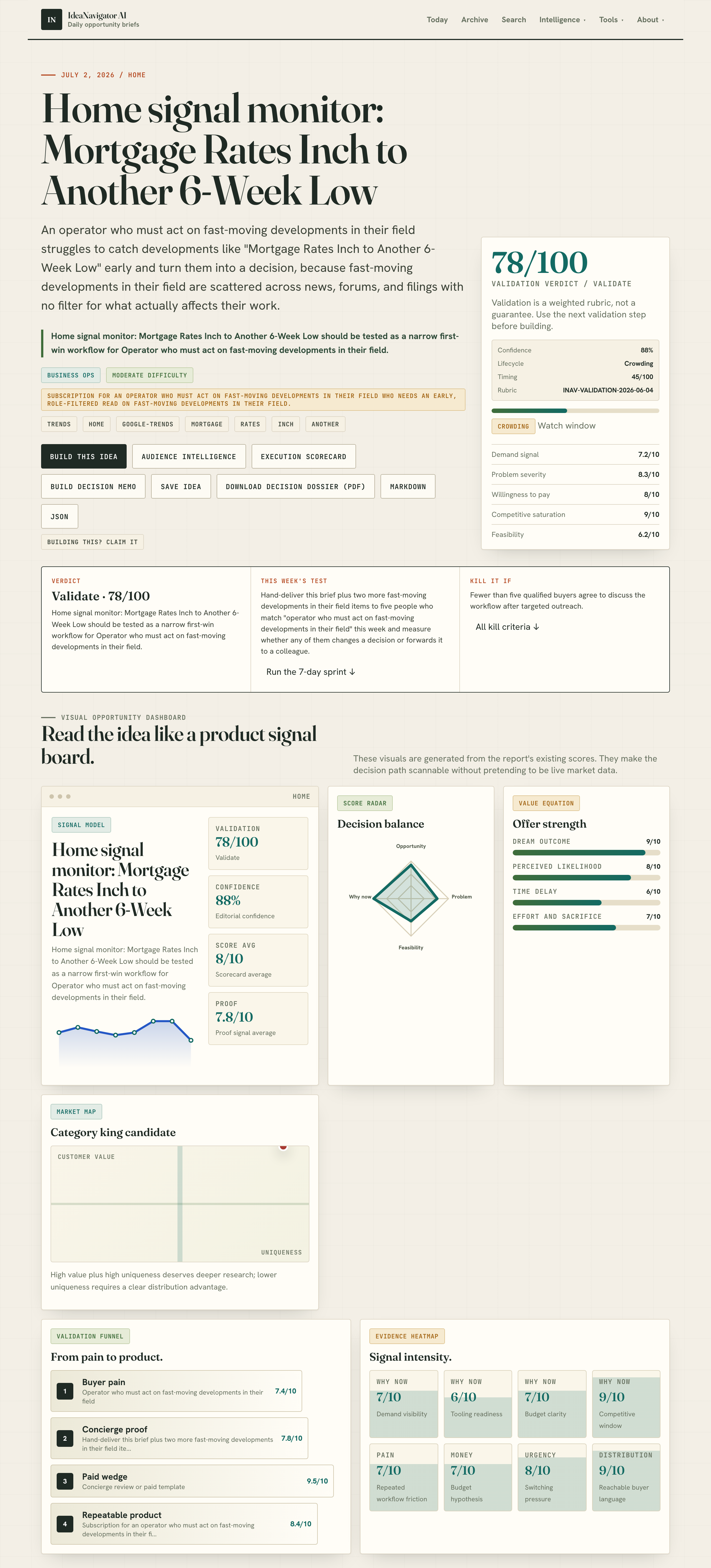
Mortgage rates have decreased to a six-week low, marking a significant movement in borrowing costs. This development could influence home affordability and market activity, but the underlying causes are still being analyzed.
Mortgage rates have declined to their lowest level in six weeks, according to recent market figures. This movement is likely to affect homebuyers and the housing market, making borrowing slightly more affordable for some borrowers. The development is confirmed by multiple financial data sources and comes amid broader economic signals.
Data from mortgage market trackers indicate that the average interest rate for 30-year fixed mortgages has decreased to approximately 6.2%, marking the lowest point since early March. This decline follows a series of rate fluctuations influenced by broader economic factors such as inflation trends and Federal Reserve policies. Experts suggest that the recent easing could encourage more home purchases or refinancing activity.
Financial analysts note that the decline is modest but notable, given the recent volatility in mortgage rates. The rate drop is partly attributed to recent bond market movements and investor sentiment shifts. The exact causes remain under analysis, but the trend aligns with a broader easing in borrowing costs observed in other lending sectors.
Mortgage lenders and real estate professionals are closely monitoring this development, as even small changes in rates can influence home affordability and market dynamics. However, it is still uncertain whether this downward movement will persist or reverse in the coming weeks.
Impact of the Rate Drop on Housing Market Activity
The decline to a six-week low in mortgage rates could make home loans more accessible, potentially stimulating demand in the housing market. Lower borrowing costs may encourage more buyers to enter the market or refinance existing mortgages, which could influence home prices and sales volumes. However, the broader economic context, including inflation and Federal Reserve policies, will determine whether this trend continues.
For consumers, even a slight decrease in mortgage rates can translate into hundreds of dollars in monthly savings, affecting affordability and borrowing decisions. Real estate professionals see this as a positive signal, but caution that rate movements are still subject to economic uncertainties.

COOSPO H6 Heart Rate Monitor Chest Strap Bluetooth 4.0 ANT+ IP67 Chest Heart Rate Sensor for Peloton Polar DDP Yoga Map My Ride Garmin Sports Watches
±1BPM HEART RATE DATA – The H6 HR sensor can monitor high-performance real-time heart rate data while exercising,…
As an affiliate, we earn on qualifying purchases.
As an affiliate, we earn on qualifying purchases.
Recent Trends and Economic Factors Influencing Mortgage Rates
Over the past few months, mortgage rates have experienced volatility amid fluctuating inflation data and Federal Reserve policy signals. In early 2023, rates surged due to inflation fears, reaching levels above 6.5%. Since then, inflation has shown signs of moderation, prompting some market analysts to anticipate a stabilization or decline in mortgage rates.
Market data indicates that bond yields, which heavily influence mortgage interest rates, have recently fallen, contributing to the rate decrease. The Federal Reserve’s recent statements suggest a cautious approach to future rate hikes, which may support continued rate stabilization or further declines.
While the current decline is encouraging for homebuyers, experts emphasize that rates remain elevated compared to pre-pandemic levels, and economic uncertainties persist.
“While the decline is modest, it signals a possible shift in the near-term trend, but we need to see if it holds in the coming weeks.”
— a mortgage industry expert

Refoss Smart Home Energy Monitor, Native Open API & Web UI (No Cloud Required), Real Time Electricity Usage Monitor, Power Consumption Meter Works with Home Assistant & MQTT, Solar Net Metering, ETL
LOCAL CONTROL & DATA PRIVACY: Access your home energy monitor data locally via Built-in Web UI, Open API,…
As an affiliate, we earn on qualifying purchases.
As an affiliate, we earn on qualifying purchases.
Uncertainties Surrounding Future Mortgage Rate Movements
It is not yet clear whether the current decline in mortgage rates will continue or reverse in the near future. Analysts caution that rates are influenced by multiple economic factors, including inflation, bond yields, and Federal Reserve policies, which remain unpredictable. Further data and policy signals are needed to confirm whether this is a short-term fluctuation or the beginning of a sustained trend.

Life Charge Real Estate Market Analysis Notepad – Residential CMA Checklist for Listing & Buyer Agents
PROPERTY VALUE CHECKLIST FOR REALTORS Evaluate residential market value with a structured CMA form. Great for seller consultations…
As an affiliate, we earn on qualifying purchases.
As an affiliate, we earn on qualifying purchases.
Next Data Releases and Market Indicators to Watch
Market watchers will be monitoring upcoming economic reports, including inflation data and Federal Reserve statements, to gauge future mortgage rate movements. Additionally, bond market trends and housing market activity levels in the coming weeks will provide further clues about whether rates will stabilize, decline further, or rise again. Mortgage lenders and homebuyers should stay alert to these developments for decision-making purposes.

TI-30XIIS Scientific Calculator, Black
Fundamental, two-line calculator that combines statistics and advanced scientific functions for high school math and science
As an affiliate, we earn on qualifying purchases.
As an affiliate, we earn on qualifying purchases.
Key Questions
What caused the recent decline in mortgage rates?
The decline is linked to falling bond yields and market expectations of a cautious Federal Reserve stance on future rate hikes, amid signs of easing inflation.
How might this rate decrease affect homebuyers?
Lower mortgage rates can reduce monthly payments and improve affordability, potentially encouraging more home purchases and refinancing activity.
Is this decline likely to continue?
It is uncertain; rates depend on economic data and Federal Reserve policies, which remain unpredictable in the short term.
How does this compare to rates earlier this year?
The current rates are still higher than pre-pandemic levels but represent a decline from recent peaks above 6.5% seen earlier in 2023.
Should I wait to buy a home until rates fall further?
Decisions should consider personal financial situations and market conditions; consulting a financial advisor is recommended. Rates may fluctuate, and timing can be uncertain.
Source: IdeaNavigator AI