
📊 Full opportunity report: How Heirs Can Assess An Advisor’s Guidance on IdeaNavigator AI — validation score, market gap, and execution plan.

Get hardware and tech essentials delivered free — and shop member deals
- Fast, free delivery on millions of items
- Access to Prime Big Deal Days deals on October 6–7
- Prime Video, Amazon Music and more included
TL;DR
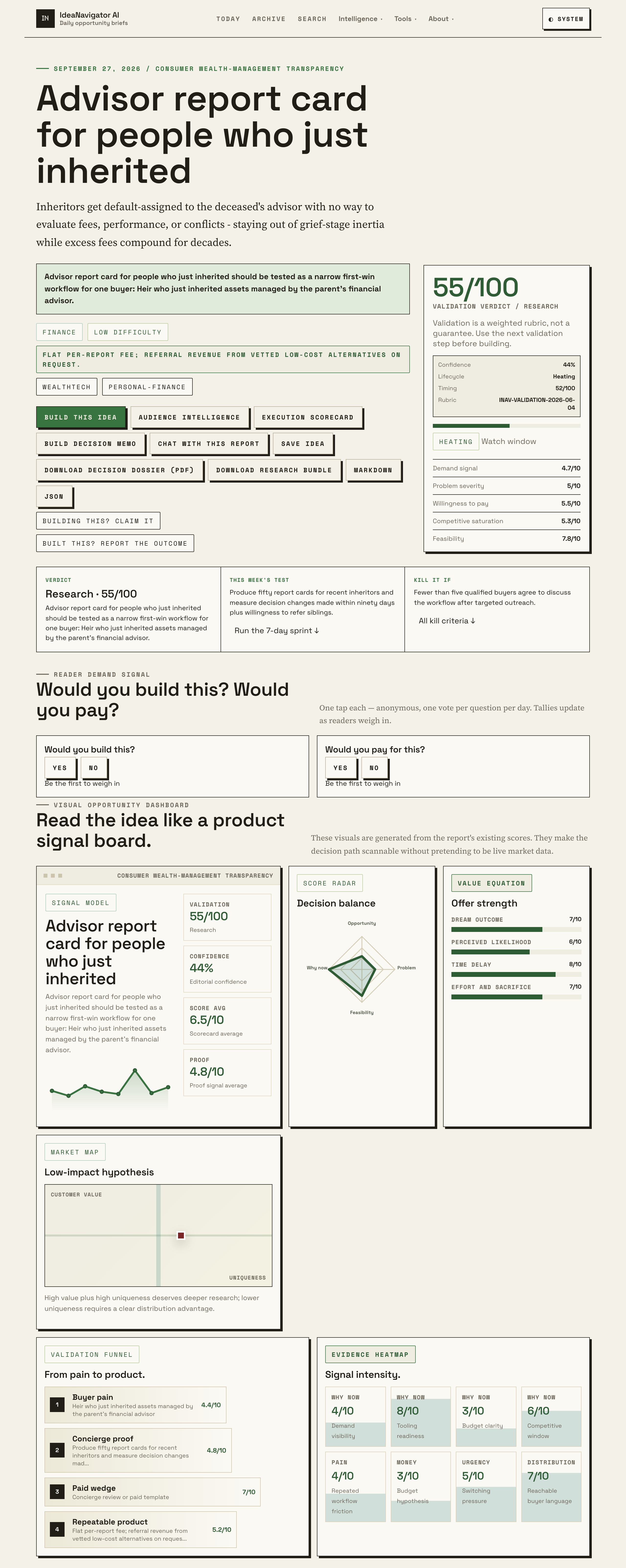
IdeaNavigator AI describes a proposed service that would help recent inheritors assess the financial advisor who managed their inherited assets. The concept would analyze regulatory disclosures and account statements, but it remains an idea to validate, not a launched product or proven service.
IdeaNavigator AI has proposed testing an advisor report card for people who have recently inherited assets managed by a parent’s financial advisor. The concept would help heirs review fees, performance and disclosed conflicts before deciding whether to keep, negotiate with or replace the advisor; no product launch or test results are reported.
The proposed service targets a specific situation: an heir inherits assets that remain with the deceased parent’s advisor and may feel little basis for evaluating that relationship. IdeaNavigator AI says the report card would let a user enter the advisor’s name and upload account statements. It would then gather regulatory history and disclosed conflicts, interpret fees visible in the statements, and compare the advisor with alternatives.
The planned output would include guidance to stay, negotiate or switch, along with scripts for conversations with the advisor. The proposal does not describe how the service would calculate investment performance, select comparison firms or account for differences in services and risk. Those details would affect how useful any comparison could be.
The suggested business model combines a flat fee per report with referral revenue if a customer asks for vetted, lower-cost alternatives. IdeaNavigator AI proposes producing 50 reports for recent inheritors, then tracking whether customers make a decision within 90 days and whether they would refer siblings. The proposal gives no results from that test.
A Check on Inherited Advice
For heirs, the immediate issue is whether they can make an informed choice about a financial relationship they did not select. A clear account of costs and potential conflicts could give them specific questions to raise, or help them decide whether to seek another opinion. The idea focuses on reducing the effort required to examine documents and disclosures at a time when an inheritance may bring competing personal and financial demands.
The service’s practical value would depend on the accuracy and completeness of its analysis. A fee figure alone cannot show whether advice is worth its cost; comparisons also need to reflect the work performed, the assets involved and the client’s circumstances. A report that recommends alternatives while earning referral revenue would also need to explain how those referrals are chosen and paid for. The proposal identifies the revenue stream but does not set out those safeguards.
For the broader market in wealth-management transparency, the concept tests whether consumers will pay for an independent-feeling review of an advisor relationship. Its proposed 90-day measure looks for actual decision changes, while referrals to siblings would offer one indication of whether users find the report useful. Neither measure has been reported yet.
Why Inherited Accounts Matter
When assets pass to an heir, the advisor who managed them for the deceased may already be involved. The proposal says inheritors can default to that advisor without a straightforward way to evaluate fees, performance or conflicts. It argues that grief and inertia could contribute to a decision to stay, while costs continue over time. That is the proposal’s description of the problem; it provides no data quantifying how often heirs keep an advisor for those reasons or the fees they pay.
IdeaNavigator AI points to two developments behind the concept: a large transfer of wealth to heirs expected over the coming decade, and the availability of public regulatory information such as Form ADV and fee disclosures. It also proposes using language-model tools to parse documents. The outline does not provide a market-size estimate, document-validation results or evidence that automated extraction can reliably capture every relevant charge and conflict.
Questions Before a Trial
The proposal does not establish that the service exists or that any reports have been produced. It names a 50-report validation exercise but gives no start date, operating details or findings. There is also no stated price for a report, description of how uploaded financial documents would be stored, or explanation of how errors in extracted fees would be checked.
Other open questions concern the advice itself. The outline does not say who would review the report, what data would support performance comparisons, or how the service would distinguish investment costs from advisory fees and other charges. It also does not explain how referral payments would be disclosed or whether they could affect the alternatives shown. Until those points are addressed, readers cannot assess the accuracy, independence or likely cost of the proposed guidance.
Testing the Report Card
The next step described by IdeaNavigator AI is to produce 50 report cards for recent inheritors and monitor decisions over the following 90 days. The proposed test would also ask whether users would refer siblings. No launch date or public release schedule is provided, and the outline does not say how participants would be recruited or how a decision would be counted.
If the test proceeds, its results could show whether heirs use the analysis to stay, negotiate or move assets, and whether they consider the report worth sharing. A meaningful assessment would also need to explain how fee estimates and comparisons were checked, and how referral revenue is disclosed. For now, the report card is a proposed consumer-finance product whose demand and reliability remain untested.
Source: IdeaNavigator AI
Key Questions
Has the advisor report card launched?
No launch is reported. IdeaNavigator AI describes a proposed service and a plan to test it with recent inheritors.
What would the report review?
The concept would gather an advisor’s regulatory history and disclosed conflicts, examine fees in uploaded account statements, and compare the advisor with alternatives. The proposal does not explain the detailed comparison method.
What would the service cost?
The proposed business model includes a flat fee for each report, but no price is given. The concept also suggests referral revenue when users request lower-cost alternatives.
How would the idea be tested?
IdeaNavigator AI proposes making 50 reports for recent inheritors and tracking decision changes within 90 days, as well as users’ willingness to refer siblings. No test results or schedule are stated.
Source: IdeaNavigator AI
Fall Picks
fall essentials
As an affiliate, we earn on qualifying purchases.