
📊 Full opportunity report: Building A Safe Foundation: Security Layers For AI Agent MCP Servers on IdeaNavigator AI — validation score, market gap, and execution plan.

Get hardware and tech essentials delivered free — and shop member deals
- Fast, free delivery on millions of items
- Access to Prime Big Deal Days deals on October 6–7
- Prime Video, Amazon Music and more included
TL;DR
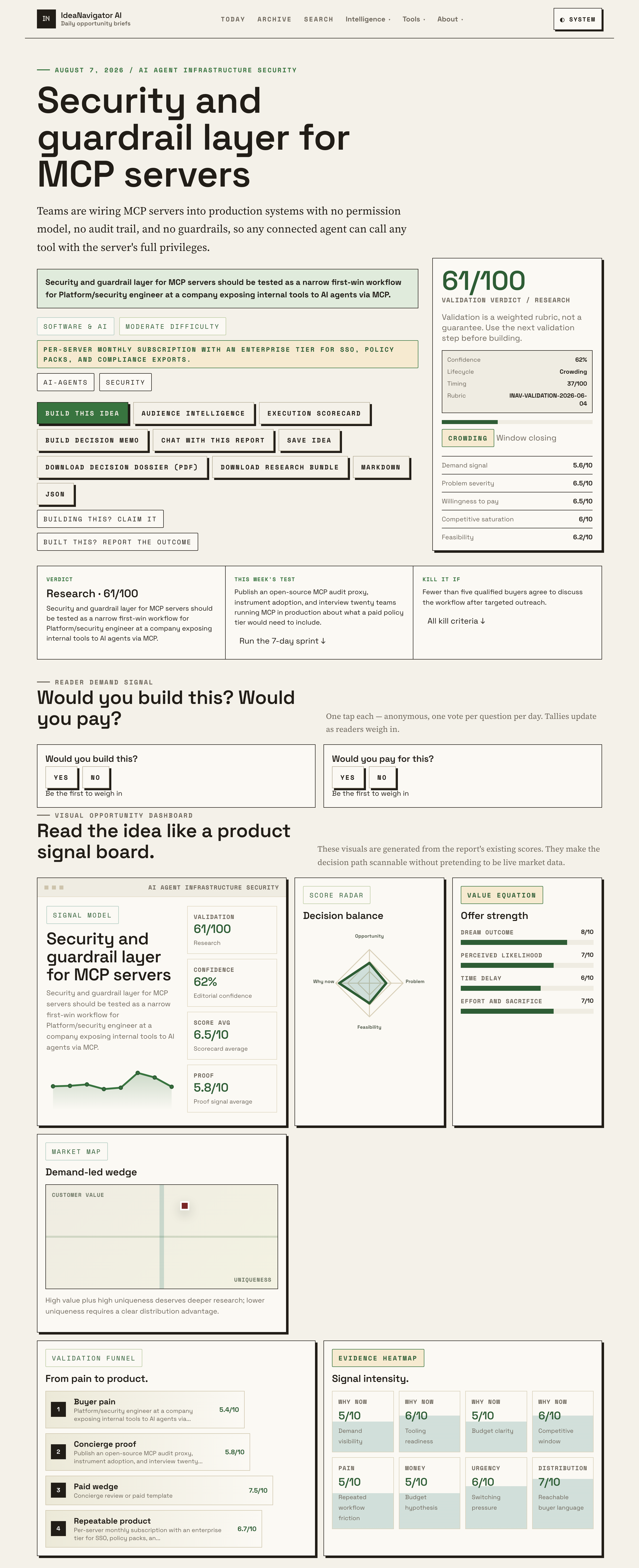
A security proxy for MCP servers is in development to introduce permission management, audit logging, and safety controls. This aims to mitigate security risks as enterprises rapidly deploy AI agents.
Security measures for MCP servers are being enhanced through the development of a proxy that adds permission controls, audit logging, and safety gates, addressing increasing security concerns in enterprise AI deployments.
The initiative focuses on creating a proxy layer that sits in front of existing MCP servers, introducing features such as per-tool allowlists, per-agent identity verification, human approval for destructive actions, rate limiting, and a searchable audit log of all tool calls, according to IdeaNavigator AI.
This approach aims to address the current security gaps where MCP servers are integrated into production systems without permission models or audit trails, leaving them vulnerable to malicious or accidental misuse. The proxy is intended as a minimal viable product (MVP) to test these security enhancements in real-world environments.
Security and platform engineers at companies using MCP are the primary target for this solution, which is being developed as an open-source audit proxy. The project plans to validate adoption through interviews with twenty teams and to explore enterprise features like SSO, policy packs, and compliance exports for future paid tiers.
Implications for Enterprise AI Security
This development is significant because it addresses a critical gap in securing AI agent infrastructure, which has become a high-priority concern as enterprises deploy MCP servers at a rapid pace. By adding layered security controls, the proxy aims to prevent tool abuse, unauthorized access, and destructive actions, reducing the risk of security breaches that could compromise sensitive internal systems.
As AI deployments grow more complex and integrated into core business operations, establishing robust security layers is essential to prevent exploitation via prompt injections or malicious tool calls, making this a key step toward safer AI infrastructure.
As an affiliate, we earn on qualifying purchases.
Background of MCP Security Challenges
Since becoming the standard for agent-tool integration in 2025-2026, MCP servers have seen widespread adoption across enterprises. However, many organizations have integrated MCP without comprehensive permission models, audit trails, or guardrails, creating vulnerabilities. Recent documented attack vectors include prompt-injection-driven tool abuse, which can lead to data leaks or system sabotage.
Security experts and platform engineers have raised concerns about the lack of built-in safeguards, prompting efforts to develop middleware solutions that can add control and visibility without requiring complete redesigns of existing MCP setups. The current focus is on creating a proxy that can be easily deployed and integrated into existing workflows, serving as a first-line defense as security reviews struggle to keep pace with rapid deployment.
This initiative reflects a broader industry trend toward securing AI infrastructure as adoption accelerates and security threats become more sophisticated.
“The security layer being developed aims to provide essential controls that are currently missing in MCP deployments, such as permission management and audit logging.”
— an anonymous researcher
enterprise permission management tools
As an affiliate, we earn on qualifying purchases.
As an affiliate, we earn on qualifying purchases.
Unanswered Questions About Deployment and Adoption
It is not yet clear how quickly the open-source MCP audit proxy will be adopted by enterprises, or what specific enterprise features will be included in paid tiers. Additionally, the effectiveness of the proxy in preventing sophisticated attack vectors remains to be validated through real-world testing.
Further details about integration complexity, performance impacts, and long-term security guarantees are still emerging, and industry feedback will shape future iterations.
audit logging software for AI servers
As an affiliate, we earn on qualifying purchases.
As an affiliate, we earn on qualifying purchases.
Next Steps for Testing and Industry Feedback
The development team plans to publish the open-source MCP audit proxy soon and begin instrumenting early adoption within select enterprise environments. Feedback from these initial deployments will guide the addition of enterprise features like SSO and policy management. Follow-up interviews with teams using MCP will help refine the product roadmap and security controls, with broader deployment expected in the coming months.
As an affiliate, we earn on qualifying purchases.
Key Questions
What is the main purpose of the new security proxy for MCP servers?
The proxy aims to add permission controls, audit logging, rate limits, and human approval gates to improve security and control over AI agent tool calls.
When will the open-source MCP audit proxy be available for testing?
The developers plan to publish the proxy soon, with early testing phases beginning shortly after.
Will enterprise features be part of a paid version?
Yes, features like SSO, policy packs, and compliance exports are planned for future paid tiers, based on enterprise feedback.
How effective will this security layer be against sophisticated attacks?
Effectiveness will depend on real-world deployment and testing; initial development aims to address common attack vectors like prompt injection and tool abuse.
What are the main challenges in deploying this security solution?
Challenges include integrating with existing MCP setups, minimizing performance impacts, and gaining enterprise trust for adoption.
Source: IdeaNavigator AI
Fall Picks
fall essentials
As an affiliate, we earn on qualifying purchases.