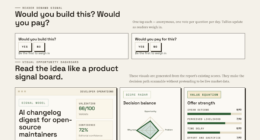
📊 Full opportunity report: The Model Is Only 10%: The Real Lesson of the New SDLC on ThorstenMeyerAI.com — validation score, market gap, and execution plan.
TL;DR
A recent Google whitepaper emphasizes that in AI-assisted software development, the model itself is only 10% of the system. The focus should be on harness design and context engineering, which drive behavior and cost efficiency.
A new Google whitepaper released in early 2026 states that the AI model constitutes only about 10% of the factors influencing system behavior. The paper argues that the real value lies in the harness and context engineering, which account for the remaining 90%. This challenges common industry assumptions that upgrading models alone drives progress and highlights a shift toward optimizing system configuration and contextual design.
The whitepaper, authored by Addy Osmani, Shubham Saboo, and Sokratis Kartakis, emphasizes that the dominant factor in AI system performance and reliability is the harness—the prompts, tools, rules, and observability layers surrounding the model. Evidence from public benchmarks shows that changing only the harness can significantly improve performance, even with the same underlying model. For example, a coding agent moved from outside the Top 30 to the Top 5 on Terminal Bench 2.0 solely by adjusting its harness, and another experiment improved scores by tweaking prompts and middleware.
The authors argue that costs are driven more by configuration and context management than by the model itself. While vibe coding—quick prompts and minimal review—may seem inexpensive, it results in high token consumption, maintenance challenges, and security vulnerabilities. Conversely, adopting disciplined, agentic engineering practices involves higher initial investment but offers lower marginal costs and better system stability over time.
The model is only 10%
A Google whitepaper argues software’s biggest shift is from writing code to expressing intent. Its sharpest claim: the model you obsess over is the smallest part of the system — the scaffolding around it does the real work.
The clearest map yet of how serious AI development works — and mostly tool-agnostic. But it’s a Google funnel: the concepts are neutral, the on-ramps point to Gemini, Jules & the ADK. If the harness is 90% and it’s yours, your moat and your costs both live there — so own your scaffolding, route across models, and remember: AI amplifies whatever engineering culture it lands in.
Implications for AI Development Strategies
This shift in understanding impacts how organizations should allocate resources in AI development. Instead of chasing the latest model improvements, companies should focus on building robust harnesses and effective context management. This approach offers a more sustainable, cost-efficient path to deploying reliable AI systems, especially as the industry moves toward more complex, integrated workflows.
AI-Powered Web Design Mastery: Harness the Power of Framer AI to Build, Customize, and Launch Stunning Websites—A Step-by-Step Guide for Beginners and Professionals
As an affiliate, we earn on qualifying purchases.
As an affiliate, we earn on qualifying purchases.
Industry Shift Toward Harness and Context Engineering
Historically, the focus in AI development has been on acquiring and deploying larger, more powerful models. However, recent benchmarks and experiments demonstrate that configuration and system design—including prompt engineering, tool integration, and context management—are often the primary determinants of success. The whitepaper situates this insight within a broader trend of moving from model-centric to system-centric AI development, aligning with industry reports of widespread AI adoption and increasing complexity.
“The model is only 10% of what determines behavior; the harness is 90%. The real work is in configuration, context, and verification.”
— Addy Osmani

AI Engineering: Building Applications with Foundation Models
As an affiliate, we earn on qualifying purchases.
As an affiliate, we earn on qualifying purchases.
Remaining Questions About Implementation and Impact
While the whitepaper presents strong evidence that harness and context are critical, it does not specify how organizations should best structure these components across diverse use cases. The long-term effects of this shift on model development priorities and industry standards remain unclear, as does the precise impact on AI safety and security practices.
AI-Powered Observability: From Noise to Insight: Transforming How We Monitor, Detect, and Respond
As an affiliate, we earn on qualifying purchases.
As an affiliate, we earn on qualifying purchases.
Next Steps for Industry Adoption and Research
Organizations are expected to reevaluate their AI development strategies, emphasizing harness design, context engineering, and verification processes. Further research will likely explore standardized frameworks for harness construction and best practices for scalable context management, shaping the next phase of AI system engineering.

#1 Indoor Air Quality Test Kit by Detekt – (12) Screening Tests 6 Mold Tests + 6 Bacteria Tests – Test HVAC & Surfaces – DIY Mold Testing – Species Identification Guide & Consultation – Made in USA
Made in the USA – Trusted Quality & Customer Service: Each Detekt Test Kit is proudly made and…
As an affiliate, we earn on qualifying purchases.
As an affiliate, we earn on qualifying purchases.
Key Questions
Why is the model only 10% of system behavior?
According to the whitepaper, system behavior is primarily determined by how the AI is configured and the context provided. The model is just the core engine; the surrounding scaffolding and management layers shape its output significantly.
What does this mean for AI developers?
Developers should focus more on building robust harnesses, designing effective context management, and implementing verification processes, rather than solely chasing larger or newer models.
Will this reduce the importance of model improvements?
While model improvements remain valuable, the whitepaper suggests that system design and configuration will have a greater impact on performance and cost-efficiency in practical deployments.
How does this affect AI safety and security?
Better harness and context management can improve safety by reducing vulnerabilities and ensuring more predictable behavior, but the whitepaper notes that security considerations must be integrated into system design.
What should organizations do now?
Organizations should assess their current AI workflows, invest in developing strong harnesses and context engineering, and prioritize verification processes to optimize costs and reliability.
Source: ThorstenMeyerAI.com