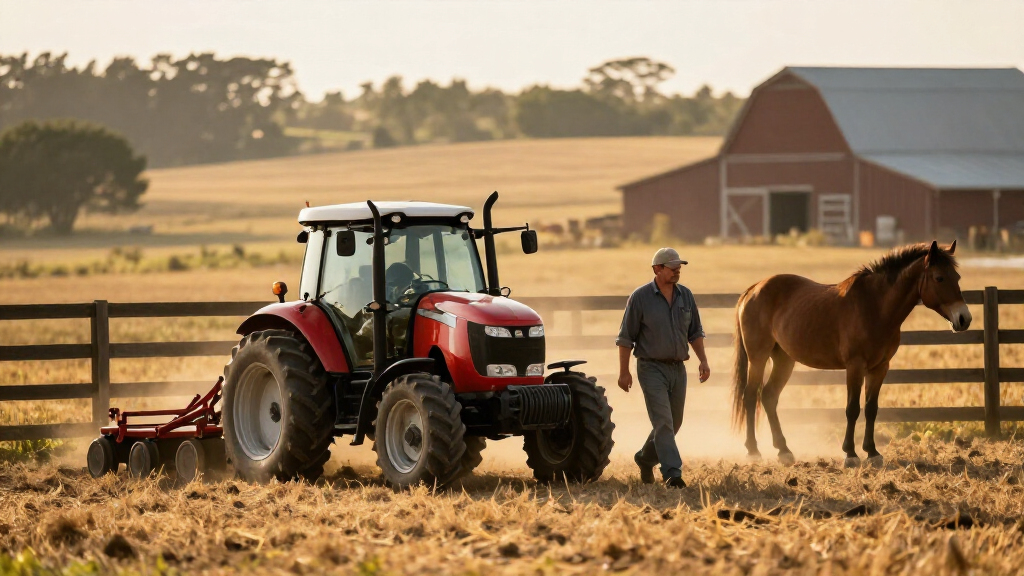

🔍 Read the full analysis: How The Tractor Changed The Role Of The Farm Horse on ThorstenMeyerAI.com

Get hardware and tech essentials delivered free with Prime
- Fast, free delivery on millions of items
- Prime Video, Amazon Music and more included
- Member-only deals all year
TL;DR
U.S. horses and mules on farms peaked at 26.7 million in January 1918, then declined as tractors and other machines spread. By 1960, the count was 3.1 million, and land once used to grow animal feed could be used for other crops. The change reshaped farm employment, but the horse-to-tractor comparison does not by itself establish what automation will mean for human workers.
Tractors displaced most working horses and mules on U.S. farms over the first half of the 20th century, with the farm-animal count dropping from 26.7 million in January 1918 to 3.1 million in 1960. A report published November 4, 2026, by ThorstenMeyerAI.com describes the shift as a major change in farm production that also reduced the acreage devoted to animal feed and changed where farm workers found jobs.
The figures cited in the report come from the U.S. Census Bureau’s 1975 edition of Historical Statistics of the United States, Colonial Times to 1970, which reprints Department of Agriculture estimates. Horses alone peaked at 21.4 million in 1915. Mules continued to increase, bringing the combined total to 26.7 million on January 1, 1918: 21.2 million horses and 5.5 million mules.
Those animals required substantial feed. In 1915, about 93 million acres of harvested cropland—out of 340 million acres in total—grew crops for horses and mules, according to the figures. The report says the feed acreage was still about 90 million in 1920, but had fallen to roughly 5 million by 1960. Tractors, unlike working animals, did not need land planted to feed them year-round.
Tractor numbers rose quickly after the Fordson entered the market in 1917. The Henry Ford museum describes the Fordson as “the first mass-produced and inexpensive lightweight tractor” and says it was built for small farmers. U.S. farm tractor counts rose from about 1,000 in 1910 to 246,000 in 1920 and 4.69 million in 1960. Around 1955, the report’s data show tractors outnumbered horses and mules: 4.35 million to 4.31 million.
The Land and Labor Behind Mechanization
The change involved more than replacing one source of farm power with another. As horses and mules disappeared from farms, acreage previously used to feed them could be planted for other purposes. Mechanization also helped raise the amount of food produced per farm worker: the Department of Agriculture estimate cited in the report rose from 7.1 people supplied per worker in 1910 to 47.1 in 1970. The 1970 figure includes people abroad supplied through exports.
Farm employment fell during the same broad period. The report gives a peak of 13.6 million U.S. farm workers in 1916 and 4.5 million in 1970, while the overall U.S. labor force doubled. Those figures show a major movement of work away from farms, but they do not establish that tractors alone caused the employment decline. The report also points to other machinery, including combines, corn pickers, balers and milking machines, as well as fertilizer and improved seed.
The history matters to current debates about automation because it offers an example of technology changing both jobs and the resources used to produce goods. It is not a direct forecast for workers in other industries: farms, labor markets and the available alternatives differ, and the animal-to-machine comparison has limits.
Products Worth Considering

Apple MacBook Air 15-inch with M5 chip, 16GB Memory, 512GB SSD, and Liquid Retina Display

Trezor Safe 5 Crypto Hardware Wallet with Color Touchscreen, Black Graphite

Logitech MX Keypad Programmable Macro Pad for Developers, Graphite
As an affiliate, we earn on qualifying purchases.
From Horse Power to Tractors
Farm tractors existed before World War I, but early models were heavy, costly and better suited to large farms, according to the report. The Fordson’s 1917 launch helped bring a lighter, less expensive model to smaller operators. On February 21, 1920, the 100,000th Fordson left the assembly line, a milestone the report cites from Henry Ford museum material.
Tractors were part of a wider wave of farm mechanization. Combine harvesters, which cut, thresh and clean grain in one pass, rose from about 4,000 on U.S. farms in 1920 to 190,000 in 1940 and 1.042 million in 1960. The report connects those machines with other equipment and agricultural changes that increased output per worker.
The horse comparison also appears in discussions of automation and employment. In 1983, economist Wassily Leontief compared workers to horses replaced by tractors, according to the report. It notes that Leontief also identified a key difference: horses could not vote. The analogy is therefore a way to frame a question about displacement, not proof that human workers will experience the same outcome.
““The first mass-produced and inexpensive lightweight tractor””
— The Henry Ford museum, describing the Fordson
What the Horse Analogy Cannot Show
The historical counts document the decline of farm horses and mules, but they do not isolate how much of the fall in farm employment was caused by tractors. Other machinery and changes in agricultural production occurred alongside tractor adoption, and workers moved into jobs beyond farming. The cited figures do not trace individual workers or establish how their livelihoods changed.
The report also describes modern agricultural automation, including a John Deere 16-camera autonomy kit introduced in February 2025 for tillage on select large tractors, and says China reported that about 74% of ploughing, sowing and harvesting was mechanized in 2023. Those are specific, attributed examples; the material does not provide comparable measures of how widely autonomous systems are used across farms or what their employment effects have been. The degree to which the horse story applies to current human workers remains uncertain.
How Farm Automation Develops
The historical record ends with the horse and mule estimates stopping soon after 1960, according to the report. Current developments to watch include whether autonomous equipment expands beyond selected tasks and large tractors, and whether use spreads to farms of different sizes. The source material provides no timetable for that expansion.
Further evidence on adoption, costs, farm size and employment would be needed to compare today’s automation with the tractor era. For now, the documented history shows a large shift in farm power and land use; it does not determine the scale or pace of future changes to human work.
Key Questions
How many horses and mules worked on U.S. farms at the peak?
The report cites a combined peak of 26.7 million on January 1, 1918: 21.2 million horses and 5.5 million mules.
When did tractors outnumber horses and mules on U.S. farms?
According to the figures in the report, the crossover came around 1955, when there were 4.35 million tractors and 4.31 million horses and mules.
Why did tractors reduce the land needed for animal feed?
Horses and mules needed feed throughout the year, while tractors required fuel when operated. The report says acreage used to grow feed fell from about 93 million acres in 1915 to roughly 5 million in 1960.
Does the history prove that automation will eliminate human jobs?
No. The history records a major decline in farm animals and employment, but it does not show that tractors alone caused the job losses or predict what will happen in other industries. The report presents the horse comparison as an analogy, not a rule.
Source: ThorstenMeyerAI.com