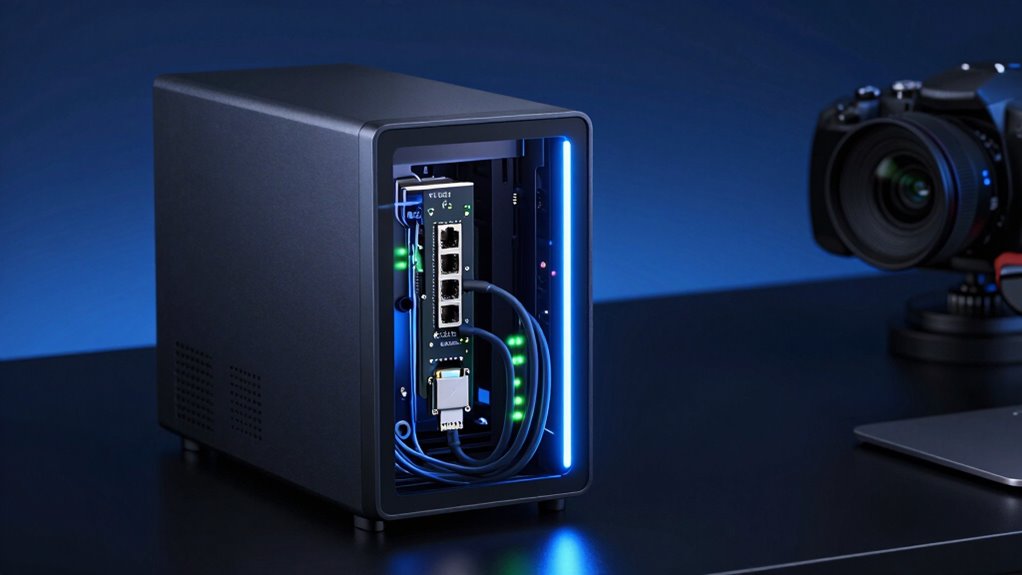

Upgrading to 10GbE instantly boosts your NAS performance by dramatically increasing data transfer speeds, reducing bottlenecks, and enhancing responsiveness. You’ll see faster backups, smoother media streaming, and quicker file access for multiple users. It handles large files effortlessly and future-proofs your setup against growing demands. With the right components, you can experience these improvements right away. Keep exploring to discover how this upgrade can transform your network even further.

Get hardware and tech essentials delivered free with Prime
- Fast, free delivery on millions of items
- Prime Video, Amazon Music and more included
- Member-only deals all year
Key Takeaways
- Dramatically increases data transfer speeds, transforming NAS responsiveness overnight.
- Eliminates network bottlenecks, enabling faster backups and media streaming.
- Requires compatible switches, network cards, and Cat6a or higher cabling for optimal performance.
- Future-proofs the network against growing data demands and high-performance workflows.
- Provides immediate, noticeable performance improvements without replacing existing NAS systems.
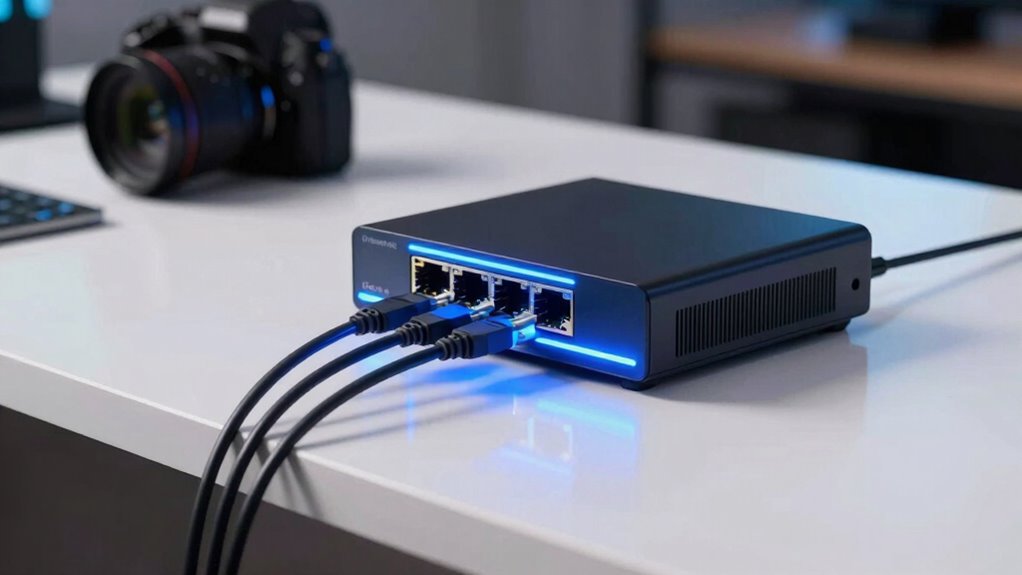
Upgrading to 10GbE can dramatically boost your NAS performance, transforming slow data transfers into lightning-fast operations practically overnight. If you’ve been frustrated with sluggish file access or long backup times, this upgrade targets the root causes—network bottlenecks and limited data transfer speeds—that hold your system back. When your network can’t handle the volume of data you need to move, it creates a bottleneck. Even with a powerful NAS, your performance stalls if your network isn’t up to speed. Switching to 10GbE eliminates this choke point, allowing your data to flow freely and quickly. You’ll notice the difference immediately as large files, backups, and media streams become almost instantaneous.
One of the biggest benefits of upgrading to 10GbE is how it enhances data transfer speeds. Traditional gigabit networks cap at around 125 MB/s, which seems fast but becomes a bottleneck when you’re dealing with multi-terabyte files or multiple users accessing the NAS simultaneously. With 10GbE, you’re looking at potential transfer speeds of up to 1.25 GB/s—more than enough to handle large workloads effortlessly. This means your backup times are cut dramatically, and you can access or transfer files without waiting. For creative professionals, video editors, or anyone working with large media files, this speed boost is a game-changer.
Implementing 10GbE isn’t just about swapping out cables; it’s about rethinking your entire network infrastructure. You’ll need compatible switches, network cards, and cabling—preferably Cat6a or higher—to realize the full benefits. The process is straightforward but requires some planning to ensure all components support 10GbE. Once set up, you’ll immediately feel the difference—your NAS’s responsiveness improves, and the network no longer limits your productivity. This upgrade also future-proofs your setup, as 10GbE is becoming the new standard for high-speed networking, capable of supporting increasing data demands. Additionally, understanding the importance of network infrastructure can help you optimize your entire setup for maximum performance. Investing in quality network components is crucial to fully harness the potential of 10GbE.
In essence, upgrading to 10GbE addresses the core issues preventing your NAS from reaching its potential. It removes network bottlenecks that slow down data transfer speeds, allowing your system to operate at peak performance. Whether you’re conducting regular backups, sharing large files across your network, or streaming high-definition media, the speed and reliability improvements are undeniable. It’s an investment that pays off instantly, transforming your NAS experience from sluggish to ultra-responsive, all without replacing your entire system.
As an affiliate, we earn on qualifying purchases.
Frequently Asked Questions
How Does 10GBE Compare to Traditional Ethernet Speeds?
You’ll find 10GbE considerably faster than traditional Ethernet, reducing network latency and boosting file transfer speeds. It handles large data loads more efficiently, especially with high-quality cables that guarantee peak performance. As a result, your network becomes more responsive, making tasks like backups and streaming smoother. Upgrading to 10GbE is a smart move for enhanced speed and reliability, especially if you work with large files or multiple devices simultaneously.
What Are the Compatibility Requirements for Upgrading to 10GBE?
You might worry about compatibility, but upgrading to 10GbE is straightforward if your hardware supports it. Make certain your cables are compatible—preferably Cat6a or higher for peak performance. Check that your switch supports 10GbE and has the necessary ports; many modern switches are already compatible. Upgrading is seamless when your NAS, cables, and switch all meet these requirements, enabling faster data transfer speeds instantly.
Will Upgrading to 10GBE Affect Existing Network Security?
Upgrading to 10GbE can impact your network security by requiring you to review network segmentation and adjust firewall settings. As data speeds increase, vulnerabilities may also grow, so you should reinforce network segmentation to isolate sensitive data. Firewall adjustments are essential to control traffic flow and prevent unauthorized access. Staying vigilant and updating security protocols ensures your upgraded network remains protected without compromising performance.
What Is the Typical Cost of a 10GBE Upgrade?
Upgrading to 10GbE typically costs between $300 and $1,000, depending on the hardware you choose. Think of it as investing in a faster highway for your data, reducing network latency substantially. However, keep in mind that higher speeds can lead to increased power consumption. While the investment might seem steep, the boost in performance often outweighs the costs, transforming your network’s efficiency overnight.
How Long Does It Take to Install and Configure 10GBE Hardware?
Installing and configuring 10GbE hardware typically takes a few hours, depending on your cabling infrastructure and familiarity with networking. You’ll need to run new cables, connect switches, and guarantee firmware updates are applied for peak performance. Planning ahead can speed up the process, but expect some time to handle the physical setup, check connections, and configure settings. Overall, it’s a manageable upgrade that can be completed within a day.
As an affiliate, we earn on qualifying purchases.
Conclusion
Upgrading to 10GbE transforms your NAS experience faster than you ever imagined—it’s like switching from a bicycle to a rocket! With lightning-fast data transfer speeds, you’ll wonder how you ever managed without it. Say goodbye to lag and hello to seamless performance that keeps up with your busiest days. Don’t wait—this upgrade is the game-changer that takes your storage to legendary levels. Prepare to be amazed as your NAS becomes an unstoppable powerhouse overnight!
As an affiliate, we earn on qualifying purchases.
As an affiliate, we earn on qualifying purchases.
Halloween Picks
halloween
As an affiliate, we earn on qualifying purchases.