
To build a practical Bitcoin home lab that makes sense, start by selecting energy-efficient hardware like ASIC miners and compatible GPUs to optimize performance and reduce costs. Focus on creating a stable environment with proper cooling, reliable power supplies, and a secure network setup. Customize your hardware to match your goals and skills, and continuously adjust for better efficiency. Keep exploring these strategies, and you’ll uncover how to maximize your mining gains and deepen your understanding of blockchain technology.
Key Takeaways
- Select energy-efficient hardware like low-power ASIC miners and compatible GPUs or CPUs to optimize profitability and reduce costs.
- Prioritize proper cooling, stable power supplies, and reliable network setups to ensure hardware longevity and consistent performance.
- Customize hardware configurations based on goals, budget, and skills, avoiding reliance on pre-built solutions.
- Continuously monitor and upgrade components to improve efficiency, troubleshoot issues, and adapt to evolving technology trends.
- Focus on a holistic setup that balances hardware performance, energy consumption, and operational stability for sustainable mining.
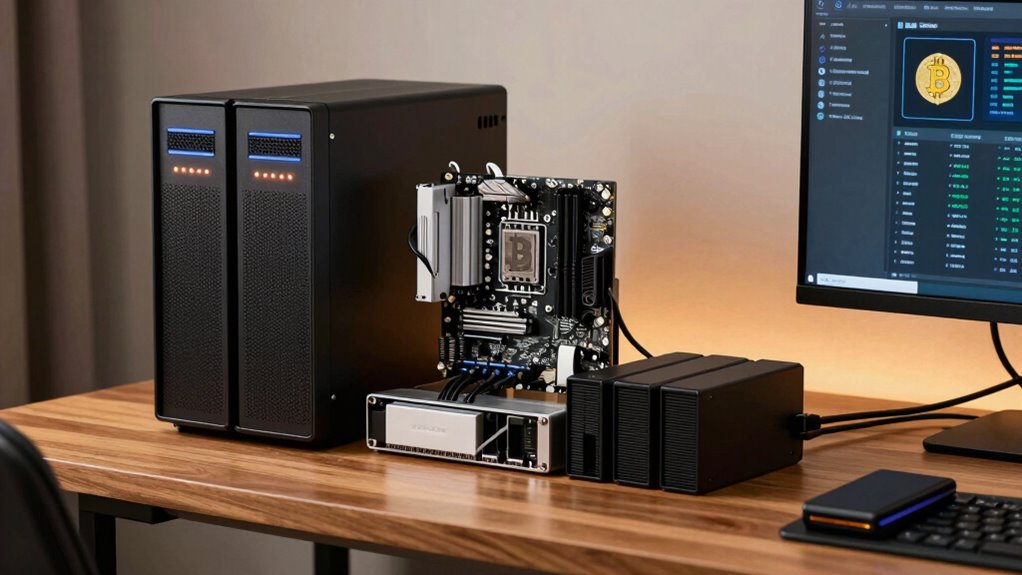
Building a Bitcoin home lab stack empowers you to take control of your digital assets and deepen your understanding of blockchain technology. When you set up your own mining rig, you’re not just participating in the network; you’re actively learning how it works behind the scenes. One key aspect to focus on is mining efficiency. The more efficient your hardware, the better your chances of earning Bitcoin without wasting energy or resources. Choosing the right components allows you to optimize power consumption and hashing power, giving you a competitive edge while keeping operational costs down. Instead of relying solely on pre-built solutions, you can customize your setup to match your goals, budget, and technical skills, guaranteeing that every part of your home lab aligns with your objectives.
Building a Bitcoin home lab enhances understanding, boosts efficiency, and allows for tailored, cost-effective mining setups.
Hardware customization is at the core of building an effective Bitcoin home lab. You can select specific GPUs, ASICs, or CPUs based on their performance, energy efficiency, and price. This flexibility means you’re not locked into generic solutions that might not meet your needs. Instead, you can fine-tune your hardware to maximize mining efficiency, which directly impacts your profitability and sustainability. For example, choosing ASIC miners designed for low power consumption can substantially reduce your electricity bill, especially if you plan to run your setup continuously. Additionally, customizing your hardware setup enables you to experiment with different configurations, helping you learn what works best in your environment. Understanding the importance of hardware efficiency can guide your choices and improve your overall results. Incorporating energy-efficient components from the start can further enhance your setup’s sustainability. Moreover, staying informed about the latest technology trends can help you keep your home lab competitive and up-to-date. Recognizing hardware compatibility is also essential to ensure all components work seamlessly together and avoid potential technical issues. A deeper knowledge of mining hardware also allows you to troubleshoot problems more effectively and optimize your setup over time.
Beyond just hardware choices, a well-designed home lab also involves optimizing cooling, power supply, and network setup. Proper cooling prevents overheating, which can degrade hardware performance and lifespan. A stable power supply ensures consistent operation, minimizing downtime. Networking your rig effectively guarantees seamless data flow, preventing bottlenecks that could hinder mining performance. This holistic approach to customization ensures that every aspect of your setup contributes to better mining efficiency. Over time, you’ll develop a keen understanding of how each component impacts overall performance, allowing you to make informed upgrades and adjustments.
In short, building a Bitcoin home lab isn’t just about acquiring hardware; it’s about crafting a tailored environment where mining efficiency and hardware customization work hand-in-hand. By actively selecting and fine-tuning your equipment, you position yourself for better results, more learning, and a deeper connection to the technology powering Bitcoin. This approach makes your home lab a powerful tool—not just for earning Bitcoin but for understanding the intricate mechanics of blockchain and digital currency.

Canaan Avalon Q Bitcoin Miner 90TH/s SHA-256 ASIC Miner Quiet Bitcoin Miner 1674W 18.6 J/TH Energy Efficient BTC Mining Machine 110V-240V for Home Mining US Plug
- Hash Rate: 90 TH/s with 18.6 J/TH efficiency
- Power Consumption: 1674 W at 90 TH/s
- Energy Efficiency: Lower power cost by 22%
As an affiliate, we earn on qualifying purchases.
As an affiliate, we earn on qualifying purchases.
Frequently Asked Questions
How Much Does Setting up a Bitcoin Home Lab Cost Initially?
Setting up a Bitcoin home lab costs around $1,000 to $3,000 initially, depending on your mining hardware choices. You’ll need a reliable computer, mining rigs, and power supplies, but be aware of energy consumption, which can increase your ongoing costs. Investing in efficient mining hardware helps reduce energy use, balancing your upfront investment with long-term profitability. Remember, costs vary based on hardware quality and setup complexity.
What Are the Best Security Practices for a Home Bitcoin Node?
To guarantee node security, you should keep your software updated regularly and use strong, unique passwords. Enable two-factor authentication where possible and isolate your node from other devices on your network. Implement hardware redundancy by using multiple power supplies and backups, so your node stays online even if one component fails. Regularly monitor your node’s logs for suspicious activity. These practices help protect your node and maintain your Bitcoin network integrity.
Can a Home Lab Support Multiple Cryptocurrencies Besides Bitcoin?
Did you know over 60% of crypto users hold multiple cryptocurrencies? Yes, your home lab can support more than just Bitcoin. By integrating versatile mining hardware and cloud services, you can run nodes for Ethereum, Litecoin, and others. This setup allows you to diversify your portfolio and enhance security. Just make sure your hardware is compatible, and you configure cloud integration properly for seamless multi-cryptocurrency management.
How Often Should I Update or Upgrade My Home Lab Components?
You should update or upgrade your home lab components when hardware compatibility issues arise or when energy efficiency improvements are available. Regularly review your setup to guarantee compatibility with new software or firmware updates, and consider energy-efficient alternatives to reduce power consumption. Typically, a yearly review helps, but if hardware becomes outdated or inefficient, upgrading sooner can enhance performance and save on energy costs.
Is Internet Downtime a Risk for Running a Bitcoin Node at Home?
Internet downtime can be a risk for running a Bitcoin node at home, but you can mitigate this by setting up cloud backup solutions and ensuring power redundancy. With a reliable internet connection, your node stays synchronized, while cloud backups protect your data during outages. Power redundancy, like an uninterruptible power supply (UPS), prevents shutdowns during outages, keeping your node running smoothly and reducing the risk of missing blocks or losing data.

Mining Rig Frame for 12GPU, Steel Open Air Miner Mining Frame Rig Case, Support to Dual Power Supply for Crypto Coin Currency Bitcoin ETH ETC ZEC Mining Tools – Frame Only, Fans & GPU is not Included
- GPU Slots: Supports 6, 8, or 12 GPUs
- Power Support: Supports dual ATX power supplies
- Material: Made of durable stainless steel
As an affiliate, we earn on qualifying purchases.
As an affiliate, we earn on qualifying purchases.
Conclusion
Now that you’ve glimpsed the potential of this Bitcoin home lab stack, imagine what’s possible when you set it up yourself. The secrets it holds could open a new level of control and security over your assets. But there’s more—something just beyond your reach. Are you ready to take the next step? The real adventure begins once you plunge in. Don’t wait too long; what’s waiting on the other side might surprise you.

Antminer L3+ ASIC Cryptocurrency Mining Rig, Dual Fan Cooling System, Silver
- Mining Hardware: Efficient Antminer L3+ ASIC miner
- Cooling System: Dual high-performance fans
- Construction: Durable silver aluminum chassis
As an affiliate, we earn on qualifying purchases.
As an affiliate, we earn on qualifying purchases.

Bitmain Genuine Antminer Power Supply APW7 PSU 1800w 110v 220v New Model for S9 or L3+ or Z9 Mini or D3 ASICs w/ 10 Connectors
- Power Output: 1800W for efficient mining
- Input Voltage: Supports 110V and 220V
- Enhanced Durability: Conformal coating for protection
As an affiliate, we earn on qualifying purchases.
As an affiliate, we earn on qualifying purchases.