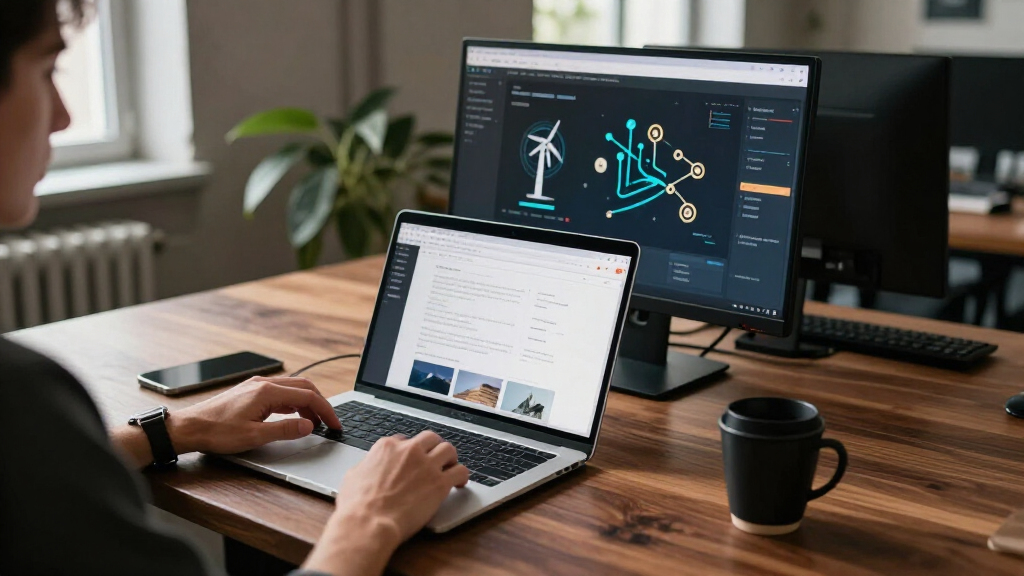

🔍 Read the full analysis: How “TURBINE — WERK 9” Connects AI, Scrolling, And SVG on ThorstenMeyerAI.com

Get hardware and tech essentials delivered free with Prime
- Fast, free delivery on millions of items
- Prime Video, Amazon Music and more included
- Member-only deals all year
TL;DR
TURBINE — WERK 9 is presented as an interactive, field-guide-style web experience built around a rotor that responds to scrolling through an SVG. The project shows how a familiar browser input can guide movement through a designed space, though details about its implementation, AI role and performance are not provided.
TURBINE — WERK 9 is an interactive web field guide built around a scroll-driven SVG rotor, turning a visitor’s movement down the page into part of the experience of exploring an industrial space, as described in the original project analysis. Presented by ThorstenMeyerAI.com, the project connects a familiar browser action with a visual mechanism, though the available description does not specify how artificial intelligence is used, if at all, in the finished interface.
The project is framed as an alternative to a conventional brochure-style page. Rather than only presenting information in a sequence, it invites visitors to explore a digitally rendered environment, with the rotor’s motion tied to scrolling. The page’s field-guide framing gives that movement a purpose: visitors proceed through the experience while encountering an industrial setting translated into a browser interface.
The presentation identifies SVG vector paths as a central part of the design. It describes a combination of browser-based interaction, constructed vector artwork and scrolling as the basis for the responsive effect. The result is intended to make movement through the page feel related to the mechanics of the place, while retaining the clarity of a deliberately designed visual object.
ThorstenMeyerAI.com directs readers to a full design teardown for details on shaping the rotor’s movement, organizing the visual system and translating a physical-feeling environment for the web. It also links to a live version of the project. The summary does not provide technical specifications, production credits or an account of user testing.
Interactive field guide · Web design
How TURBINE — WERK 9 Connects AI, Scrolling, and SVG
TURBINE — WERK 9 turns a familiar browser action into part of an industrial exploration. As visitors scroll, an SVG rotor responds, making movement through the page feel connected to the machine. The described interaction is clear; the project’s use of AI remains unspecified.
“What if a web page behaved less like a brochure and more like a machine you could walk around?”
Project framing · ThorstenMeyerAI.com01 / The interaction
Scroll becomes part of the machine
The design proposition is simple: page movement can contribute to the subject, instead of serving only as a way to pass between blocks of text.
A familiar gesture
Visitors scroll through the experience using a standard browser control. No separate controller is described.
A rotor in motion
The SVG rotor responds to scrolling, connecting a visitor’s movement with the industrial visual language.
Explore a space
The field-guide framing gives the motion a role in exploring a digitally rendered industrial setting.
Scroll
The visitor moves through the page.
Respond
The rotor changes with that movement.
Explore
Motion supports a sense of moving through a place.
Interpret
The interaction echoes the mechanics of its subject.
02 / The visual system
A field guide built for browsers
The presentation names three ingredients: browser interaction, constructed vector artwork, and scrolling. It does not include a step-by-step technical account.
From page to place
Instead of presenting information only as a conventional brochure, TURBINE — WERK 9 frames the browser as a space visitors can explore. Its scroll-linked SVG rotor is the confirmed mechanism at the center of that idea.
03 / What is known
AI role and build details remain open
The project is discussed for audiences interested in AI and automation, but that framing does not establish an AI-powered feature.
Scroll-linked SVG
The available description identifies browser scrolling and SVG vector paths as the basis for the rotor interaction.
AI involvement
No account says whether AI contributed to design, coding, image creation, or operation of the finished experience.
Evaluation and delivery
Browser technologies, accessibility, mobile behavior, performance, user testing, and production credits are not provided.
The presentation outlines the intended experience. The linked teardown is described as the source for more on rotor motion and visual-system decisions.
04 / Continue exploring
The teardown holds the next clues
Readers seeking implementation specifics can follow the full design teardown and inspect the live experience linked from the project presentation.
What is TURBINE — WERK 9?
An interactive web field guide presenting an industrial setting through a rotor-centered browser experience.
How does scrolling affect it?
The rotor is described as scroll-driven, making page movement part of the interaction.
Does it use AI?
The available description does not say whether AI was used in the build or appears as a feature.
Where can I learn more?
ThorstenMeyerAI.com links to a design teardown and a live version of the project.
Scroll Becomes Part of the Machine
The project’s design proposition is that scrolling can do more than move a reader between blocks of text. When a visual element responds to that input, page navigation can also help communicate the character of the place being represented. In TURBINE — WERK 9, the rotor gives the interaction a mechanical reference point, linking the user’s action to an industrial visual system.
That approach may interest designers and developers working with interactive storytelling, SVG and browser automation. It offers a compact example of how an ordinary input can shape the experience without requiring a separate controller. The project’s description presents AI tools and automation fans as part of its audience, but does not establish that AI generated the artwork, controls the rotor or powers the page. The confirmed design detail is the scroll-linked SVG interaction, not a particular AI capability.
The distinction matters because the project is being discussed at the intersection of AI and web design, while its described mechanism is a familiar combination of vector graphics and browser input. Without implementation details, readers cannot tell whether AI played a production role or is simply part of the site’s broader framing. For now, the clearest takeaway is about interaction design: a page’s movement can contribute to its subject rather than serving only as navigation.
Products Worth Considering

Apple MacBook Air 15-inch Laptop with M5 Chip, 16GB Memory, 512GB SSD, Midnight

Logitech MX Brio Ultra HD 4K Webcam

Logitech MX Keypad Programmable Macro Pad, Graphite
As an affiliate, we earn on qualifying purchases.
A Field Guide Built for Browsers
The project’s stated design challenge begins with a comparison: a web page might behave less like a brochure and more like a machine that a visitor can move around. TURBINE — WERK 9 takes that idea into an interactive field-guide format, using the industrial setting as the organizing concept for the online experience.
Its described ingredients are specific but limited: a browser, a set of carefully constructed SVG paths, and scroll as the input. These components support the rotor animation and the sense that the visitor is moving through a space. The project summary does not identify the physical site in detail, provide a release date or describe earlier versions, so those points cannot be established from the presentation.
The name includes “WERK 9,” but the available description does not explain the site’s history or the significance of the number. Nor does it identify individual designers or engineers. The linked teardown is presented as the place to learn more about the visual system and motion design; the project summary itself gives an overview rather than a step-by-step technical account.
“What if a web page behaved less like a brochure and more like a machine you could walk around?”
— ThorstenMeyerAI.com
AI Role and Build Details Remain Open
The project description does not explain whether AI was used in the design, coding, image creation or operation of TURBINE — WERK 9. Its appeal to AI and automation audiences is stated, but that framing is not evidence of an AI-powered feature. The confirmed interactive element is a rotor driven by scrolling and rendered through SVG artwork.
Other practical details are also absent from the summary: the specific browser technologies, accessibility provisions, mobile behavior, loading performance and whether the animation responds continuously or in defined steps. No user-testing results or measures of how visitors interact with the experience are reported. The exact industrial setting and its relationship to any physical location are not described either.
These gaps limit what can be concluded about the project’s technical novelty or effectiveness. The presentation explains the intended experience, but independent performance assessments and the fuller implementation account are not included in the available description.
The Teardown Holds Technical Detail
The next step for readers seeking implementation specifics is the full design teardown linked from the project presentation. It is described as covering rotor motion, visual-system organization and the translation of a physical-feeling space into a browser experience. The live room link offers a way to inspect the interaction directly.
No further release, feature announcement or development milestone is specified. Until a fuller technical account is available, the project can be described as an interactive field guide using scroll-linked SVG, while questions about its AI involvement, technical architecture and evaluation remain open.
Source: ThorstenMeyerAI.com
Key Questions
What is TURBINE — WERK 9?
It is an interactive web field guide that presents an industrial setting through a browser experience built around a rotor animation.
How does scrolling affect the experience?
The project description says the rotor is scroll-driven, making page movement part of the interaction rather than only a way to move between content.
Does the project use artificial intelligence?
The available description does not say whether AI was used in the build or appears as a feature. It identifies SVG artwork, browser interaction and scrolling, but provides no AI implementation details.
What is the rotor made with?
The presentation identifies SVG vector paths as part of the visual system. It does not provide further technical details about the code or animation method.
Where can readers find more information?
ThorstenMeyerAI.com links to a full design teardown and a live version of the project. The teardown is described as covering the rotor’s movement and the design system.
Source: ThorstenMeyerAI.com