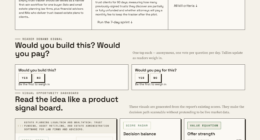

📊 Full opportunity report: IdeaNavigator AI: One Evidence-Mined Idea a Day on ThorstenMeyerAI.com — validation score, market gap, and execution plan.

Get hardware and tech essentials delivered free — and shop member deals
- Fast, free delivery on millions of items
- Access to Prime Big Deal Days deals on October 6–7
- Prime Video, Amazon Music and more included
TL;DR
IdeaNavigator AI autonomously generates and publishes one software idea per day based on mined online complaints. It scores each idea on evidence strength to help validate market demand before building. This approach aims to lower costly failure rates in software development.
IdeaNavigator AI has begun publishing a new software product idea every day, generated and validated entirely through an autonomous pipeline that mines online complaints for genuine demand signals.
The startup has developed an automated system that scours platforms like App Store reviews, Hacker News, GitHub issues, and Stack Overflow for user frustrations and unmet needs. It then transforms these complaints into fully scoped product ideas, which are scored from 0 to 100 based on the strength of the evidence. Only the top ideas receive a ‘Build’ verdict, while most are labeled ‘Validate,’ ‘Research,’ or ‘Rethink,’ helping developers avoid costly investments in weak signals.
This process runs autonomously on a single Mac mini, producing two ideas daily but publicly sharing only one, emphasizing quality over quantity. The system’s goal is to invert traditional idea generation, which often relies on brainstorming without validation, by focusing on real demand signals before any coding begins.
Founded as a spin-off of IdeaClyst, a private validation workspace, IdeaNavigator aims to reduce the high failure rate in software projects caused by building products based on hunches rather than evidence, thus making the process more efficient and less risky.
IdeaNavigator AI — one evidence-mined idea a day
Idea generation is cheap; validation is the bottleneck. Mine real complaints, scope an idea, score it 0–100 — and let the verdict tell you when not to build.
Verdict: Validate. Promising — but a high score is a prior, not a proof. The point of the gauge is the verdicts that say not yet.
Independent commentary, produced with AI assistance under human editorial oversight. The views are the author’s own and may change. IdeaNavigator AI generates, mines and scores ideas via automated pipelines; scores and verdicts are programmatic priors that may contain errors or bias and are not validated demand — verify independently before building. As an Amazon Associate the author earns from qualifying purchases; pages may contain affiliate links. Product and company names are trademarks of their respective owners; mention does not imply endorsement.
How Automated Evidence-Driven Ideas Impact Software Development
This initiative could significantly reduce the costly failure rate in software projects by prioritizing ideas grounded in real user frustrations. By automating the validation process and focusing on evidence, it shifts the industry away from guesswork toward data-backed decision-making, potentially saving startups and established companies millions in development costs.
Moreover, the approach promotes more disciplined product development, where most ideas are filtered out early, leaving only those with proven demand to be considered for building. This could influence best practices across the tech industry, encouraging a move toward evidence-based innovation.
bug tracking and complaint analysis software
As an affiliate, we earn on qualifying purchases.
As an affiliate, we earn on qualifying purchases.
Background of Evidence-Based Idea Generation in Tech
Traditionally, software development relies heavily on brainstorming and market assumptions, often leading to the high failure rate of new products. The cost of building products based on unvalidated ideas is well-documented, with many startups and companies wasting resources on features or products that no one needs.
Recent trends emphasize user feedback and data-driven decision-making, but many tools and processes remain manual, slow, or disconnected from real-time signals. IdeaNavigator’s automation and focus on mining genuine complaints represent a step toward integrating evidence directly into the early stages of product ideation, aiming to reduce risk and improve success rates.
As an affiliate, we earn on qualifying purchases.
It is not yet clear how well the system’s scoring correlates with actual market success or how it performs across different industries and product types. The reliability of mined complaints as demand signals, and whether the filtered ideas will lead to commercially viable products, remains to be seen.
Additionally, the scalability and adaptability of the system in dynamic markets or with evolving online communities are still untested at a broad level.
As an affiliate, we earn on qualifying purchases.
Next Steps for Validating and Scaling the System
The company plans to monitor the performance of ideas published through the system, tracking which lead to successful products or further validation. They may also expand the sources of complaints or refine the scoring algorithm based on real-world outcomes.
Further integration with development workflows and feedback loops from early adopters will be key to assessing the system’s practical impact and potential for wider adoption.
As an affiliate, we earn on qualifying purchases.
Key Questions
How does IdeaNavigator AI identify product ideas?
It mines online complaints from platforms like App Store reviews, Hacker News, GitHub issues, and Stack Overflow to find genuine frustrations and unmet needs, then transforms these into scoped product ideas.
What does the scoring system indicate?
The 0–100 score reflects the strength of the evidence supporting the demand for an idea. Higher scores suggest a stronger signal, with 'Build' being rare and reserved for ideas with the most compelling evidence.
Can this system predict market success?
No, the scoring is a prior based on evidence signals, not a guarantee of success. It helps prioritize where to validate further but does not ensure market acceptance.
Will this replace traditional product development?
It aims to complement existing processes by reducing risky, hunch-based decisions and focusing efforts on ideas with proven demand, but human judgment and additional validation will still be necessary.
Source: ThorstenMeyerAI.com
Fall Picks
fall essentials
As an affiliate, we earn on qualifying purchases.