📊 Full opportunity report: Why CVE-2026-8037 Should Be Your Top Concern In 2026 Cybersecurity Trends on IdeaNavigator AI — validation score, market gap, and execution plan.
TL;DR
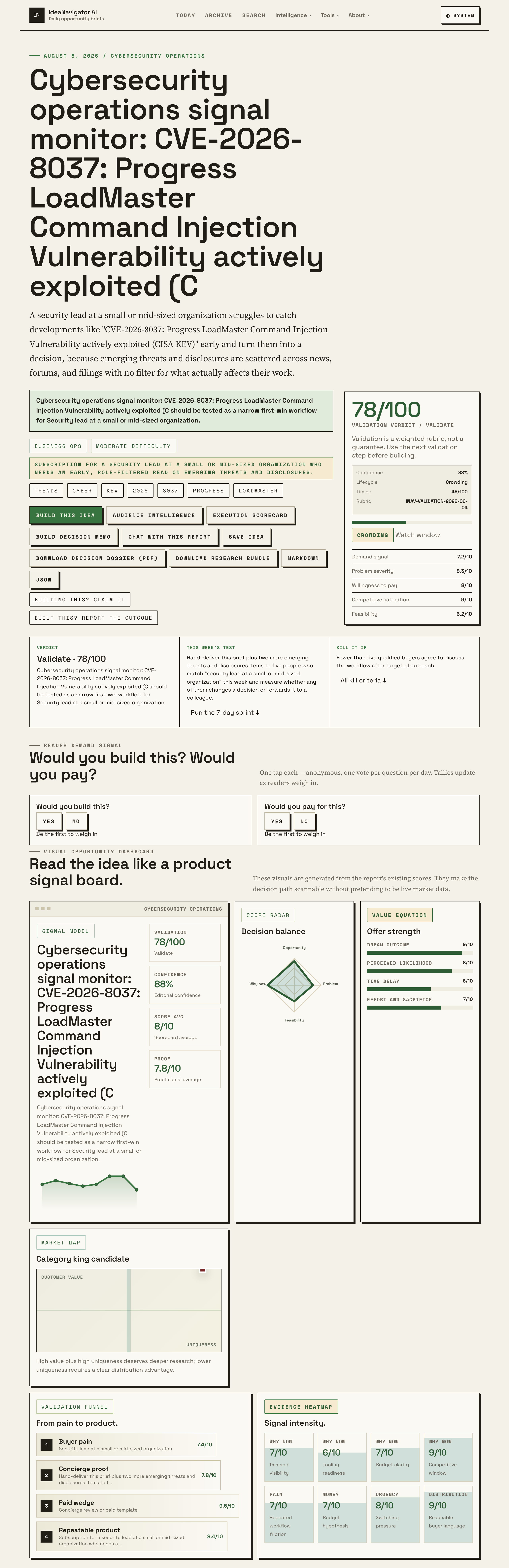
CVE-2026-8037, a command injection flaw in Progress LoadMaster, is currently being exploited. It poses a significant risk to organizations, requiring immediate attention from security teams.
CVE-2026-8037, a command injection vulnerability in Progress LoadMaster, is currently being exploited in active attacks, making it a critical concern for cybersecurity teams in 2026. This development underscores the importance for security leaders at small and mid-sized organizations to prioritize immediate detection and mitigation efforts.
Security researchers have confirmed that CVE-2026-8037 is being actively exploited in the wild. The vulnerability allows attackers to execute arbitrary commands on affected systems, potentially leading to full system compromise. The flaw resides in the LoadMaster application, a widely used load balancing solution, which has seen increased targeting since early 2026.
According to cybersecurity alerts, the exploit is sophisticated but has been detected using specific indicators of compromise, enabling security teams to identify and respond to incidents. The vulnerability was publicly disclosed in early 2026, but its active exploitation now emphasizes the need for rapid patching and monitoring.
Implications for Small and Mid-Sized Organizations
This vulnerability’s active exploitation presents a significant risk to organizations relying on Progress LoadMaster, especially those with limited cybersecurity resources. Successful exploitation can lead to data breaches, service disruptions, and further network infiltration. Given the widespread use of LoadMaster in various industries, the threat underscores the need for immediate action to prevent potential widespread compromise.

NetAlly CyberScope Air Wi-Fi Edge Network Vulnerability Scanner (Wireless Only Version). Validate Edge Infrastructure Hardening, Hunt Down Rogue Devices, Investigate Suspect RF Interference
- Portable Design: Handheld for on-site security testing
- Wireless Discovery & Scanning: Inventory devices and scan for vulnerabilities
- Wi-Fi Spectrum Visibility: Real-time 2.4, 5, and 6 GHz monitoring
As an affiliate, we earn on qualifying purchases.
As an affiliate, we earn on qualifying purchases.
Recent Trends in Exploiting LoadMaster Vulnerabilities
Progress LoadMaster has been a popular choice for load balancing in enterprise and smaller networks. Prior to CVE-2026-8037, the platform had other security issues, but this particular command injection flaw is notable for its active exploitation. Security researchers first identified the vulnerability in late 2025, with public disclosures in early 2026. The rapid shift from disclosure to active exploitation highlights a pattern of increasing threat sophistication and speed.
Industry reports indicate that threat actors are increasingly targeting known vulnerabilities in widely used infrastructure software, aiming for quick gains before patches are applied. This trend makes CVE-2026-8037 especially urgent for organizations to address.
“The active exploitation of CVE-2026-8037 underscores the need for immediate patching and vigilant monitoring.”
— an anonymous cybersecurity researcher
network intrusion detection system
As an affiliate, we earn on qualifying purchases.
As an affiliate, we earn on qualifying purchases.
Remaining Unknowns About Exploitation Scope
It is not yet clear how widespread the exploitation of CVE-2026-8037 is across different sectors or whether specific attacker groups are behind the campaigns. Details about the full scope, including targeted industries and attack methods, are still emerging. Additionally, the effectiveness of current mitigation strategies varies among organizations.
As an affiliate, we earn on qualifying purchases.
Critical Next Steps for Security Teams
Security teams should prioritize applying available patches for LoadMaster and enhance monitoring for indicators of compromise related to CVE-2026-8037. Ongoing threat intelligence updates are expected to clarify the scope of exploitation. Organizations are advised to conduct vulnerability assessments and review incident response plans to prepare for potential attacks.
As an affiliate, we earn on qualifying purchases.
Key Questions
What is CVE-2026-8037?
CVE-2026-8037 is a command injection vulnerability in Progress LoadMaster that is currently being exploited in active cyber attacks.
Why is CVE-2026-8037 a top concern in 2026?
Because it is actively exploited, allowing attackers to execute arbitrary commands and potentially take full control of affected systems, posing a significant risk to organizations.
Who is most at risk from this vulnerability?
Organizations using Progress LoadMaster, especially small and mid-sized companies with limited cybersecurity resources, are at higher risk of exploitation.
What should organizations do now?
Apply available patches immediately, increase monitoring for signs of compromise, and review incident response procedures to mitigate potential damage.
Are there any signs of widespread exploitation yet?
Details about the scope of exploitation are still emerging; it is unclear how widespread or targeted the attacks currently are.
Source: IdeaNavigator AI