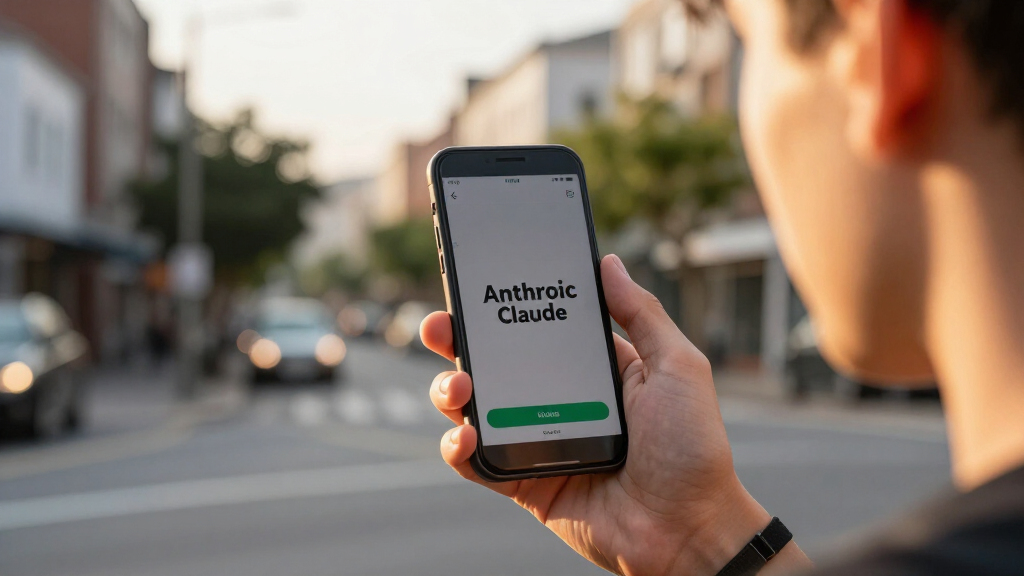

📊 Full opportunity report: Understanding Anthropic’s Claude Watermark: A New Era For AI Marking Methods on ThorstenMeyerAI.com — validation score, market gap, and execution plan.

Get hardware and tech essentials delivered free with Prime
- Fast, free delivery on millions of items
- Prime Video, Amazon Music and more included
- Member-only deals all year
TL;DR
A report indicates Anthropic is exploring a new watermarking method for Claude-generated text, which could impact AI content identification. However, details about its implementation and effectiveness are still unclear.
A report has raised the possibility that Anthropic’s Claude uses a new method for marking generated text, potentially affecting how AI-produced content is identified online. The report does not confirm whether this system has been deployed or how it functions, leaving key details unverified.
The report suggests that Claude might incorporate a watermark—an identifiable signal embedded in AI-generated text—though no technical specifications have been publicly released. It remains unclear if this feature is active across all Claude models or limited to specific versions. The mechanism behind the proposed watermark, whether based on statistical patterns, hidden characters, metadata, or other techniques, has not been disclosed. For more details, see the original analysis. Furthermore, there is no confirmation that Anthropic has officially announced or described such a system.
Experts note that watermarking AI text is technically challenging due to the ease of paraphrasing, editing, or translating content, which can weaken or remove embedded signals. This challenge is discussed in detail in the original analysis. The report emphasizes that current evidence does not prove every Claude response is marked or that detection tools exist at scale. The potential for a watermark to aid in content provenance, plagiarism detection, and platform moderation is significant, but its practical effectiveness remains unproven at this stage.
Implications for AI Content Verification and Transparency
If confirmed and effectively deployed, a watermark in Claude’s outputs could provide a valuable tool for publishers, platforms, and researchers to trace AI-generated content. This could enhance transparency, support efforts to combat misinformation, and facilitate compliance with disclosure policies. However, the lack of technical details and independent testing means the true impact and reliability of such a system are still unknown. Additionally, the absence of evidence that major search engines or moderation tools can detect the watermark limits its immediate practical use.
AI content watermark detection tools
As an affiliate, we earn on qualifying purchases.
As an affiliate, we earn on qualifying purchases.
Background on AI Watermarking Challenges and Developments
Watermarking AI-generated text has long been a goal for developers seeking to distinguish machine-made from human-written content. Previous approaches have included embedding metadata, adjusting token choices to create statistical patterns, or attaching external provenance information. However, these methods face challenges: metadata can be stripped, linguistic patterns may produce false positives, and paraphrasing can weaken signals. Anthropic’s potential development of a watermark in Claude aligns with broader industry efforts to address these issues but remains unconfirmed by official sources. The recent report highlights ongoing debates about the feasibility and reliability of such markers.
“Detecting AI-generated text reliably requires rigorous testing, which is currently lacking for the reported Claude watermark.”
— Technical researcher in AI safety
AI-generated text verification software
As an affiliate, we earn on qualifying purchases.
As an affiliate, we earn on qualifying purchases.
Unconfirmed Details and Testing Limitations of the Claimed Watermark
Several core facts remain unresolved: there is no official confirmation that Anthropic has deployed a watermark system across all Claude models, nor any technical documentation describing how it works. It is also unknown whether the watermark can be removed, how well it survives editing, or if detection tools exist at scale. The accuracy of current detection claims is unverified, and the effectiveness against paraphrased or heavily edited text is uncertain. Until independent testing and official disclosures occur, the existence and reliability of the watermark remain speculative.
As an affiliate, we earn on qualifying purchases.
Awaiting Official Documentation and Independent Validation
The next step involves awaiting formal statements from Anthropic regarding the technical details, scope, and deployment of the watermark. Independent researchers and industry experts will likely conduct testing to evaluate its robustness, detection rate, and resistance to manipulation. The development of standardized detection tools and transparency from Anthropic will determine whether this watermark becomes a practical tool for AI content attribution.
As an affiliate, we earn on qualifying purchases.
Key Questions
Has Anthropic confirmed that all Claude responses are watermarked?
No. There is no official confirmation that every Claude response contains a watermark or that such a system has been deployed across all products.
How might the Claude watermark work?
The exact mechanism has not been publicly disclosed. It could involve statistical patterns, hidden characters, or metadata, but these remain unconfirmed possibilities.
Can search engines detect the reported watermark?
There is no confirmed evidence that search engines recognize or use the watermark as a ranking factor. Its detection, if possible, would depend on future technical developments.
Would a watermark definitively prove a passage was generated by Claude?
No. Detection systems may face accuracy limits, and editing or paraphrasing can weaken signals. Reliable attribution requires documented testing and supporting evidence.
What are the implications for AI transparency and regulation?
If proven effective, watermarks could enhance transparency and accountability in AI-generated content, but their current status remains unconfirmed and untested at scale.
Source: ThorstenMeyerAI.com
Halloween Picks
halloween
As an affiliate, we earn on qualifying purchases.