
🔍 Read the full analysis: What Google’s Android XR Glasses Offer—and The Privacy Questions They Raise on ThorstenMeyerAI.com

Get hardware and tech essentials delivered free with Prime
- Fast, free delivery on millions of items
- Prime Video, Amazon Music and more included
- Member-only deals all year
TL;DR
Google and XREAL launched the XREAL AURA on October 28, 2026, as wired glasses running Android XR with Gemini features. The device can share the wearer’s view with Gemini when enabled, but details about XREAL’s “always-on AI visual processing” and some camera-data handling remain unclear.
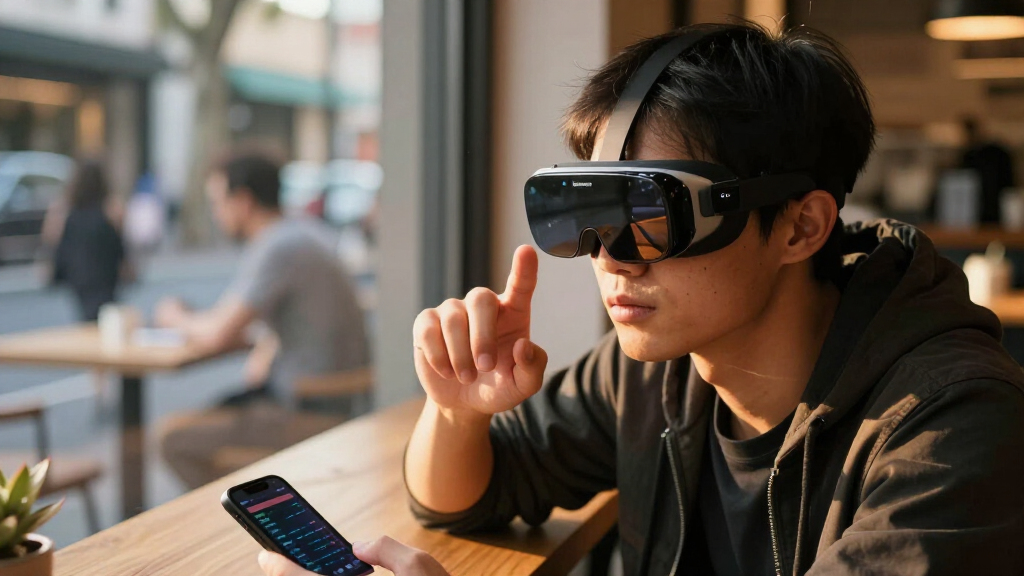
Google and XREAL launched the XREAL AURA on October 28, bringing Google’s Android XR operating system and Gemini assistant to a pair of wired, see-through glasses. Gemini can answer questions about the wearer’s surroundings when view sharing is switched on, a feature that makes the device useful for hands-free help but raises questions about camera use and data handling.
AURA uses two small displays behind transparent lenses, so wearers see the room directly with digital windows layered over it. The glasses weigh under 95 grams and connect by cable to a separate puck, which contains the processor, battery and controls and weighs 265 grams, according to Google and XREAL specifications. The system’s field of view is listed at 70 degrees.
Google and XREAL say users can run Android apps, watch video on a virtual screen, play games and connect a laptop over USB-C. The puck contains Qualcomm’s Snapdragon Reality Elite chip, 12 or 16 gigabytes of memory and a 4,455 mAh battery. The companies have not published an official battery-life figure.
The glasses start at $1,099 for the 12 GB/256 GB model under a limited-time offer, with a 16 GB/512 GB model at $1,299 through December 2026. The stated regular prices are $1,279 and $1,499. Orders opened in the U.S., Canada and South Korea on October 28; Japan orders are scheduled to open November 2. XREAL says shipping is expected from mid-November. Buyers must be 18 or older.
Infographic 01 · XREAL AURA in plain words
Light glasses, a heavy puck, and Gemini in between.
AURA splits the device in two: what has to sit on your face, and what can ride in your pocket. All figures are XREAL’s and Google’s own.
On your head: the glasses
You see the real room through the lenses. The apps float on top.
- Two Sony micro-OLED displays, 1920 × 1200 pixels per eye, up to 120 Hz
- Lenses darken in five steps, by hand or automatically
- Two tracking cameras for your hands and position
- One high-resolution camera with a privacy LED
- Speakers next to each ear, four microphones
- Two sizes for the distance between your eyes, prescription lenses possible
In your pocket: the puck
The heavy parts, on a cable.
- Qualcomm Snapdragon Reality Elite chip (debuts in AURA)
- 12 GB / 256 GB or 16 GB / 512 GB
- 4,455 mAh battery, a small fan
- Touchpad and fingerprint button
- Second USB-C port: power, or a laptop’s video signal (“Wired Mirroring”)
What Gemini does
- Helps across your apps and windows
- With view sharing on: sees your screens and the room
- Can mark an object with a box
Google docs
Makers’ claims
- “3 ms” motion-to-photon latency
- “48 TOPS” of AI processing
- “Always-on AI visual processing” in the X1S chip, not explained
vendor figures
Not published
- An official battery-life figure
- Independent full reviews (only demos so far)
- Prices in Canada, Japan, Korea in this article
XREAL told Android Authority: about 4–5 h of streaming (single source).
A laptop screen you wear like sunglasses, with the computer in your pocket.Thorsten Meyer · my reading
Sources: XREAL specs, accessed 29 Oct 2026; XREAL, 28 Oct 2026; Google, 28 Oct 2026; Android Authority, 6 Sep 2026.
Powered by Thorsten Meyer AI
Gemini Puts the Wearer’s View in Play
AURA brings an AI assistant into a device worn in public, where the camera’s field of view may include other people, workplaces and private surroundings. This shifts privacy decisions from a phone held in a user’s hand to a camera worn at eye level. Bystanders may not know whether the wearer is sharing the scene, and workplace policies may need to address recording or AI-assisted viewing.
Google’s help page advises users to ask permission before including other people in their view. That guidance puts responsibility on the wearer, but does not by itself answer how a bystander can tell when view sharing is active or what safeguards apply to information captured during a session. Those details matter to individuals and organizations deciding whether the glasses are suitable for shared spaces.
The product also offers a different format from enclosed mixed-reality headsets: its transparent lenses leave the real world visible without showing it through cameras. That design may make the glasses feel less isolating, but it does not remove the privacy questions created by a camera and an assistant that can interpret what the wearer sees.
Products Worth Considering

Logitech MX Master 4 for Mac, Ergonomic Bluetooth Mouse with Haptic Feedback, Ultra-Fast Scrolling, USB-C Charging, for MacOS, iPadOS, Windo

Logitech MX Brio Ultra HD 4K Webcam, Graphite

LG UltraGear 32GX870A-B 32-inch 4K OLED Gaming Monitor
As an affiliate, we earn on qualifying purchases.
How AURA Differs From XR Headsets
AURA is a see-through glasses system, rather than an enclosed headset such as Apple Vision Pro or Samsung’s Galaxy XR. Its displays sit behind clear lenses, while a cable connects the frames to a pocketable computing unit. Users can also connect a laptop and place or resize its screen in their field of view, according to the companies.
Google’s help page describes two ways to use Gemini. Without view sharing, users can ask about apps and digital content. When they enable Gemini Live view sharing, the assistant can receive information about both digital content on the device and the physical space visible through it. Google’s example is asking which fruit at a stand has the most fiber, with the glasses able to mark an object on screen.
Google says view sharing is off until the user turns it on in the Gemini app, and users can switch it off. If they disable the setting, the glasses ask for consent before the next share. Google also says Android XR hand-tracking images are processed in real time and deleted, and are not stored on the device or sent to Google. That statement applies to hand-tracking images; it does not settle every question about other camera-related processing.
“Ask people for permission before you include them in your view.”
— Google’s help page, as summarized in its guidance
Camera Processing Needs More Detail
One technical description has not been explained in detail. XREAL says the in-frame X1S chip handles “always-on AI visual processing,” but the source material does not establish what that means for camera operation, the privacy light or data handling. It is also unclear whether any camera processing beyond the stated hand-tracking function takes place locally or sends information elsewhere.
Google’s statements about view sharing and hand-tracking data address specific functions; they should not be read as a blanket explanation of every camera-related process. The launch information also does not provide an official battery-life estimate. Hands-on reports cited in the source were based on supervised demonstrations of pre-release units, not independent long-term use of retail devices.
Retail Shipments and Policy Questions
XREAL says AURA shipments are expected to start in mid-November, with orders opening in Japan on November 2. XREAL has said it plans to bring the glasses to more countries in 2027, but the source material gives no dates or market list for those launches.
As retail units reach customers, clearer documentation on the X1S chip, camera indicators and data flows could help buyers and organizations judge how the device handles sensitive settings. Companies considering workplace use will also need to decide how their existing rules apply to camera-equipped glasses and AI view sharing. Those policies, and any further technical disclosures from Google or XREAL, remain to be seen.
Key Questions
What are Google’s Android XR glasses?
The XREAL AURA, made by XREAL with Google, is a pair of see-through glasses that runs Android XR. A cable connects the glasses to a separate puck containing the processor and battery.
Can Gemini see what the wearer sees?
Gemini can receive the wearer’s view when view sharing is enabled. Google says this can include digital content on the device and physical space visible through it. The feature is off until the user turns it on.
What has Google said about hand-tracking privacy?
Google says images used for Android XR hand tracking are processed in real time and deleted, and are not stored on the device or sent to Google. That statement does not explain all camera processing described for the glasses.
How much does AURA cost and when does it ship?
The limited-time prices through December 2026 are $1,099 for the 12 GB/256 GB model and $1,299 for the 16 GB/512 GB model. XREAL says shipments are expected from mid-November; buyers must be 18 or older.
What privacy issue remains unresolved?
XREAL describes the in-frame X1S chip as handling “always-on AI visual processing,” but the available launch information does not explain what that means for camera operation, the privacy light or data handling.
Source: ThorstenMeyerAI.com