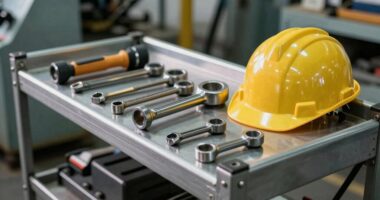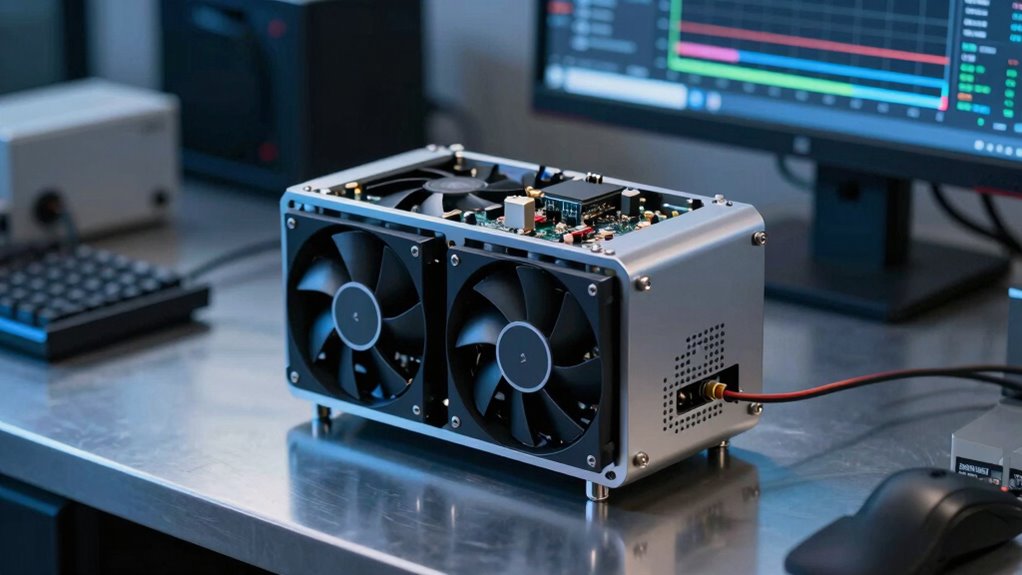

To benchmark your ASIC miner effectively before scaling, start by measuring its current performance under typical workloads, including hash rate, power consumption, and temperature. Confirm compatibility with your existing hardware and infrastructure, checking for energy efficiency and operational costs. Conduct real-world tests over an extended period to assess stability and reliability, then document all results meticulously. Proper benchmarking now helps you optimize your setup and avoid costly issues later—keep going to discover detailed steps you can take.

Get hardware and tech essentials delivered free — and shop member deals
- Fast, free delivery on millions of items
- Access to Prime Big Deal Days deals on October 6–7
- Prime Video, Amazon Music and more included
Key Takeaways
- Conduct consistent, real-world performance tests over a set period to gather accurate data.
- Measure and record hash rate, power consumption, and temperature under typical workloads.
- Evaluate hardware compatibility with existing infrastructure before scaling.
- Analyze energy efficiency and operational costs to determine cost-effectiveness.
- Document performance metrics thoroughly to establish a reliable baseline for future expansion.
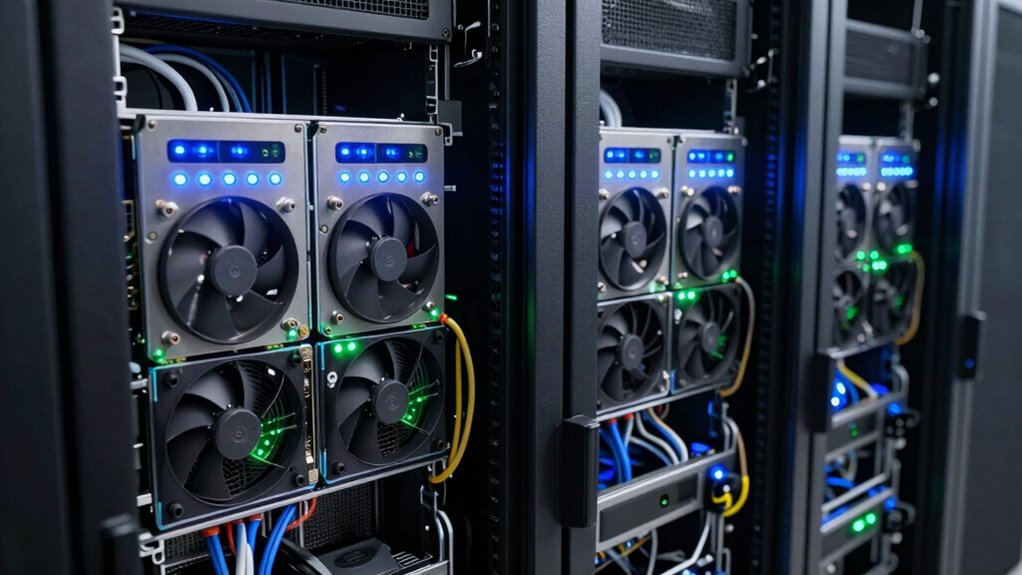
Before scaling up your cryptocurrency mining operations, it’s vital to benchmark your ASIC miners thoroughly. This step guarantees you understand the current performance levels and can identify potential bottlenecks or issues that could hinder larger deployments. One of the key factors to take into account during benchmarking is energy efficiency. Mining consumes significant power, so evaluating how much energy each ASIC uses relative to its hashing power helps you determine which models provide the best return on investment. An energy-efficient miner not only reduces operational costs but also minimizes environmental impact, making it a smarter choice for scaling. Take the time to measure power consumption under typical workloads, and compare these figures across your different units. This process helps you prioritize the most efficient hardware when expanding your mining farm.
Alongside energy efficiency, hardware compatibility plays a critical role in effective benchmarking. Not all ASIC miners are created equal, and some may have compatibility issues with your existing infrastructure. You need to verify that the hardware integrates seamlessly with your power supplies, cooling systems, and management software. Check the specifications for each model for compatibility with your current setup, and test how they perform under real-world conditions. Identifying hardware compatibility issues early prevents costly delays once you start scaling up. It also allows you to plan necessary upgrades or adjustments beforehand, ensuring your larger operation runs smoothly from the start. Additionally, conducting comprehensive testing helps you uncover potential issues that might impact long-term stability. Incorporating performance monitoring tools can further help you track and optimize hardware efficiency over time. Moreover, understanding the energy consumption of each miner during prolonged operations can reveal insights into their ongoing operational costs. Furthermore, it’s essential to verify that your chosen hardware is compliant with relevant regulatory standards to avoid future legal complications.
When benchmarking, don’t just rely on manufacturer data or theoretical performance figures. Conduct real-time tests by running each miner under similar conditions for a consistent period. Record metrics like hash rate, power draw, and temperature. These real-world numbers give you a clearer picture of how each unit performs in your environment, helping you make more informed decisions. Also, consider the stability and reliability of each miner during extended testing. A device that performs well initially but crashes or degrades over time might not be suitable for large-scale deployment. Incorporating long-term performance evaluation into your process ensures you select hardware that remains dependable over time.
Finally, document everything. Keeping detailed records of each miner’s energy efficiency, hardware compatibility, and overall performance ensures you have a solid baseline before expanding. With this data, you can optimize your setup, avoid unnecessary expenses, and ensure the scaling process is both efficient and profitable. Benchmarking isn’t just about testing — it’s about gaining insights that guide smarter, more sustainable growth in your mining operation.
ASIC miner performance benchmarking tools
As an affiliate, we earn on qualifying purchases.
As an affiliate, we earn on qualifying purchases.
Frequently Asked Questions
How Often Should I Benchmark My ASIC Miner During Operation?
You should benchmark your ASIC miner regularly, ideally weekly or after any significant changes to your setup. During these efficiency analyses, monitor power consumption closely to guarantee ideal performance. Frequent benchmarking helps identify performance drops or inefficiencies early, so you can adjust settings or troubleshoot issues. Consistent checks keep your miner running at peak efficiency, saving you money and extending its lifespan while maintaining reliable operation.
What Tools Are Best for Real-Time ASIC Miner Benchmarking?
You’d think finding the best tools for real-time ASIC miner benchmarking would be obvious, right? Surprisingly, specialized software like ASIC-specific monitoring tools, hardware performance analyzers, and energy efficiency trackers are your best bets. These tools help optimize hardware, improve energy efficiency, and identify bottlenecks. Irony aside, they’re essential for fine-tuning your setup, ensuring you get the most out of your hardware without wasting energy or money.
Can Benchmarking Affect the Long-Term Performance of My Miner?
Yes, benchmarking can affect your miner’s long-term performance if you push it too hard or neglect proper settings. Excessive power consumption during benchmarking may strain hardware components, potentially reducing hardware longevity. To protect your investment, use benchmarking results to optimize efficiency without overloading your miner. Regular, balanced benchmarking helps identify issues early, ensuring consistent performance and extending the lifespan of your ASIC miner.
How Do Environmental Factors Influence Benchmarking Results?
Environmental factors like ambient temperature and power fluctuations profoundly impact your benchmarking results. High ambient temperatures can cause your miner to overheat, reducing efficiency and skewing performance data. Power fluctuations can lead to inconsistent operation, making it harder to get accurate benchmarks. To guarantee reliable results, keep the ambient temperature stable and use a consistent power supply, minimizing these environmental influences during benchmarking.
Is It Necessary to Benchmark Multiple Miners Simultaneously?
It’s beneficial to benchmark multiple miners simultaneously because it helps you compare mining efficiency across different units, revealing which hardware performs best under identical conditions. This approach also allows you to identify potential issues that could affect hardware longevity. By testing several miners at once, you get a clearer picture of overall system performance, optimize your setup, and guarantee your investment remains profitable and sustainable over time.
As an affiliate, we earn on qualifying purchases.
Conclusion
Just like testing a new recipe before serving it to guests, benchmarking your ASIC miner guarantees you’re not caught off guard. I once skipped this step and faced unexpected performance issues, much like serving a dish that’s undercooked. Take the time to benchmark—think of it as tasting your dish first. Doing so helps you refine your setup, optimize efficiency, and confidently scale up, turning potential setbacks into a smooth, successful mining operation.
ASIC miner compatibility testing equipment
As an affiliate, we earn on qualifying purchases.
As an affiliate, we earn on qualifying purchases.
mining hardware temperature monitoring
As an affiliate, we earn on qualifying purchases.
As an affiliate, we earn on qualifying purchases.
Fall Picks
fall essentials
As an affiliate, we earn on qualifying purchases.