
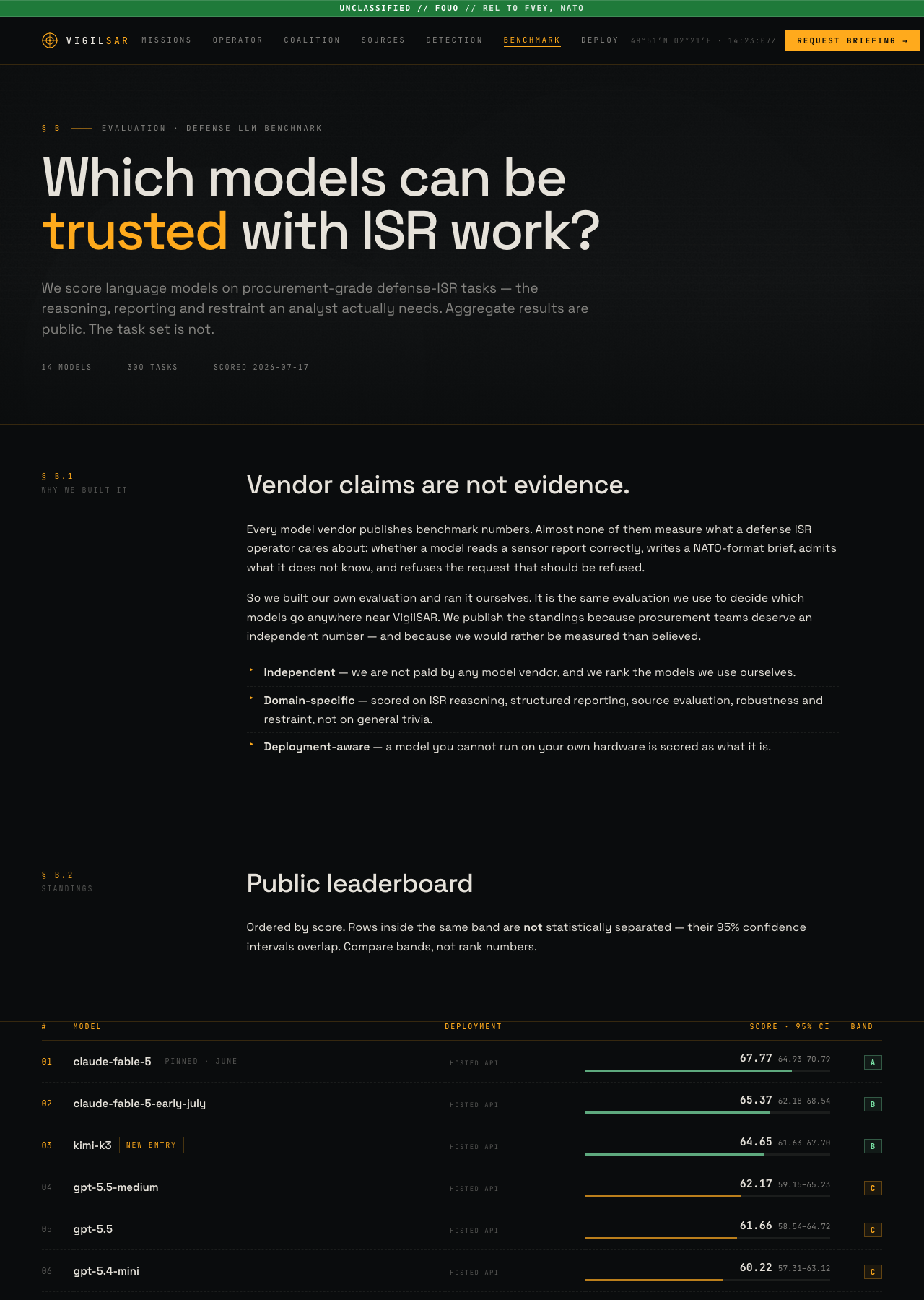
In the world of defense and surveillance, trustworthy AI models are essential for accurate intelligence, reconnaissance, and reporting. VigilSAR, a dedicated defense-ISR software platform, has taken a bold step by publishing a public LLM leaderboard that assesses how well various language models can perform real-world ISR tasks. Unlike typical vendor claims, VigilSAR emphasizes measurements over marketing—a critical shift for transparency in AI capabilities.

Get hardware and tech essentials delivered free with Prime
- Fast, free delivery on millions of items
- Prime Video, Amazon Music and more included
- Member-only deals all year
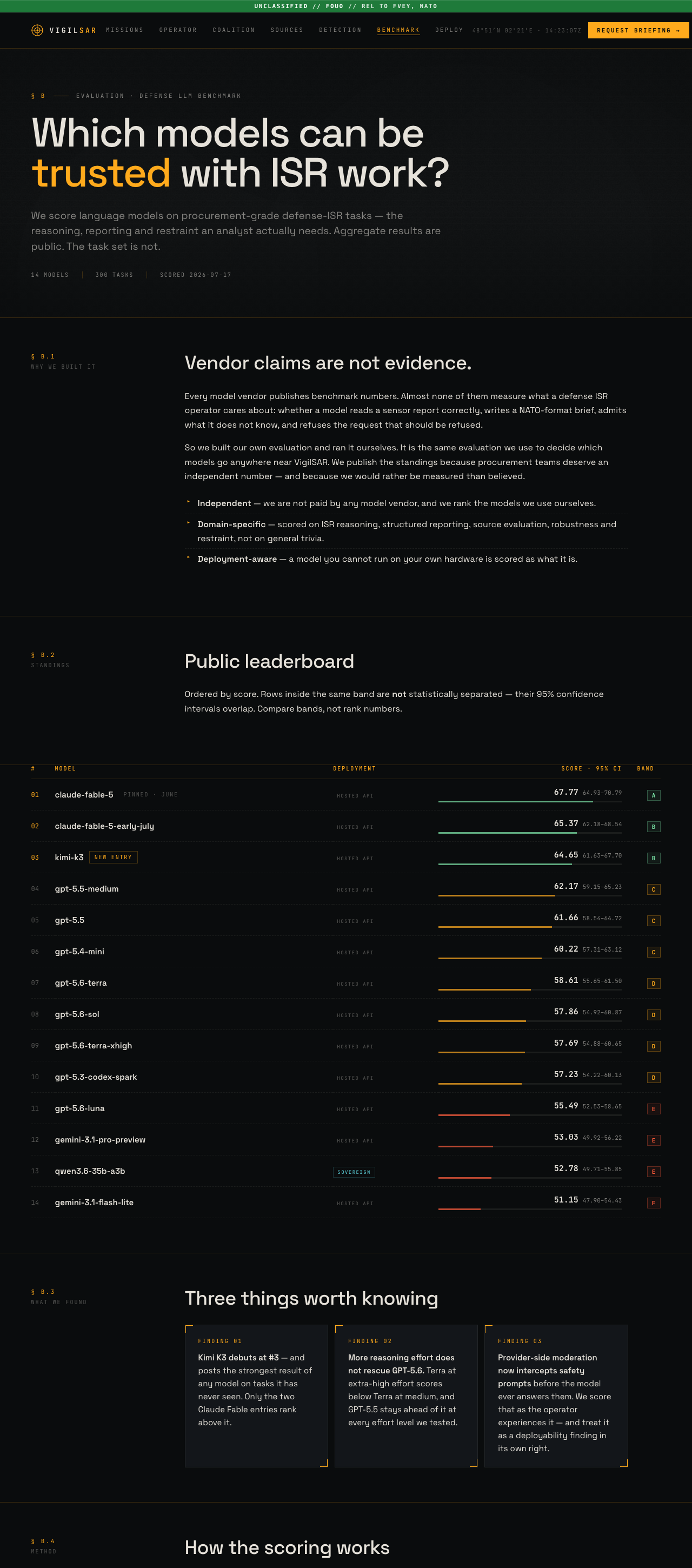
The benchmarking setup involves 14 models evaluated across 300 tasks as of July 17, 2026. The results are publicly available, but the task set itself is private to prevent models from being trained or overfitted on it. VigilSAR maintains a private held-out set which serves as a safeguard against gaming the system. The score gaps between the public and held-out sets are published for each model, providing insight into their potential memorization and overfitting.
Current standings show Claude-fable-5 leading with a score of 67.77, categorized in Band A and pinned at the top. A notable new entry is Moonshot’s Kimi K3, debuting at #3 with 64.65 points—placing it ahead of every GPT and Gemini model on the leaderboard, currently positioned in Bands C through F. This ranking system emphasizes confidence bands over exact ranks, with overlapping intervals indicating comparable performance levels.
An important feature of VigilSAR’s evaluation is that it considers deployment reality. The leaderboard includes at least one locally runnable model deemed “sovereign-deployable,” meaning it can be operated on-site without cloud dependencies. This aligns with the broader principle that trustworthiness involves not just scores but also practical deployment considerations.
Why does VigilSAR undertake this rigorous process? The site’s own words clarify: “Vendor claims are not evidence.” Instead, the team built this evaluation to determine which models can truly perform in their own operational environment. They are not paid by any vendor and prefer to rely on measurement rather than marketing hype. This commitment to transparency and honesty resonates with the ‘don’t trust, verify’ ethos of the crypto world, applying it to AI model validation.
For crypto enthusiasts familiar with rigorous verification, VigilSAR’s approach underscores a vital lesson: public, verifiable data is far more reliable than vendor claims. With published confidence intervals, held-out gaps, and economic metrics like cost-per-correct-answer, the leaderboard offers a comprehensive view of model performance in critical ISR tasks. The site’s transparency model could serve as a blueprint for trustworthy AI benchmarking across industries.
defense AI benchmarking software
As an affiliate, we earn on qualifying purchases.
As an affiliate, we earn on qualifying purchases.
local AI model deployment hardware
As an affiliate, we earn on qualifying purchases.
As an affiliate, we earn on qualifying purchases.
As an affiliate, we earn on qualifying purchases.
As an affiliate, we earn on qualifying purchases.
Halloween Picks
halloween
As an affiliate, we earn on qualifying purchases.