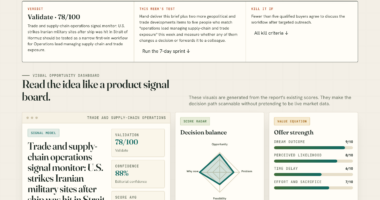

📊 Full opportunity report: The Real Cost Of Free AI: Who Bears The Burden? on ThorstenMeyerAI.com — validation score, market gap, and execution plan.

Get hardware and tech essentials delivered free — and shop member deals
- Fast, free delivery on millions of items
- Access to Prime Big Deal Days deals on October 6–7
- Prime Video, Amazon Music and more included
TL;DR
As AI models become commoditized and nearly free, economic value shifts to physical infrastructure and human oversight. This raises concerns about regional sovereignty and accountability in the AI economy.
Recent industry analysis reveals that as AI models become increasingly commoditized and inexpensive, the economic value shifts away from the models themselves toward the physical infrastructure and human oversight that support AI deployment. This shift has significant implications for regional sovereignty and the distribution of technological power, making the physical capacity to produce and manage AI a critical strategic asset.
Thorsten Meyer, an industry analyst, argues that the core value in AI today is no longer in the intelligence models but in the physical infrastructure—chips, data centers, power supplies—and the human judgment that guides AI application. He emphasizes that the physical capacity to produce and scale AI infrastructure remains scarce and difficult to replicate, unlike the models which can be quickly copied or improved.
According to Meyer, regions that do not control this physical production capacity risk outsourcing their strategic advantage, as the moat of AI sovereignty shifts to physical assets. He highlights that building and maintaining data centers and supply chains requires significant time, investment, and expertise, making them the real currency of AI power.
Additionally, Meyer notes that despite the proliferation of AI models, human oversight remains irreplaceable. People prefer accountability, trust, and responsibility, which are inherently human qualities. The value of human judgment, especially in decision-making and accountability, is likely to grow as AI becomes more prevalent and commoditized.
The forecast is right: intelligence becomes a commodity, cheap and ambient like electricity. But “commodity” is a statement about where value leaves. The whole game is being early to where it goes instead.
▲ Opinion & analysis · not investment adviceWhen the crude is cheap, value moves to the refinery, the trusted name on the deal, and the buyer who can only drink so much. Same shape here.
When a capability becomes abundant and free, we stop exercising it. Some of that is fine. Some of it hollows us out.
knowing which wishes are worth making — and being a person who can still tell.
Physical Infrastructure and Human Judgment Define AI Power
This analysis underscores that economic and strategic power in AI is shifting from model development to ownership of physical infrastructure and human oversight. Countries and companies that control these assets will have a lasting competitive advantage, raising questions of sovereignty and technological independence. For consumers and businesses, it means that cheap AI models do not eliminate the importance of strategic infrastructure or human accountability, which remain scarce and valuable. This shift could reshape global AI leadership and influence geopolitical dynamics, as regions lacking physical capacity may become dependent on external providers, risking loss of control over critical AI applications and data.As an affiliate, we earn on qualifying purchases.
Shift Toward Infrastructure and Human Oversight in AI Economy
The industry forecast over the past decade has predicted that AI intelligence will become a commodity—cheap, abundant, and ubiquitous. This has led many to assume that the value of AI lies solely in the models and algorithms. However, recent insights challenge this view, emphasizing that the real strategic assets are the physical infrastructure—chips, data centers, power supplies—and the human oversight that guides AI deployment.
Historically, control over infrastructure has been a key factor in technological dominance, and AI is no exception. Building large-scale AI infrastructure requires significant investment, time, and expertise, making it a scarce resource. As models become cheaper and more accessible, the competitive advantage will increasingly depend on who owns and controls the physical means of production and the human judgment behind AI applications.
This perspective aligns with recent industry observations that model innovation is rapidly becoming a fungible commodity, while infrastructure and human accountability remain unique and valuable. The geopolitical implications are significant: regions that lack the physical capacity to produce and manage AI infrastructure may become dependent on external providers, impacting sovereignty and strategic autonomy.
"The moat was never the intelligence. The moat is the means of production."
— Thorsten Meyer
As an affiliate, we earn on qualifying purchases.
Uncertainties in AI Infrastructure and Global Impact
It remains unclear how quickly physical infrastructure will be developed in regions currently lacking capacity, and whether geopolitical tensions will accelerate or hinder infrastructure investments. Additionally, the future of human oversight—whether AI can fully replace human judgment in decision-making—remains uncertain. The pace at which physical assets become the dominant strategic resource is also still developing, with potential shifts depending on technological and economic factors.
As an affiliate, we earn on qualifying purchases.
Monitoring Infrastructure Growth and Regulatory Responses
Next steps include tracking investments in AI infrastructure by different regions, especially in Europe, North America, and Asia. Policymakers and industry leaders will need to consider strategies to develop or acquire physical assets to maintain strategic independence. Further analysis will explore how AI regulation and geopolitics influence infrastructure development and control, shaping the future landscape of AI power.
industrial power supplies for data centers
As an affiliate, we earn on qualifying purchases.
As an affiliate, we earn on qualifying purchases.
Key Questions
Why is physical infrastructure more important than AI models?
Because physical assets like data centers, chips, and power supplies are scarce and difficult to replicate, they provide a lasting competitive advantage that models, which can be quickly copied or improved, do not offer.
How does human judgment remain relevant in an AI-driven world?
People value accountability, trust, and responsibility—qualities that are inherently human—and these are essential in decision-making processes, especially in high-stakes or sensitive contexts.
What are the geopolitical implications of this shift?
Regions lacking physical infrastructure risk dependence on external providers, which could impact sovereignty and strategic autonomy, especially if infrastructure development is delayed or politicized.
Will AI models become completely commoditized?
Models are likely to continue becoming more accessible and fungible, but the physical infrastructure and human oversight that support their deployment will remain scarce and valuable.
What should policymakers focus on to maintain AI sovereignty?
Investing in physical infrastructure—such as data centers, chips, and energy capacity—and fostering human expertise and oversight are key to maintaining strategic independence in AI.
Source: ThorstenMeyerAI.com
Fall Picks
fall essentials
As an affiliate, we earn on qualifying purchases.