📊 Full opportunity report: Backyard Home Reports: Ideas For Building An ADU on IdeaNavigator AI — validation score, market gap, and execution plan.

Get hardware and tech essentials delivered free — and shop member deals
- Fast, free delivery on millions of items
- Access to Prime Big Deal Days deals on October 6–7
- Prime Video, Amazon Music and more included
TL;DR
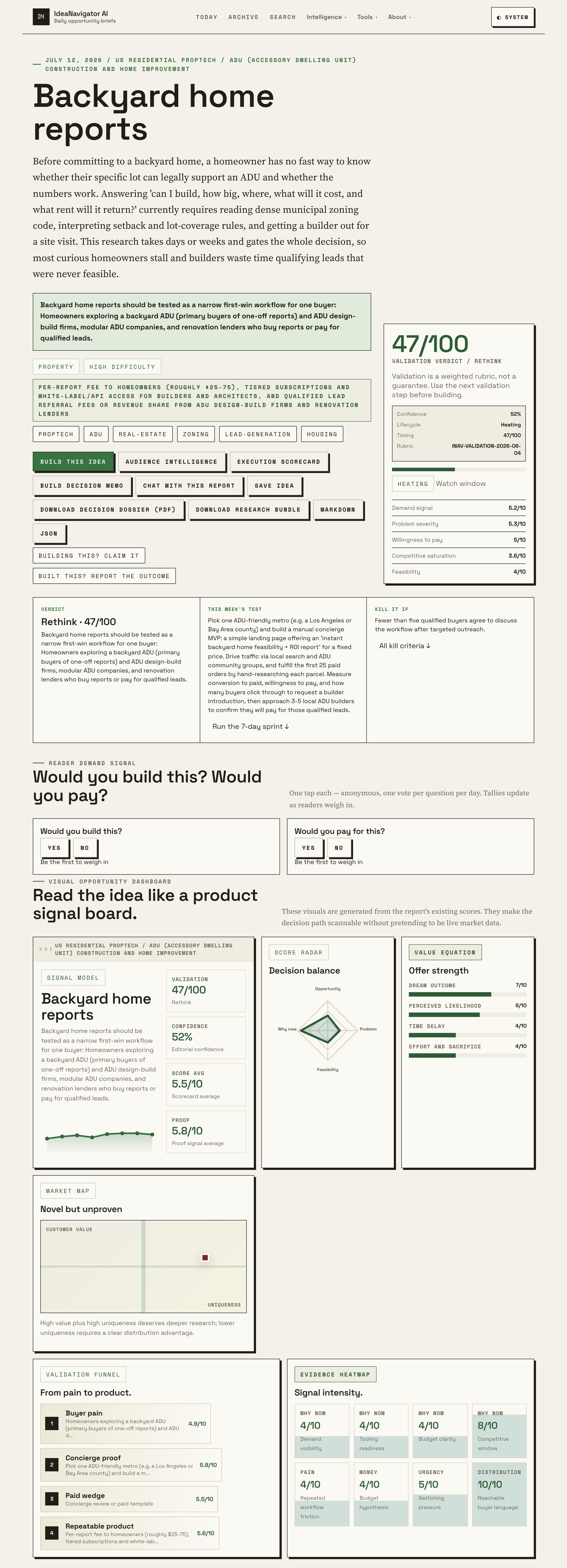
IdeaNavigator AI has proposed testing a paid, address-specific report to help homeowners assess whether a backyard accessory dwelling unit may fit their lot and budget. The concept has not been shown to be a launched service: its proposed first step is to research 25 properties by hand and see whether homeowners and local builders will pay.
IdeaNavigator AI has proposed testing paid, address-specific reports for homeowners considering a backyard accessory dwelling unit, or ADU. The proposed report would estimate what might be built on a particular lot, relevant zoning limits, construction costs and potential rent, addressing an early decision that can otherwise require substantial municipal-code research and a builder site visit.
The concept is aimed first at homeowners exploring an ADU, with possible business customers including design-build firms, modular-home companies and renovation lenders. A homeowner would enter a property address and pay for a PDF report. The proposed initial service would focus on one metro area and use parcel data, state ADU law and a manually curated set of local zoning rules.
Reports could cover permitted ADU types, maximum size, setbacks and lot coverage, alongside an estimated buildable area. They would also give a construction-cost range and projected rental income based on local rent comparisons. The proposal describes these figures as estimates; it does not provide a completed report, a tested accuracy record or a method for resolving cases where local rules or property data are ambiguous.
Potential revenue would come from one-off homeowner fees of about $25 to $75, subscriptions or white-label and API access for industry customers, and referral fees for connecting homeowners with builders or lenders. The proposed validation would begin as a concierge service: researchers would manually prepare the first 25 paid reports, track purchases and requests for builder introductions, then ask three to five local builders whether they would pay for qualified leads.
A Faster First Check for ADUs
The proposed service targets a decision point that can determine whether a homeowner continues planning at all: does this property appear suitable for an ADU? Zoning rules, setbacks and lot coverage can vary by jurisdiction and parcel. If a homeowner cannot make sense of those restrictions quickly, the idea may stall before a builder has a chance to assess the site. A property-specific report could organize early research in one place and help a homeowner decide whether to seek professional advice.
The same screening could matter to builders and lenders. According to the proposal, firms spend time qualifying inquiries that may prove infeasible. Reports that identify likely constraints could help direct that effort toward more promising projects. But the commercial case remains unproven: the suggested pricing and referral model are hypotheses to test, not evidence of demand or savings.
Any report would also carry practical limits. A parcel-data estimate and a curated rule set cannot by themselves guarantee approval, construction feasibility or a particular rental return. Local review and site conditions still matter, and readers would need clear explanations of assumptions before relying on estimates in a major housing decision.
California ADU Growth Sets the Scene
IdeaNavigator AI’s proposal points to California’s statewide ADU legislation, which began in 2016 and has been loosened in subsequent years, as part of the policy backdrop. The proposal also cites more than 45,000 ADUs permitted in Los Angeles County in 2023 and says ADUs account for roughly one in five new housing units produced in California. It does not identify a dataset or link to documentation for those figures.
The proposal argues that a persistent US housing shortage, along with more accessible parcel and zoning data and language-model tools for parsing codes, could make address-level reports more practical. It suggests starting in an ADU-friendly county in Los Angeles or the Bay Area, where rules could be curated by hand before any wider rollout. The plan is deliberately narrow: establish whether a report is useful and saleable in one market before expanding coverage.
That approach matters because zoning is local even when state law sets broad protections or minimum standards. A tool would need to account for local requirements and property details, rather than assume a single statewide rule answers whether a particular lot can support a backyard home.
Demand and Accuracy Remain Untested
IdeaNavigator AI’s proposal describes no completed customer test, operating product, named company launch or paid order count. The proposed first 25 reports are a future validation step, so it remains unknown whether homeowners will pay the suggested $25 to $75 fee, how often reports will lead to builder introductions, or whether builders and lenders will pay for those leads.
The proposal also leaves open how the service would handle incomplete parcel records, unusual lot shapes, overlapping local rules or changes in law. It does not specify who would review estimates, how often the rule set would be updated, or what evidence would support cost and rent ranges. The proposal provides no source links for its permitting and housing figures and does not detail their definitions or comparison periods.
A 25-Report Market Test
IdeaNavigator AI’s proposal recommends choosing a single metro or county, publishing a landing page offering a fixed-price feasibility and return estimate, and attracting prospective customers through local search and ADU community groups. The team would then research the first 25 properties by hand, recording whether visitors convert to paid orders and whether buyers request an introduction to a builder.
After that initial customer test, the proposal calls for conversations with three to five local ADU builders about paying for qualified leads. No schedule, chosen county, landing page or results have been specified. Until those steps take place, the report remains a business concept rather than a demonstrated service.
Source: IdeaNavigator AI proposal
Key Questions
Is the backyard ADU report service available now?
The IdeaNavigator AI proposal describes a service to test, but gives no launch date or evidence that it is operating.
What would a homeowner receive?
A proposed PDF would estimate applicable ADU types and zoning limits, buildable area, construction costs and potential rent for a specific property. These would be estimates, not a guarantee of approval or financial return.
How much might a report cost?
The suggested one-off price in the proposal is about $25 to $75. The proposal has not established that customers will pay within that range.
How would the idea be tested?
The proposal recommends manually preparing the first 25 paid reports in one market, measuring purchases and builder-introduction requests, and asking three to five local builders about paying for qualified leads.
Source: IdeaNavigator AI
Evergreen bestsellers Picks
bestsellers
As an affiliate, we earn on qualifying purchases.