🔍 Read the full analysis: 10 Powerful AI Mini PCs For LLMs In 2027 on ThorstenMeyerAI.com

Get hardware and tech essentials delivered free with Prime
- Fast, free delivery on millions of items
- Prime Video, Amazon Music and more included
- Member-only deals all year
TL;DR
A source article from ThorstenMeyerAI.com presents 10 mini PCs for local AI workloads, but the supplied material identifies only a handful of models and does not provide a complete, verifiable 10-device lineup. It names memory capacity, sustained cooling, software compatibility and external GPU support as key buying factors; performance comparisons and 2027 availability are not independently established in the source.
ThorstenMeyerAI.com’s 2027 guide compares mini PCs intended for local AI work, naming the GMKtec EVO-X3 as its top pick and emphasizing memory, cooling and upgrade options. The supplied source material, however, names fewer than 10 distinct models and does not include a complete ranked list, so the advertised 10-device comparison cannot be fully verified from the information available here.
The guide says the EVO-X3, fitted with an AMD Ryzen AI Max+ 395 and a stated 128GB LPDDR5X memory pool, is its preferred option for running larger local language models. It argues that memory capacity and bandwidth can matter more to inference speed than peak CPU clock rates, particularly when models exceed the limits of smaller memory configurations. Those performance conclusions are the guide’s assessments, not independently tested findings included in the supplied material.
Other named systems include the GEEKOM GT13 MAX, described as an Intel Core Ultra 9 185H option with broad connectivity; the GEEKOM A9 Max, credited with a larger chassis and vapor-chamber cooling; the GMKtec K17, characterized as compact but potentially constrained by cooling; and the GMKtec K15, cited for Oculink connectivity. The material does not provide full model specifications, prices, test results or enough names to establish all 10 picks.
The article says its selection criteria include NPU performance, memory bandwidth, thermal behavior and ports, factors also considered in AI mini PCs for local workloads. It also says devices with less than 16GB of soldered RAM were excluded and that it considered performance with quantized 7-billion- and 13-billion-parameter models. No measured token-generation rates, temperatures or standardized test methodology are included in the supplied text.
The 10 picks
- 1
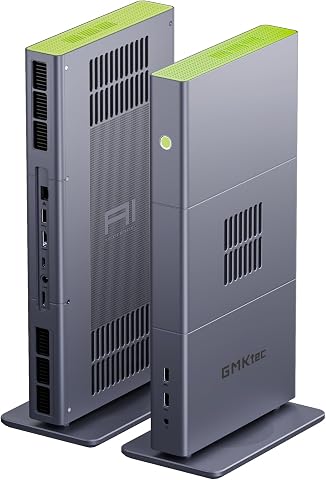 GMKtec EVO-X3 Mini PC with AMD Ryzen AI Max+ 395, 128GB LPDDR5X RAM, and 2TB…View on Amazon →
- 2
 GMKtec EVO-X3 Mini PC with AMD Ryzen AI Max+ 395, 128GB LPDDR5X, and 2TB PCIe…View on Amazon →
- 3
 GMKtec EVO-X2 Mini PC with AMD Ryzen AI Max+ 395View on Amazon →
- 4
 GMKtec EVO-X2 AI Mini PC with AMD Ryzen AI Max+ 395View on Amazon →
- 5
 GEEKOM A9 Max AI Mini PC with AMD Ryzen AI 9 HX 470, 32GB DDR5 RAM, and 2TB SSDView on Amazon →
- 6
 GEEKOM GT15 Max Business & Professional Mini PC with Intel Core Ultra 9, 32GB…View on Amazon →
- 7
 GEEKOM GT1 Mega AI Mini PC with Intel 14th Gen Core Ultra 9, 32GB DDR5, 1TB N…View on Amazon →
- 8
 GMKtec K15 AI Mini PC Oculink Intel Ultra 5 125U 32GB DDR5 512GB SSD, Desktop…View on Amazon →
- 9
 Glorlin Mini PC with AMD Ryzen 7 Pro 8845HS, 16GB DDR5 RAM, 500GB PCIe 4.0 SS…View on Amazon →
- 10
 GMKtec K17 Mini AI PC with Intel Core Ultra 5 226V, 16GB LPDDR5XView on Amazon →
Memory and Cooling Shape Local AI
The guide’s central point is that compact computers can run some AI workloads locally, but the experience depends on more than the processor’s advertised AI rating. Memory capacity and bandwidth limit which models fit and how quickly data can be processed; thermal design can affect performance during extended use. These tradeoffs matter to users weighing a small desktop against a larger workstation or a cloud service.
Upgrade paths may also affect how long a system remains useful. The guide describes Oculink and Thunderbolt as routes to external GPU enclosures, though actual compatibility and performance depend on the specific computer, enclosure, GPU and software. The source does not quantify the claimed cost or speed benefits, so readers should treat those points as considerations rather than guaranteed outcomes.
Products Worth Considering

Apple MacBook Pro 16.2-inch with M5 Pro, 18-core CPU, 20-core GPU, 48GB Memory, 2TB SSD, Space Black

Apple MacBook Pro 14-inch (2021) – M1 Pro Chip, 10-Core CPU, 16-Core GPU, 16GB RAM, 1TB SSD, Space Gray

Ledger Nano X Bluetooth Crypto Wallet
As an affiliate, we earn on qualifying purchases.
How the Guide Evaluates Mini PCs
The source frames its recommendations around local inference rather than general-purpose desktop performance. It distinguishes NPUs, which are designed for certain efficient AI tasks, from integrated graphics, which may be used for more demanding generation workloads. It says software support varies: the author characterizes AMD’s Ryzen AI tools as gaining traction for Stable Diffusion and Intel’s OpenVINO as useful for selected computer-vision tasks.
The guide also argues that a high peak TOPS rating does not by itself establish sustained performance. It recommends attention to cooling under extended workloads and to whether the intended applications support a device’s processor and drivers. The supplied text offers no independent benchmark data to compare these systems on equal terms.
“Memory bandwidth is the primary bottleneck for local AI performance.”
— ThorstenMeyerAI.com guide
The Missing Model Comparisons
The material provided does not identify 10 distinct mini PCs, despite the title’s promise, and it does not show a full ranking. It also lacks prices, release or availability details, test conditions, measured inference speeds, sustained temperatures and direct comparisons across the named devices. Claims about relative performance, software support and cooling therefore remain attributed assessments rather than independently confirmed results.
It is also unclear whether every named configuration is available in the stated form in 2027 or whether specifications vary by region and model revision. Readers cannot determine from this source alone which system offers the best value or will run a particular model at a specific speed.
What Buyers Should Verify
Before choosing a system, readers should check the manufacturer’s current specification sheet for the exact processor, memory configuration, ports and cooling design, then confirm that their intended AI tools support the device. Independent reviews that report model size, quantization, token-generation rate and sustained-load temperatures would make the comparisons more useful. The source material gives no date for a fuller list or additional testing.
Key Questions
Does the supplied guide provide all 10 mini PC picks?
No. The supplied material names the GMKtec EVO-X3, GEEKOM GT13 MAX, GEEKOM A9 Max, GMKtec K17 and GMKtec K15, but it does not identify 10 distinct devices.
What does the guide identify as the top pick?
It names the GMKtec EVO-X3 with an AMD Ryzen AI Max+ 395, citing a stated 128GB LPDDR5X memory pool. This is the source author’s recommendation, not an independently verified result in the supplied material.
What specifications matter most for local LLM use?
The guide emphasizes memory capacity and bandwidth, cooling under sustained loads, and compatibility with the AI software a buyer plans to use. It does not provide enough benchmark data to set a universal performance threshold.
Can these mini PCs use an external graphics card?
The guide says some systems may support external GPUs through Oculink or Thunderbolt. Buyers should verify the exact port, enclosure and GPU compatibility; the source does not provide measured eGPU performance.
Source: ThorstenMeyerAI.com