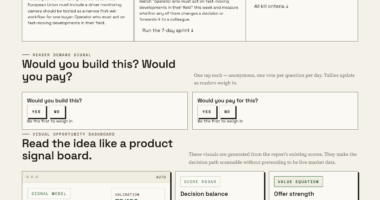
🔍 Read the full analysis: Could T3 Code Simplify Working With Claude, Codex, And Several Macs? on ThorstenMeyerAI.com

Get hardware and tech essentials delivered free with Prime
- Fast, free delivery on millions of items
- Prime Video, Amazon Music and more included
- Member-only deals all year
TL;DR
Thorsten Meyer says he moved his multi-machine AI coding setup to T3 Code, linking eight Macs and a Linux server to one workspace with Claude Code and Codex. The open-source app organizes and routes agents but remains a fast-moving project, and Meyer reports no measured productivity gain.
Developer Thorsten Meyer says he has linked eight Macs and a Linux server to one T3 Code workspace, where he manages sessions for Claude Code and Codex. In a November 18 account on ThorstenMeyerAI.com, Meyer said the app gives him one place to monitor agents running across machines; he did not report a measured productivity gain.
Meyer said he adopted T3 Code after finding that his previous setup split Claude Code and Codex sessions across terminal windows, a terminal multiplexer and Claude’s desktop app. Each Mac had its own sessions, he wrote, making it difficult to see which agents were active, waiting for approval or asking for input. Passing work from a coding agent to one checking its changes also required him to move context between tools.
He describes T3 Code as a free, open-source app under the MIT license that acts as a shared interface for coding agents. The app runs agents on the machines doing the work and connects to accounts users already have with providers; according to the project’s site, it does not resell tokens. The project documentation lists Claude Code and Codex among supported agents, along with other tools.
Meyer’s stated workflow uses one agent to build and another to check the result. He says T3 Code can organize sessions in a thread list, switch agents within a thread, and create separate threads in Git worktrees. The documentation says a model switch carries over the conversation, but not the previous agent’s reasoning, tool-call state or attachments. These are product capabilities described by the project and Meyer, not independently tested results in his account.
My switch to T3 Code · before and after
From terminal windows on many Macs to one workspace
The agents did not change. Claude Code and Codex still run on the Macs that do the work. What changed is where I see them: in one list of threads, on the laptop or the phone.
- 1 · BeforeSessions sit in terminal windows on each Mac. Nothing tells you which agent did what, or which one waits for you.
- 2 · One workspaceEach Mac runs T3 Code. One app connects to all of them, over the local network, Tailscale, SSH or T3 Connect.
- 3 · ThreadsOne thread per task. Claude Code builds, Codex checks. Busy threads fold away; a thread that needs an answer comes back to the top.
- 4 · RemoteThe phone approves the next step. The Mac keeps doing the work and has to stay on.
Sources: T3 Code README and user docs (remote access, working with threads, mobile notifications, FAQ), read November 18, 2026. Setup: the author’s own. Drawing: a generic interface, not a product screenshot.
Graphic: Powered by Thorsten Meyer AI
One Dashboard Across Coding Machines
For developers running several coding agents at once, the problem is not just generating code; it is keeping track of what each agent is doing and responding when it needs a decision. A shared view across machines could reduce the need to check terminals one by one and make it easier to hand a change from one agent to another. Meyer identifies that coordination problem, rather than a shortcoming in Claude Code or Codex themselves, as the main reason for switching.
Remote access may also matter when a developer is away from the workstation. T3 Code documentation describes phone access and alerts for agents that finish, fail, need approval or request input. But a phone is a remote control, not a way to move the work off the computer: the machine running the agent must remain on. Meyer says he has not measured whether the new arrangement makes him more productive, so the account supports a description of his workflow, not a quantified performance claim.
Products Worth Considering
Logitech MX Creative Console with 9 Customizable Keys, Graphite

Ledger Nano X Crypto Hardware Wallet – Bluetooth (Black + Billfodl)

Trezor Safe 5 Crypto Hardware Wallet
As an affiliate, we earn on qualifying purchases.
Meyer’s account is a first-person report about his own setup, not a formal product test or an announcement that T3 Code has launched. Before switching, he ran Claude Code in terminals and its desktop app, while Codex used other terminal windows. He said that setup worked, but left him responsible for tracking sessions and carrying context between tools.
According to the project documentation cited in the account, machines can connect through a local network, Tailscale HTTPS, SSH or T3 Connect. The project describes T3 Connect as free for now and limited to three machines per account; the documentation also names a paid T3 Chat plan with support for up to 10 machines on Pro. T3 Code’s version was 0.1.10 on November 17, 2026, and Meyer characterized the project as young and fast-moving.
Some features remain in beta, including linked environments, which the documentation says can let agents on one machine start, message or stop threads on another. Optional load balancing can select a machine for new threads and is off by default, according to the source material. These details matter because the experience depends on the connection method, plan and maturity of the feature being used.
“I have not measured a productivity gain, so I won’t quote one.”
— Thorsten Meyer, writing on ThorstenMeyerAI.com
The source is Meyer’s account and summaries of T3 Code’s own documentation; it does not provide independent testing of the app’s reliability, security or performance across the eight Macs and Linux server. Meyer supplies no measurements of time saved, coding quality or error rates, and it is unclear how consistently the system works under different network conditions.
Several multi-machine capabilities are described as beta, and T3 Connect is described as free “for now.” The account does not say whether pricing or machine limits will change, or detail the security arrangements for remote connections. Users’ existing provider terms and plan limits still apply, according to Meyer. The project documentation also says new threads start in full-access mode, a setting users should understand before delegating work.
Testing the Setup as It Grows
Meyer says additional machines can join his workspace, but his account does not give a schedule for adding them or describe a future product milestone. The next practical test is whether T3 Code’s multi-machine connections and beta linked-environment features remain dependable as he expands the setup. Project updates, documentation and any changes to T3 Connect limits will help clarify how the service develops.
For readers considering a similar workflow, the immediate decision is whether managing agents across several tools or machines is a problem they actually have. Meyer says a single agent in one terminal may not need this layer. Anyone trying the app would also need to keep the work machines available, check provider plan limits and understand the access granted to new threads.
Key Questions
What did Meyer connect to T3 Code?
He says he linked eight Macs and one Linux server to a workspace on his laptop, with Claude Code and Codex available on each Mac.
Does T3 Code provide Claude or Codex subscriptions?
No, according to Meyer’s account. Users sign in with their existing provider accounts, and the project says it does not resell tokens. Provider plan limits and terms still apply.
Can agents keep working when the user leaves the computer?
They run on the machine doing the work, according to the project documentation. Phone access can let a user respond remotely, but the computer must stay on.
Has Meyer shown that T3 Code increases productivity?
No. Meyer says he has not measured a productivity gain. His report describes why he switched and how he organizes agents, rather than providing performance data.
Are all of T3 Code’s multi-machine features fully released?
No. Meyer says several multi-machine features remain in beta. The project documentation describes T3 Connect as free for now and limited to three machines per account; other connection options and a paid plan are also listed.
Source: ThorstenMeyerAI.com