
TL;DR

Get hardware and tech essentials delivered free with Prime
- Fast, free delivery on millions of items
- Prime Video, Amazon Music and more included
- Member-only deals all year
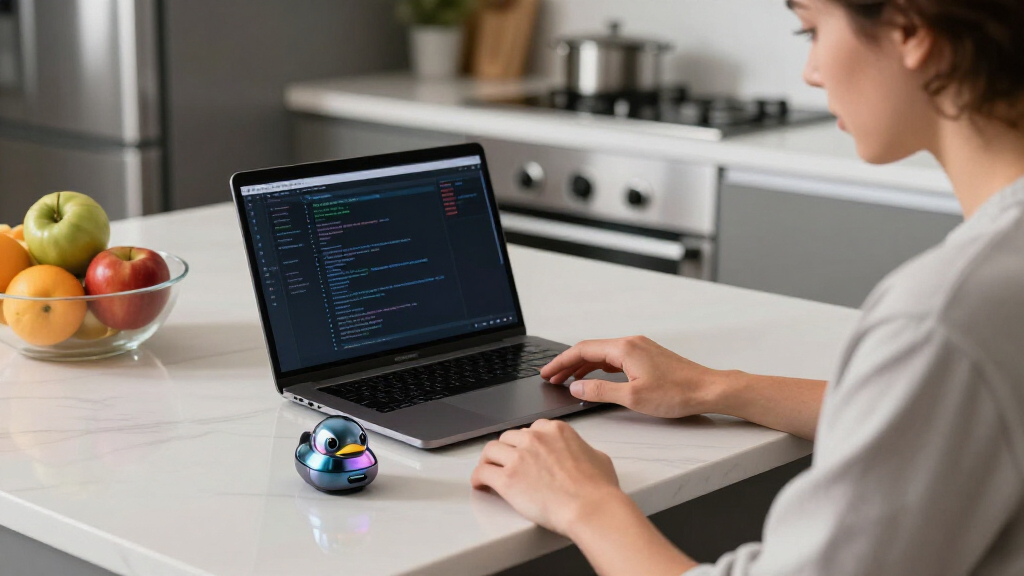
Hugging Face announced Microduck, a $399 open-source robot that demonstrates movement and learning capabilities. While marketed as a toy, it aims to democratize embodied AI development, raising strategic questions about its broader implications.
Hugging Face has introduced Microduck, a small, open-source robot designed for reinforcement learning and movement, priced at $399. This development signals a shift in robotics from high-cost, proprietary systems to accessible, developer-friendly platforms, making the potential for advanced embodied AI more widely available. While the device appears as a charming toy, its underlying platform aims to foster open, customizable AI training in physical systems, with implications extending well beyond entertainment.
Microduck is a roughly 25-centimeter-tall, lightweight robot equipped with 15 motors, sensors including IMUs, LiDAR, a camera, microphone, and speaker. It can perform tasks such as waddling, sitting, recovering from falls, and even rollerblading in demo videos. The robot is marketed as a platform for developers to experiment with reinforcement learning, with preorders starting at $399. Its hardware is designed to be fall-tolerant, enabling trial-and-error learning processes that are central to reinforcement learning methods.
Crucially, the full SDK, simulation environment, and training stack are open-source and hosted on GitHub. This means developers can read, fork, and retrain the system, making it a tangible step toward democratizing embodied AI. Hugging Face’s strategy echoes its success with open language models, now applied to physical robotics, aiming to lower barriers for developers outside traditional robotics labs.
However, the device is primarily a learning platform, not a household robot. Its demos, such as sock retrieval and rollerblading, are curated highlights, and real-world reliability remains to be proven. The onboard sensors and network connectivity also raise data and privacy considerations, as the device continuously observes and listens within a user’s home environment.
Open-Source Robotics as a Democratizing Force
The launch of Microduck signifies a strategic move to make embodied AI accessible and customizable for a broader developer base. By providing an affordable, open hardware platform, Hugging Face aims to foster innovation outside traditional robotics institutions, much like its impact on language models. This could accelerate the development of practical, embodied AI applications, from education to research, with potential ripple effects across the industry.
Moreover, this initiative challenges the prevailing dominance of proprietary, high-cost robots, shifting the landscape toward open, community-driven development. If successful, Microduck could serve as a foundational tool for the next generation of physical AI systems, making advanced robotics more inclusive and adaptable.
As an affiliate, we earn on qualifying purchases.
Background of Open-Source AI and Robotics Development
Hugging Face has established itself as a leader in democratizing AI through open-source models, notably in natural language processing. Its move into robotics with Microduck continues this philosophy, applying it to embodied AI and physical systems. The company acquired Pollen Robotics in April 2025, integrating its hardware expertise to develop affordable, open robotic platforms.
Previous efforts in robotics often involved expensive, proprietary systems with limited developer access, hindering widespread experimentation. Microduck aims to change that by providing a low-cost, fully open platform for reinforcement learning, a core method for training adaptable, autonomous behaviors. The release aligns with broader industry trends emphasizing open hardware and software as catalysts for innovation.
However, the open approach also introduces new vulnerabilities, as demonstrated by recent security incidents involving open infrastructure, highlighting the need for robust cybersecurity measures in such systems.
“The Microduck is more than a toy; it’s a deliberate step toward democratizing embodied AI, making advanced robotics accessible and customizable for developers worldwide.”
— Thorsten Meyer
As an affiliate, we earn on qualifying purchases.
Unresolved Questions About Practical Use and Security
It remains unclear how reliably Microduck will perform in real-world, unscripted environments beyond curated demos. The extent to which developers can successfully train and deploy robust behaviors is still to be tested. Additionally, security vulnerabilities inherent in open, networked systems pose risks, especially given recent incidents involving open infrastructure platforms like Hugging Face and others. The privacy implications of a home-based robot continuously observing and listening are also unresolved, requiring further scrutiny.
As an affiliate, we earn on qualifying purchases.
Next Steps for Developer Adoption and Industry Impact
Hugging Face plans to ship Microduck before Christmas, with initial units available for developers and researchers. The open-source community will likely begin experimenting with the platform, potentially leading to new applications and improvements. Monitoring how the device performs in diverse environments and how the community addresses security and privacy concerns will be critical. The broader industry will observe whether Microduck’s open platform can catalyze practical embodied AI innovations or remains primarily a developmental tool.
As an affiliate, we earn on qualifying purchases.
Key Questions
Can Microduck perform household chores?
No, Microduck is designed as a developer platform for reinforcement learning and movement experiments. It is not built for household chores or practical household tasks.
Is Microduck secure for home use?
The device includes sensors and network connectivity that could pose privacy and security risks. Its open-source nature means vulnerabilities could be exploited if not properly secured, and users should consider these risks before deployment.
Will Microduck be reliable outside curated demos?
It is currently uncertain how well Microduck will perform in real-world, unpredictable environments. Its success depends on community development, ongoing training, and improvements in robustness.
Is this the beginning of open robotics?
Microduck represents a significant step toward open, accessible robotics development, similar to open-source software. Its impact will depend on community adoption and the evolution of the platform.
What does the potential Nvidia acquisition mean for Microduck?
While unconfirmed, if Nvidia acquires Hugging Face, it could lead to increased resources and integration with larger AI ecosystems, potentially accelerating development and deployment of open robotics platforms like Microduck.
Source: ThorstenMeyerAI.com
Halloween Picks
halloween
As an affiliate, we earn on qualifying purchases.