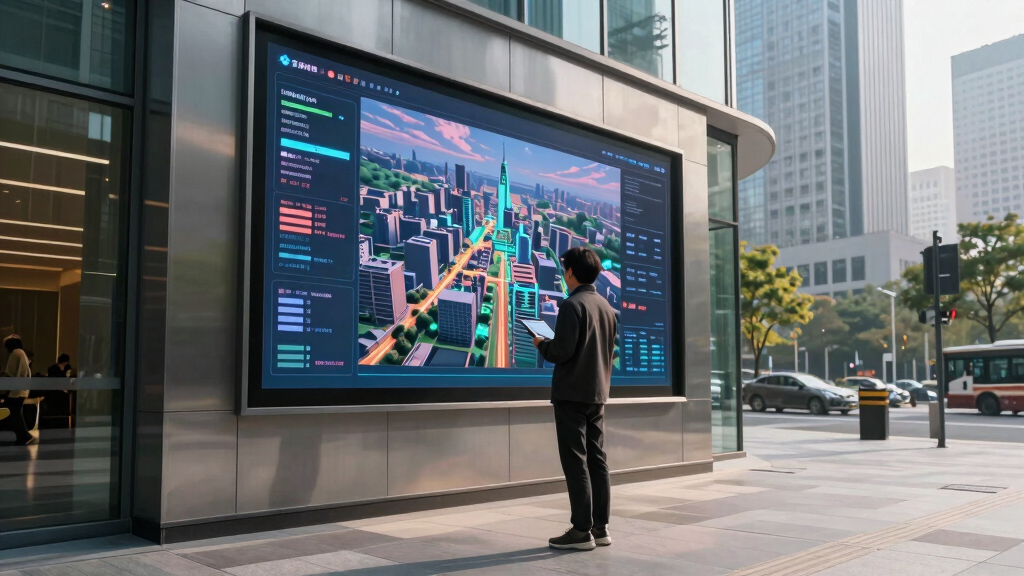

📊 Full opportunity report: The City That Watches Itself: The Living Digital Twin, and the God’s-Eye View We’re Building on ThorstenMeyerAI.com — validation score, market gap, and execution plan.

Get hardware and tech essentials delivered free with Prime
- Fast, free delivery on millions of items
- Prime Video, Amazon Music and more included
- Member-only deals all year
TL;DR
Cities are creating dynamic digital replicas using sensors, radar, and AI, enabling real-time monitoring and simulation. This advances urban planning but raises surveillance concerns.
Multiple cities worldwide are adopting advanced digital twins that integrate real-time sensor data, radar, and AI to create living models of urban environments. These digital replicas can be queried in natural language, enabling unprecedented oversight and planning capabilities. This development is significant because it combines state-of-the-art technologies to produce a tool that is both highly useful and potentially invasive, raising questions about surveillance and data sovereignty.
Urban digital twins are virtual, three-dimensional models of cities that reflect real-time conditions by aggregating data from IoT sensors, satellite imagery, GIS, and utility networks. Examples include Singapore’s Virtual Singapore, Helsinki, and Las Vegas, which use these models for planning and operational efficiencies. The latest evolution involves integrating Wide-Area Motion Imagery (WAMI), which allows continuous, rewindable tracking of vehicles and pedestrians across entire urban areas, and synthetic-aperture radar (VigilSAR), which provides all-weather, day-and-night coverage. These sensors feed into AI systems capable of understanding complex data, recognizing patterns, and answering natural-language queries, effectively turning the city into an interactive, intelligent entity.
This convergence of technologies shifts digital twins from static planning tools to dynamic, self-monitoring systems that can anticipate issues, optimize infrastructure, and support urban management. However, the same capabilities that improve city planning also create tools that can be used for detailed, real-time monitoring of individuals and activities, raising concerns about privacy and data sovereignty.
The city that watches itself: the living digital twin, and the god’s-eye view we’re building
Soon most cities will exist twice — once in concrete, once as a live data model you can rewind, simulate, and question in plain language. Persistent sensing + frontier AI turn the planner’s digital twin into an oracle. The most useful thing we’ve built — and the most powerful surveillance instrument. Both at once.
- Plan better — cities & rural: traffic, zoning, energy, land use
- Emergency response — route crews, one live picture, ~50% faster
- Disaster resilience — simulate, track live, assess damage in hours
- Mass surveillance — track everyone, retroactively, forever
- Pattern-of-life — AI links movements, infers associations
- Social control — no warrant, no suspicion (cf. Baltimore, 2021 ruling)
We’re building a city that watches itself, remembers everything, and can be asked anything. The technology won’t choose between saving lives and ending privacy — we will, through the rules we write now, while the twin is still under construction and the defaults haven’t yet hardened into permanence. WAMI and the living twin open our lives to a view from the heavens that, from the dawn of civilization until a heartbeat ago, was reserved for gods and stars. The question is no longer whether we can see everything — it’s who gets to look, and who watches the watchers.
Impacts of Self-Watching Cities on Urban Management and Privacy
This technological development enables cities to optimize infrastructure, potentially improving efficiency and responsiveness. For example, some cities report reductions in planning cycles and improved land use efficiency. Nonetheless, the ability to monitor and analyze activities within a city raises questions about privacy and data security. The potential for misuse or external control of these systems underscores the importance of governance and regulation as these technologies become more widespread.
As an affiliate, we earn on qualifying purchases.
Development Timeline and Technological Foundations of City Digital Twins
The concept of digital twins for cities has been evolving over the past decade, with Singapore’s Virtual Singapore launched after 2012 as a pioneering example. These models initially served as static planning maps but have now incorporated live data streams from sensors and satellites. The recent integration of WAMI sensors, capable of tracking every vehicle and pedestrian, and synthetic-aperture radar, which sees through weather and darkness, represents significant technological progress. The current generation of AI models, capable of understanding complex, heterogeneous data and natural language queries, is what enables these systems to become interactive, information sources. Advances in frontier AI models like GPT-5.6 and Fable 5 are contributing to this evolution.
“The merging of real-time sensors, radar, and AI is transforming cities into living, queryable entities—both a step forward for urban management and a development requiring careful oversight.”
— Thorsten Meyer, AI researcher
As an affiliate, we earn on qualifying purchases.
Unresolved Issues and Risks of City Digital Twins
It remains uncertain how widely these systems will be adopted and what regulatory frameworks will be established to govern their use. Concerns include the security of these systems, potential external influences, and privacy protections for individuals. Additionally, questions persist regarding the reliability of AI in interpreting sensitive data without bias or error, and the long-term implications for civil liberties.
As an affiliate, we earn on qualifying purchases.
Future Developments and Regulatory Considerations for Urban Digital Twins
As adoption increases, efforts are expected to focus on establishing legal frameworks related to privacy, data ownership, and security. Technological advancements are likely to continue, enhancing AI capabilities and sensor coverage. International cooperation or regulation may develop to address potential misuse, though timelines and scope remain uncertain. Cities will need to balance the benefits of these technologies with the protection of civil liberties and individual rights.
As an affiliate, we earn on qualifying purchases.
Key Questions
How do digital twins improve city planning?
They enable simulation of changes, analysis of potential impacts, and optimization of infrastructure prior to implementation, which can help reduce costs and errors.
What are the privacy concerns associated with city digital twins?
These systems can track individual movements in real time, raising concerns about surveillance, data security, and privacy violations if not properly regulated.
Are these technologies accessible to all cities?
Currently, adoption is primarily limited to well-funded urban areas; broader deployment depends on technological, financial, and regulatory factors.
Could external actors control or manipulate these city models?
Yes, if security measures are insufficient or if governance is compromised, there is a risk of external interference or control, which could impact sovereignty.
What safeguards are being proposed for these systems?
Proposed safeguards include developing legal regulations, implementing data encryption, establishing access controls, and setting international standards, though implementation varies.
Source: ThorstenMeyerAI.com
Columbus Day / Indigenous Peoples' Day Picks
long weekend sales
As an affiliate, we earn on qualifying purchases.