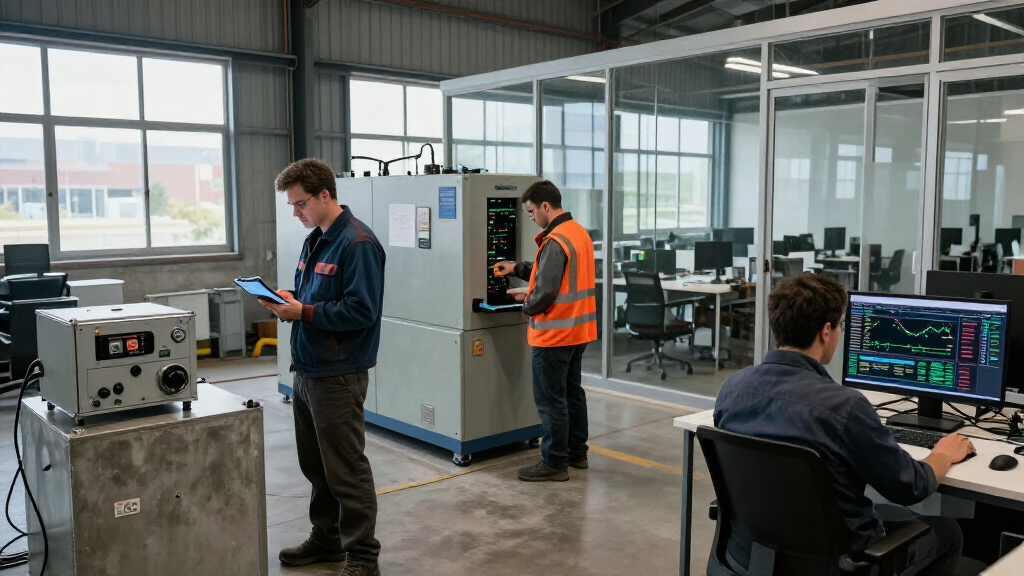
🔍 Read the full analysis: Three Workplaces, Three Sectors: Field, Factory, And Office on ThorstenMeyerAI.com

Get hardware and tech essentials delivered free with Prime
- Fast, free delivery on millions of items
- Prime Video, Amazon Music and more included
- Member-only deals all year
TL;DR
ThorstenMeyerAI.com published the first episode of Work After Work on Nov. 2, 2026, using the field, factory and office framework to trace shifts in employment. Its figures show farming’s share of the U.S. labor force falling from 73.7% in 1800 to an ILO-modelled 1.5% in 2025; the article also distinguishes historical data from its author’s speculation about automation.
ThorstenMeyerAI.com published the first episode of its planned 60-part series, Work After Work, on Nov. 2, using the categories of field, factory and office to explain how employment has shifted from farming toward manufacturing and services. The article brings together historical employment estimates and a modelled global figure, while presenting its forecast that automation could become a sector of its own as the author’s thesis, not an established fact.
The episode defines the primary sector as work that takes resources from nature, including farming, fishing and forestry. The secondary sector makes things through activities such as manufacturing, construction and energy supply. The tertiary sector covers services, from trade and transport to health, education, government and office work. The categories are broad rather than universally consistent: the article notes that mining and some jobs at manufacturing companies can be classified differently across statistical systems.
For the United States, the article cites economic historian Stanley Lebergott’s historical estimates: farming accounted for 73.7% of the labor force in 1800, 54.8% in 1850, 40.2% in 1900 and 12.0% in 1950. It then gives an ILO modelled estimate of 1.5% in 2025. These figures come from different historical and statistical sources; the 2025 number is identified as a modelled estimate, not a direct historical census count.
The article says the shift also occurred elsewhere, citing a decline in China’s primary-sector employment share from 83.5% in 1952 to 22.2% in 2024, and in Japan from 53.8% in 1920 to 3.2% in 2020. It also reports that, according to ILO modelled estimates, services have employed more people worldwide than farming since 2001. The series says later episodes will examine how technology affects work and movement between sectors.
Where Workers Have Moved
The three-sector framework offers readers a simple way to understand a major economic change: employment has moved away from agriculture as productivity and economies changed, while more people came to work in industry and services. That matters because debates about automation often focus on whether machines eliminate jobs, but the history in this episode also concerns where workers go after sectors change.
The figures do not mean farming has become unimportant. They describe its share of employment, not the amount of food produced or the sector’s value to society. The article’s own U.S. example makes that distinction clear: it says factory employment is about 35% below its June 1979 peak, while real manufacturing output in 2025 was about 1.9 times its 1979 level. Those measures concern different things—jobs and output—and should not be treated as interchangeable.
For readers following technology’s effect on employment, the series frames the key issue as a question rather than a settled outcome: can new work absorb people displaced by machines, as services did during earlier changes? The answer may vary by occupation, country and period; the sector labels alone cannot predict the result for individual workers.
Products Worth Considering

Ledger Flex Crypto Wallet

Logitech MX Keys S Wireless Keyboard, Graphite

Logitech MX Brio Ultra HD 4K Webcam, Graphite
As an affiliate, we earn on qualifying purchases.
The Model Behind Three Sectors
The article traces the framework to economists who formalized distinctions between primary, secondary and tertiary activity in the first half of the 20th century. It says New Zealand economist Allan G. B. Fisher used “tertiary” in a book written in 1934 and published in 1935. Colin Clark compared employment patterns across countries in The Conditions of Economic Progress, published in 1940, and described movement from agriculture to manufacturing and then to commerce and services.
French economist Jean Fourastié argued in 1949 that services would absorb workers released as technology raised productivity in other sectors. The episode presents that idea as an important historical argument, not proof that future technological change will produce the same outcome. Its 60-episode plan starts with this framework because later installments are intended to examine particular technologies and jobs.
The categories have limits. A software engineer employed by a carmaker, for example, might be counted under manufacturing in one statistical system and services in another. Mining is also classified differently in some frameworks. The labels can help show broad employment patterns, but they do not provide a single universally applied account of what every worker does.
“In every progressive economy, employment shifts from primary activities ‘to secondary activities of all kinds, and to a still greater extent into tertiary production.’”
— Thorsten Meyer, author of the Work After Work episode
Limits of the Employment Figures
The figures combine estimates from different years, institutions and methods. The episode identifies the 2025 U.S. farming figure as an ILO modelled estimate, while the earlier U.S. values come from Lebergott’s historical series. The supplied material does not give a comparable definition or methodological note for every country and year, so the data should not be read as one uniform census series.
The three-sector classification also leaves room for disagreement about where particular jobs belong. The source notes varying treatment of mining and of work performed inside manufacturing firms. It does not provide a full account of how those differences affect each reported national figure.
The claim that automation could become a distinct sector doing up to 90% of work is explicitly Meyer’s thesis, not a confirmed forecast. The episode supplies no method, timeframe more precise than “within a decade or a few decades,” or evidence establishing that level. Its planned later discussion is not evidence that the prediction will occur.
Later Episodes Test Automation
Work After Work is described as a daily series of 60 episodes about how economies are built, how work has moved and which tasks may remain human as machines take on more work. The source says episode 48 will put Meyer’s automation-sector thesis on trial, but it does not give a publication date for that installment or a more detailed episode schedule.
The next installments are expected, according to the series description, to move from the broad sector map to specific technologies and jobs, including tractors and chatbots. Readers should distinguish those future discussions and the author’s predictions from the employment figures presented as historical estimates or modelled data.
Key Questions
What are the three sectors in the article?
The primary sector takes resources from nature; the secondary sector makes goods and supplies activities such as construction and energy; and the tertiary sector provides services, including health, education, trade and transport.
How much of the U.S. labor force worked in farming in 2025?
The episode cites an ILO modelled estimate of 1.5% for 2025. It contrasts that with historical estimates from Stanley Lebergott, including 73.7% in 1800; the figures come from different sources and should be understood in that context.
Does the article say the United States no longer makes things?
No. The episode says U.S. factory employment was about 35% below its June 1979 peak, while real manufacturing output in 2025 was about 1.9 times its 1979 level. Employment and output measure different aspects of manufacturing.
Is automation already a separate economic sector?
The source does not establish that. The idea that automation could become a sector of its own is Meyer’s thesis, which he says a later episode will examine.
Source: ThorstenMeyerAI.com