
📊 Full opportunity report: Acoustic Dampening, Placement, and the “Rig in the Closet” Setup on ThorstenMeyerAI.com — validation score, market gap, and execution plan.

Get hardware and tech essentials delivered free with Prime
- Fast, free delivery on millions of items
- Prime Video, Amazon Music and more included
- Member-only deals all year
TL;DR
Moving AI workstations out of the workspace into separate rooms or closets significantly reduces noise. Proper ventilation is essential for enclosed setups to prevent overheating. Acoustic foam alone is less effective than strategic placement and isolation.
Recent discussions among AI practitioners highlight that the most effective way to reduce noise from high-power workstations is to physically move the rig away from the workspace, such as into a separate room or closet, rather than relying solely on acoustic treatment.
Experts emphasize that the primary method to minimize noise is to increase distance and isolation—placing the machine in another room or a dedicated closet. This approach leverages the natural sound attenuation of physical separation, often more effective than acoustic foam or barriers alone.
A common strategy is to operate the rig headless, connecting remotely via network, which allows the workstation to be located in a less noise-sensitive area. This method requires reliable wired or wireless connectivity and proper ventilation for the enclosed space.
Placing a rig in a closet or sealed cabinet can be highly effective but presents challenges related to heat dissipation. Without adequate airflow, the temperature can rise quickly, leading to thermal throttling and increased fan noise. Proper ventilation, including passive vents or active exhaust fans, is essential to prevent overheating while maintaining noise reduction.
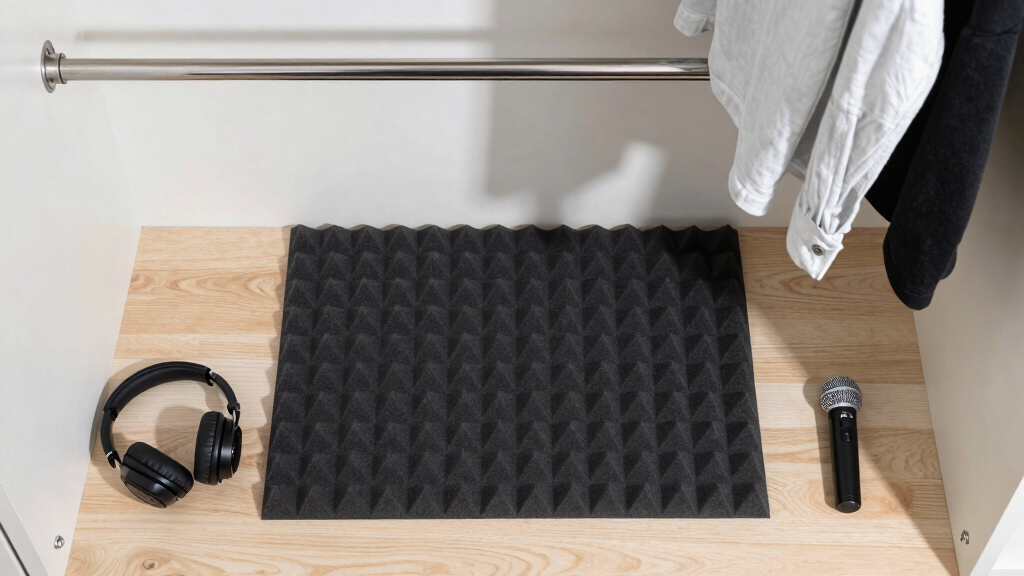
Acoustic dampening
& the rig in the closet.
The most powerful noise fix isn’t a material — it’s a floor plan. A rig you can’t hear because it’s in another room beats any amount of foam. Tap the approaches in Part 1 to see what actually works.
(another room)
(levers 1–4)
(door / barrier)
(acoustic foam)
Contain the noise, not the heat
Why Placement and Ventilation Are Critical for Quiet AI Workstations
Effective noise management is crucial for maintaining a productive and comfortable workspace, especially for high-power AI rigs that generate significant heat and sound. Proper placement and ventilation not only improve the acoustic environment but also extend hardware lifespan by preventing overheating. This approach is often more cost-effective and practical than extensive acoustic treatment.
acoustic soundproofing foam panels
As an affiliate, we earn on qualifying purchases.
As an affiliate, we earn on qualifying purchases.
Background on Noise Reduction Strategies for High-Power Rigs
Traditional noise mitigation relies heavily on acoustic foam and barriers, which primarily absorb airborne sound but do little to address structure-borne noise or heat. Recent insights suggest that physical separation and proper airflow are more effective at reducing perceived noise and preventing thermal issues.
In the AI community, there has been a shift towards remote operation of workstations, enabling users to keep their workspaces silent while the hardware operates elsewhere. This method aligns with the increasing use of networked, headless AI rigs.
"Moving the rig into another room or closet is often the most effective way to eliminate noise, provided ventilation is properly managed."
— Thorsten Meyer, AI workspace expert
networked headless AI workstation enclosure
As an affiliate, we earn on qualifying purchases.
As an affiliate, we earn on qualifying purchases.
Remaining Challenges in Balancing Noise Reduction and Heat Dissipation
While moving rigs into separate rooms or closets effectively reduces noise, the optimal ventilation solutions and their configurations are still evolving. The precise balance between noise suppression and thermal management depends on specific hardware and room conditions, and best practices are still being refined.
It is also unclear how different enclosure designs compare in cost-effectiveness and ease of implementation across varied workspaces.
quiet computer case for high-performance PC
As an affiliate, we earn on qualifying purchases.
As an affiliate, we earn on qualifying purchases.
Next Steps in Developing Practical, Quiet AI Workstation Setups
Future developments may include more affordable, integrated soundproof cabinets with advanced airflow management. Researchers and hardware manufacturers are likely to focus on improving thermal solutions that allow for enclosed, quiet setups without risking overheating. Users should monitor emerging best practices and innovations in ventilation and acoustic isolation.
ventilated closet for computer setup
As an affiliate, we earn on qualifying purchases.
As an affiliate, we earn on qualifying purchases.
Key Questions
Is acoustic foam enough to quiet a high-power AI workstation?
No, acoustic foam mainly absorbs airborne sound within a room and does not significantly reduce noise emanating from the hardware itself or prevent heat buildup. Placement and ventilation are more effective for noise and thermal management.
Can I put my AI rig in a closet without overheating?
Yes, but only if the closet has proper ventilation, such as passive vents or active exhaust fans, to allow heat to escape. Without adequate airflow, the temperature can rise quickly, risking hardware damage.
What are the advantages of a 'rig in the closet' setup?
The main benefit is significant noise reduction in the workspace, creating a quieter environment. It also allows for better thermal management if ventilation is properly implemented.
What equipment is recommended for ventilating an enclosed AI rig?
Quiet exhaust fans, passive vents, rubber feet for decoupling, and purpose-built soundproof cabinets with integrated airflow management are recommended to maintain cooling while minimizing noise.
Source: ThorstenMeyerAI.com
Halloween Picks
halloween
As an affiliate, we earn on qualifying purchases.