🔍 Read the full analysis: How To Read The Held-Light Approach In “OORT — Comet Vigil For P/2043 K1 Vesper” on ThorstenMeyerAI.com

Get hardware and tech essentials delivered free with Prime
- Fast, free delivery on millions of items
- Prime Video, Amazon Music and more included
- Member-only deals all year
TL;DR
OORT — Comet Vigil for P/2043 K1 Vesper is an AI-built exhibition about a fictional comet, not an astronomical discovery. According to ThorstenMeyerAI.com, its interface uses persistent star trails, scroll-linked comet imagery and a simulated shutter log to make visitors’ time part of the artwork.
OORT — Comet Vigil for P/2043 K1 Vesper is an online, AI-built exhibition that makes a visitor’s time at the page part of the artwork, as detailed in the original analysis. ThorstenMeyerAI.com describes the room as centering on a fictional observatory and fictional comet; its changing star trails and simulated observation log are artistic devices, not records of a real celestial event.
According to ThorstenMeyerAI.com, the exhibition’s signature feature is a field of stars that draws curved trails over time, as described in its coverage of the held-light technique. The feature says a repeatable seed keeps the local sky consistent on a device, while local storage preserves elapsed time so the image can continue when a visitor returns. The effect is designed to make duration visible rather than treat time on the page as a pause before the main content.
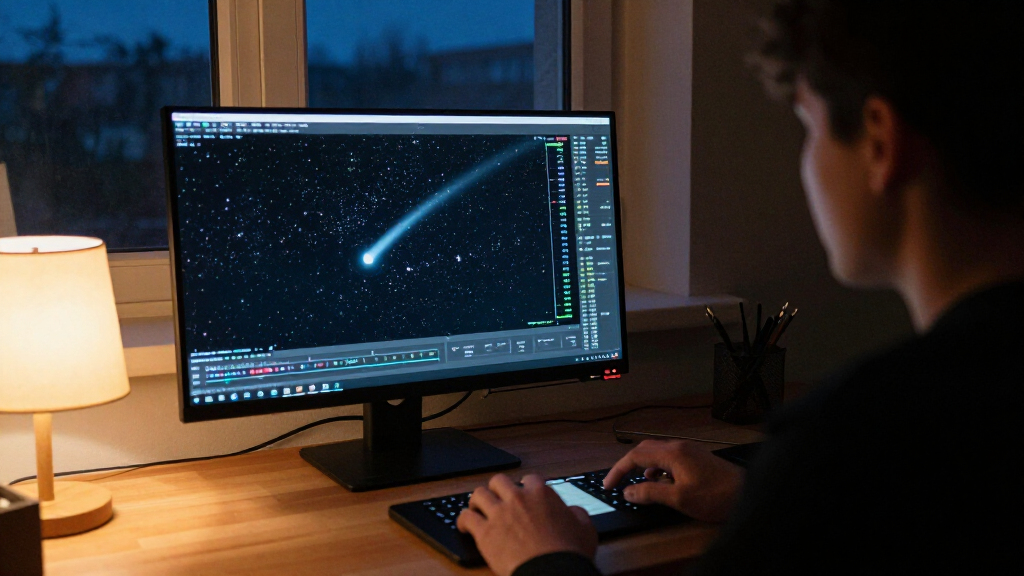
The feature also describes elements that respond to visitor input. Scrolling moves the comet through an inline SVG, with an ion tail directed away from the sun and a dust tail that curves along the imagined orbit. A shared progress value coordinates the illustration’s geometry, distance and year. A range control changes a defocused view and an associated brightness estimate, while holding a control briefly opens a simulated shutter and records a timestamp.
ThorstenMeyerAI.com describes a restrained, dark observatory palette: black backgrounds, cyan for the ion tail and readings, and red-orange for instructions and actions. It says the page also pauses its animation loop when hidden and provides a still version for visitors who prefer reduced motion. The feature presents the room as part of a 175-room exhibition and identifies it as room 170.
A guide to the held-light approach
How to Read the Held-Light Approach in “OORT — Comet Vigil for P/2043 K1 Vesper”
OORT is an AI-built web exhibition about a fictional comet. Its star trails, scrolling imagery and simulated shutter log turn a visitor’s time and attention into part of the artwork.
How the interface makes waiting visible
According to ThorstenMeyerAI.com, the held-light technique gives duration a visible consequence. A repeatable seed keeps the local sky consistent on a device, while local storage preserves elapsed time so the image can continue when the visitor returns.
Stay, leave, return
Star trails grow with time on the page. The described local persistence lets a visitor resume the same sky on the same device.
Comet in transit
Scrolling moves the comet through inline SVG geometry. The ion tail points away from the sun; the dust tail curves along the imagined orbit.
Attention, recorded
Holding a control briefly opens a simulated shutter and logs a timestamp. It records an act of attention, not a comet sighting.
A fictional setting frames the visit.
Trails make duration part of the scene.
Motion and a timestamp respond to input.
Stored elapsed time carries the image forward.
One progress value, several visual cues
The feature describes a shared progress value coordinating the illustration’s geometry, distance and year. A range control shifts a defocused view and its associated brightness estimate.
Changes position
The comet advances through the inline SVG as the visitor moves through the page.
Changes the view
A defocused view and brightness estimate respond together to the selected value.
Offers a still version
The account says animation pauses when the page is hidden and a reduced-motion option is provided.
Observatory palette
The described design uses black backgrounds, cyan for the ion tail and readings, and red-orange for instructions and actions. These colors borrow the visual language of observation while serving the artwork’s fictional world.
A fictional observatory by design
ThorstenMeyerAI.com describes an imagined community watching P/2043 K1 Vesper over decades. In-world amateur logs, an ephemeris-style table, magnitude-estimation material and a provenance reference to a last sighting in 1608 are presented as parts of the constructed world.
Artwork and interface intent
It describes an AI-built exhibition, a fictional comet and observatory, accumulating star trails, scroll-linked comet geometry, a simulated shutter log, and intended reduced-motion behavior.
Independent verification
It supplies no evidence that the comet or records are real, and no independent code review, device testing or performance measurements. The implementation and review process cannot be confirmed from this account alone.
Read the distinction: The exhibit borrows astronomical conventions, but its in-world comet, community and observation records are fictional. It is not an announcement or scientific report.
What to keep in mind
Is P/2043 K1 Vesper a real comet?
No. ThorstenMeyerAI.com identifies the comet, observatory and imagined community as fictional.
What does “held-light” mean here?
Star trails accumulate as time passes on the page. The described repeatable seed and local storage allow the same device’s sky to resume later.
What does the shutter control do?
It briefly opens a simulated shutter and records a timestamp, marking attention rather than revealing a new sighting.
What is the next development?
The feature names no future launch, scheduled update or scientific observation. It points readers toward the artwork, its build notes and the wider 175-room exhibition.
How the Interface Makes Waiting Visible
As ThorstenMeyerAI.com frames it, OORT’s central idea is not a claim about comet science; it is a design choice about time and attention. The growing trails give a visitor’s time a visible consequence, while the return visit continues the same locally stored sky. This makes persistence part of the piece rather than an invisible technical detail.
The feature says the simulated shutter reinforces that framing. Instead of presenting a fabricated sighting as a reward, the site records an act of attention while keeping the comet unseen and in transit. That distinction matters: the exhibition makes clear that its observatory belongs to fiction, even as it borrows the language and visual conventions of astronomical observation.
ThorstenMeyerAI.com also presents the work as an example of how browser interactions can carry an artistic premise. The feature describes canvas animation, local storage, scrolling SVG geometry and motion preferences as parts of one system. The result invites readers to examine not only what the page depicts, but how its behavior shapes the experience of staying, leaving and returning.
As an affiliate, we earn on qualifying purchases.
A Fictional Observatory by Design
ThorstenMeyerAI.com describes OORT as an AI-built exhibition piece devoted to P/2043 K1 Vesper, a fictional comet watched by an imagined community over decades. According to the feature, the fictional premise includes invented amateur logs, an ephemeris-style table, magnitude-estimation material and a provenance reference to a last sighting in 1608. Those details belong to the artwork’s constructed world; the supplied material does not establish them as real astronomical records.
The feature says the room’s design brief is also available through a “Prompt” link in its footer. It calls for a single-page site built with HTML, CSS and JavaScript, without frameworks or external requests, and specifies responsive layouts, accessible contrast, keyboard focus styles and reduced-motion behavior. ThorstenMeyerAI.com says the room went through a three-pass process: an initial build and self-critique, a further critique and fixes, then an art-direction review.
ThorstenMeyerAI.com lists the room at fable-25-830.netlify.app/sites/oort/ and invites readers to visit it and the wider 175-room hub. The supplied material does not independently verify the site’s implementation or the described review process.
interactive observatory virtual tour
As an affiliate, we earn on qualifying purchases.
As an affiliate, we earn on qualifying purchases.
What the Source Does Not Verify
ThorstenMeyerAI.com identifies the comet and observatory as fictional. The feature provides no evidence that P/2043 K1 Vesper is a real comet, that a real community has monitored it, or that the dates and records in the room refer to actual observations. Readers should not mistake its in-world astronomy for an announcement or scientific report.
Although the feature describes technical details, the supplied material includes no independent testing results, source code review or performance measurements. It is therefore not possible from this account alone to confirm how the site behaves across devices, how its local persistence works in practice, or whether all accessibility and responsiveness targets were met. No named developer or independent reviewer is quoted.
As an affiliate, we earn on qualifying purchases.
Explore the Room and Its Build Notes
ThorstenMeyerAI.com encourages readers to open the live OORT room and observe how its sky changes during a visit, then compare what happens after leaving and returning on the same device. The feature says the site’s design guide and footer prompt provide further material on the intended build and visual direction.
The feature also points to the wider exhibition of 175 rooms. It identifies no future launch, scientific observation or scheduled update, so the next development is not a comet milestone but continued access to the artwork and its accompanying documentation.
As an affiliate, we earn on qualifying purchases.
Key Questions
Is P/2043 K1 Vesper a real comet?
No. ThorstenMeyerAI.com identifies P/2043 K1 Vesper as fictional, as well as the observatory and its imagined community. The room is an artwork, not a report of a real comet observation.
What does the held-light approach mean?
It refers to star trails that accumulate as time passes on the page. ThorstenMeyerAI.com says a repeatable seed and local storage allow the same device’s sky to resume on a later visit.
What happens when a visitor holds the shutter control?
The site opens a simulated shutter and records a timestamp. According to ThorstenMeyerAI.com, it records attention rather than showing a newly discovered comet.
Does the exhibit describe verified astronomy?
No. Its comet, long vigil and in-world records are fictional elements, according to ThorstenMeyerAI.com. The feature describes the site’s tail geometry and interface behavior, but does not present them as observations of a real object.
Source: ThorstenMeyerAI.com
Halloween Picks
halloween
As an affiliate, we earn on qualifying purchases.