🔍 Read the full analysis: Is 16 To 64 GB Enough For Local AI On A Mac Mini? on ThorstenMeyerAI.com

Get hardware and tech essentials delivered free with Prime
- Fast, free delivery on millions of items
- Prime Video, Amazon Music and more included
- Member-only deals all year
TL;DR
Apple’s 2026 Mac mini configurations offer 16GB to 64GB of unified memory, enough for several quantized open models but not every large model. Whether a model fits depends on memory left for macOS and context; even when it fits, the Mac mini’s bandwidth is far below that of a data-center GPU.
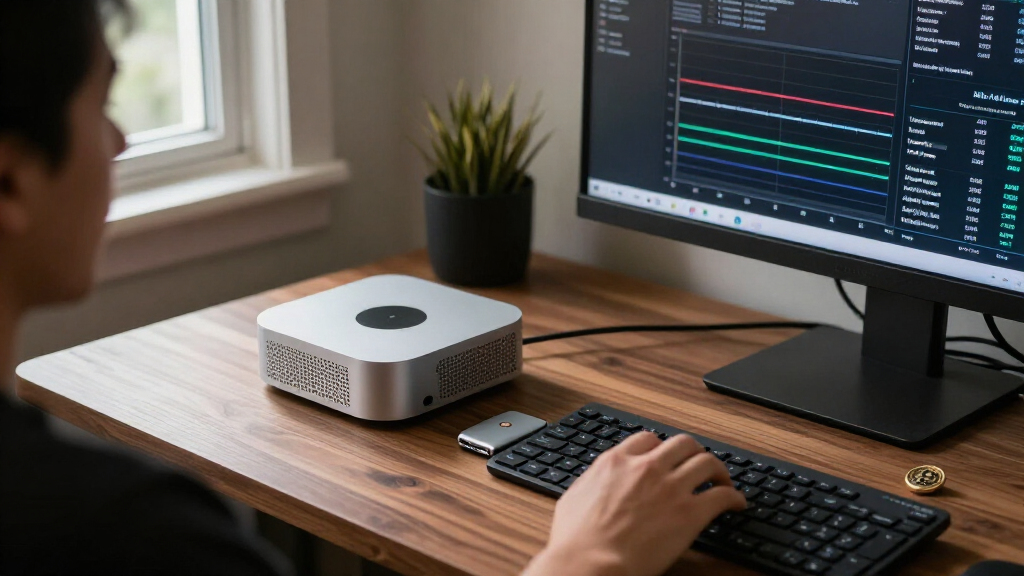
Apple is marketing its 2026 Mac mini as a desktop for always-on AI, but its 16GB to 64GB of unified memory sets clear limits on which models can run locally. Published requirements from Google and OpenAI indicate that smaller and quantized models can fit, while larger models may exceed the top configuration or run more slowly than on data-center hardware.
The central constraint is memory. Apple silicon gives the CPU and GPU access to a shared pool of unified memory, allowing the GPU to use more of the Mac’s available capacity than a setup where graphics memory is separate. But that pool is also needed by macOS and other applications, and model weights are only part of the requirement. Google says its published figures cover static weights; longer context windows require additional memory.
Google’s Gemma 4 figures illustrate the range. Its 12B model at 4-bit precision requires about 6.7GB, while the 31B model requires 17.5GB at 4-bit and 34.9GB at 8-bit. That puts the smaller model within reach of a 16GB Mac mini on paper, though memory for the system and context must also fit. A 32GB configuration has more room for the 31B model at 4-bit. A 64GB machine can accommodate the 31B model at 8-bit in weight-size terms, but the 16-bit version is listed at 69.9GB and exceeds the machine’s total memory.
OpenAI says its gpt-oss-20b runs within 16GB of memory. Its larger gpt-oss-120b is sized for a single 80GB GPU, beyond the Mac mini’s maximum 64GB. Prices listed on Apple’s U.S. site on November 16 start at $899 for 16GB; the cited 64GB M5 Pro configuration with 1TB storage costs $3,199. Memory is selected when ordering.
The Memory Ceiling for Local Models
For people considering local AI, the specifications help separate what can fit from what may be practical to use. Running a model on the computer can avoid per-token service charges, allow offline use and keep prompts and outputs on the device. Those benefits may matter for privacy-sensitive work or an agent that needs to remain available without relying on a cloud connection.
Those advantages do not make the Mac mini a replacement for high-end AI servers. Apple lists memory bandwidth of 153–170GB/s for M6 and 307GB/s for M5 Pro. Nvidia lists 3.35TB/s for its H100 SXM, about 11 times the M5 Pro figure. Because a model repeatedly reads its weights while generating output, bandwidth is one factor affecting speed. Actual performance also depends on the model, software, precision and workload; the specifications alone do not establish a particular response rate.
Cost is part of the trade-off. The price rises from $899 for the cited base configuration to $3,199 for the 64GB model. Buyers need to weigh that upfront cost against their expected use, the value of keeping work local and the possibility that larger or longer-context tasks will still need cloud services or more capable hardware. Local AI performance also varies by workload and software, and model output can be unreliable; users should not treat generated results as verified facts.
Products Worth Considering

Logitech MX Mechanical Wireless Illuminated Keyboard, Tactile Quiet, Graphite

Trezor Safe 5 Crypto Hardware Wallet

Ledger Flex + Folio Crypto Hardware Wallet
As an affiliate, we earn on qualifying purchases.
How the 2026 Mac mini Is Configured
Apple introduced the new Mac mini on August 25, 2026, describing it in its press release as “the leading desktop for always-on agentic computing.” On an April 30 earnings call, Tim Cook said customer recognition of the Mac mini and Mac Studio as platforms for AI and agentic tools was arriving faster than Apple had predicted, according to MacRumors. These statements show Apple’s positioning and its account of demand; they do not establish how quickly local AI workloads run.
The listed configurations span 16GB to 32GB on M6 and 24GB to 64GB on M5 Pro. Google’s examples also show why parameter count alone can mislead: its Gemma 4 26B A4B is a mixture-of-experts model that activates four billion parameters per token, but Google says all 26 billion parameters must be loaded into memory. Quantization, such as using 4-bit rather than 16-bit weights, reduces memory needs but can affect model quality.
Apple says Thunderbolt 5 can link multiple Mac mini systems to run large AI models on-device. That option may extend capacity, but the supplied material does not give performance results or explain how much setup and cost a particular workload would require.
“the leading desktop for always-on agentic computing”
— Apple, in its August 25, 2026 Mac mini press release
Fit Does Not Guarantee Useful Speed
The cited requirements describe whether model weights can fit, not the real-world speed or quality a user will get on each Mac mini configuration. The source material does not provide benchmark results for particular prompts, response times or context lengths, and available memory will vary with macOS, open applications and the task. Google’s figures are approximate and cover static weights, not the full working-memory demand.
It is also unclear how much Thunderbolt 5 clustering improves performance for specific models, or what the total cost and configuration would be. Prices and product details here are a snapshot from Apple’s U.S. site on November 16, 2026; availability and options may change. No claim that every model listed will run smoothly follows from the memory figures alone.
Check Workloads Before Choosing Memory
The practical next step for prospective users is to compare the specific model’s memory requirements with the chosen Mac mini’s capacity, while reserving space for macOS, applications and the desired context length. Model documentation and local-AI software requirements should be checked for updates before purchase; memory is a configure-to-order choice in the listed lineup.
Apple’s specifications and future software support may add detail, while independent testing would help show performance across real workloads. Until such results are available, the published figures support a capacity-based conclusion: 16GB can suit some smaller models, 32GB and 64GB accommodate progressively larger or higher-precision options, and models requiring more memory need another approach.
Key Questions
Can a 16GB Mac mini run local AI models?
Published figures suggest some models can fit. Google lists about 6.7GB for Gemma 4 12B at 4-bit, and OpenAI says gpt-oss-20b runs within 16GB. These figures do not leave the entire pool free for model use: macOS, applications and context also require memory.
What does 64GB let the Mac mini run?
Google lists the Gemma 4 31B model at 34.9GB at 8-bit precision, which is below 64GB before other memory needs are counted. The same model at 16-bit is listed at 69.9GB and exceeds the Mac mini’s total memory.
Does a model that fits run quickly?
Not necessarily. Memory capacity addresses whether weights can be loaded, while memory bandwidth and workload affect generation speed. The cited specifications do not provide benchmark timings for specific models or tasks.
Why does quantization matter?
Quantization stores model weights at lower precision, reducing the memory they require. For example, Google lists Gemma 4 31B at 17.5GB at 4-bit and 34.9GB at 8-bit. Lower precision can affect quality, so reduced memory use is not a guarantee of identical results.
Can the Mac mini run the largest models locally?
Not all of them on a single machine. OpenAI sizes gpt-oss-120b for an 80GB GPU, while the largest Mac mini configuration has 64GB. Apple says Thunderbolt 5 can connect multiple Mac minis for large on-device models, but the supplied material does not give results for specific setups.
Source: ThorstenMeyerAI.com